
Short answer: Three two-wheeled kick scooters, and a similar title does not make the frames the same. The steel one, model S200D, weighs 4.5 kg, the colour is black and blue, and the size is 900 × 380 × 1000 mm. The three handlebar positions on the page are 33.9 / 36.6 / 100 cm and, in parentheses, 860 / 930 / 1000 mm. 100 cm and 1000 mm agree. 33.9 cm is not 860 mm, and 36.6 cm is not 930 mm. The page does not explain that gap. Both writings stay. The two aluminium scooters are model S200C, both 3.5 kg, and the size is also 900 × 380 × 1000 mm. One is black, the other is blue. Their height is 35.4 / 38.2 / 104 cm and, in parentheses, 900 / 970 / 1040 mm. 104 cm and 1040 mm agree. 35.4 cm is not 900 mm. The wheels on all of them are φ20.3 cm and, in the same row, φ200 mm. 20.3 cm is not 200 mm. The brake is the rear wheel. Steering is by leaning, not by turning the handlebar.
Products in this guide
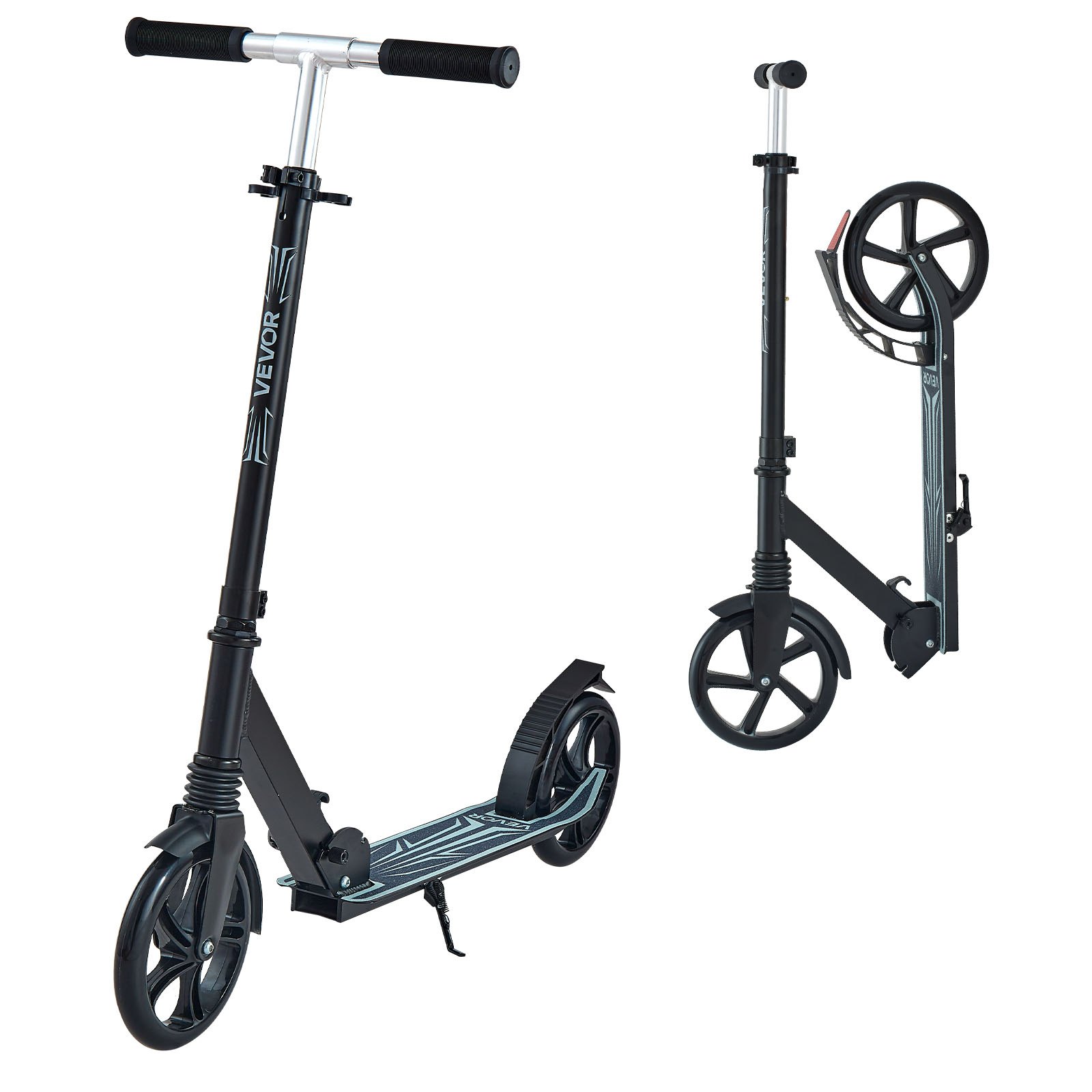 Kick scooter S200C, aluminium, black, 3.5 kg89,90 €View →
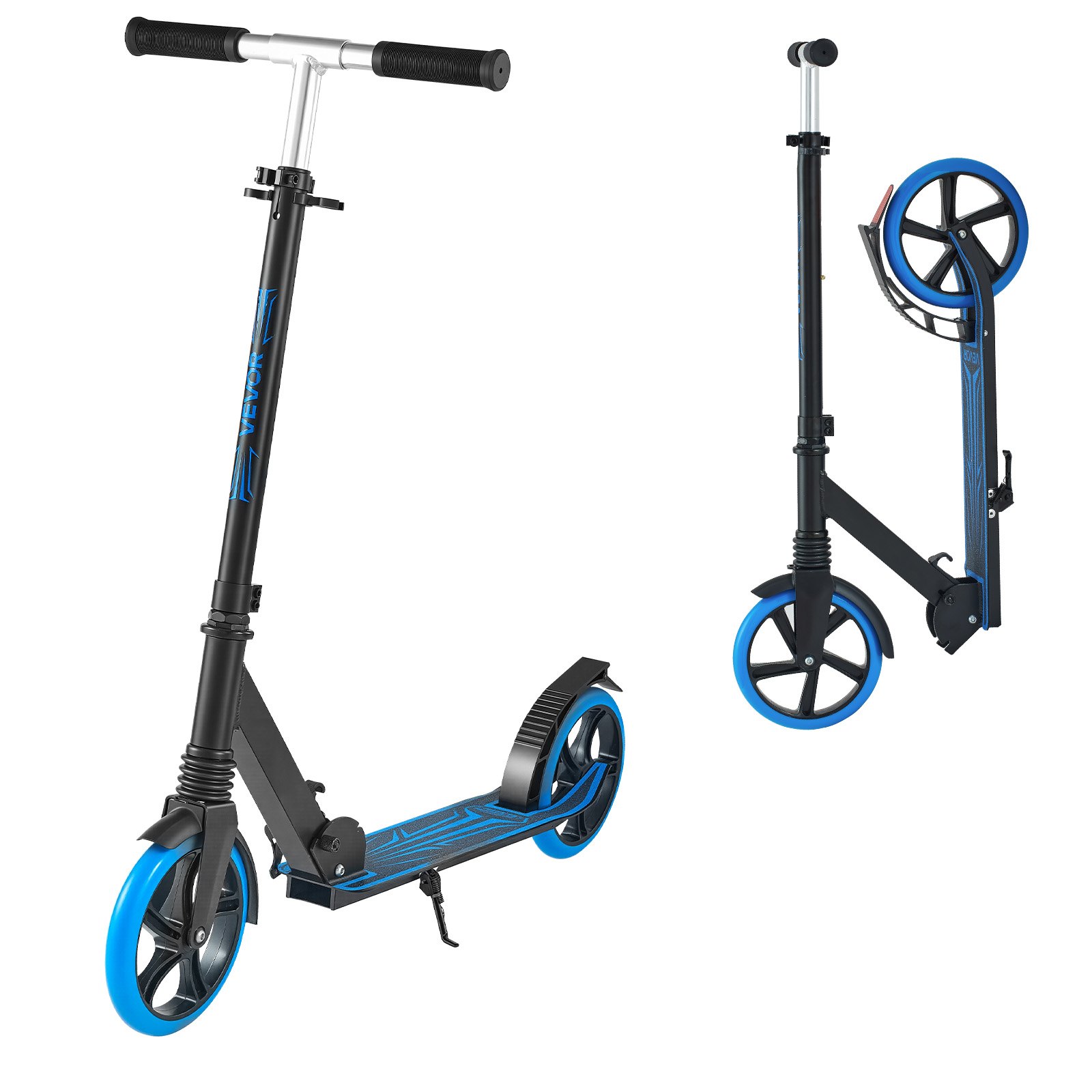 Kick scooter S200C, aluminium, blue, 3.5 kg92,90 €View →
99.8 kg and 8+ are on all of them, the weight is not
Up to 99.8 kg is a sentence on every page, and the text adds that the scooter also suits an adult. That 99.8 kg is not the weight of the scooter itself. The steel one weighs 4.5 kg. Both aluminium ones weigh 3.5 kg. A lighter frame does not raise or lower the 99.8 kg line on the page. The black aluminium frame at 3.5 kg does not carry less than the steel frame at 4.5 kg, because the page prints 99.8 kg on all three. The blue aluminium frame prints the same 99.8 kg line. Frame weight and the load line are two different numbers, and they are not subtracted from each other.
Age 8+ is on every page as well. A younger age, a height in centimetres, and a helmet are not stated. “Grows with the child” is the page’s sentence about the three heights, not a measured amount of growth. 8+ does not mean an adult does not fit. The same pages that say from 8 years also say the scooter suits an adult, up to 99.8 kg. No page gives the rider’s height in centimetres. The three handlebar steps are the heights the pages print. They are not a growth chart with a measured result.
The titles look alike because each one says 8+ and 99.8 kg. The frames do not match that likeness. S200D is steel and weighs 4.5 kg, with the colour black and blue together. The two S200C scooters are aluminium and weigh 3.5 kg, one black and one blue. A shared title line does not copy the steel height row onto the aluminium pages, and it does not copy the aluminium height row onto the steel page. 99.8 kg still does not become 4.5 kg or 3.5 kg.
Centimetres and millimetres are different numbers on the page
S200D height: 33.9 cm beside 860 mm, 36.6 cm beside 930 mm, and 100 cm beside 1000 mm. Only the top step is the same size in both units. The guide does not recalculate the two lower steps, because the page itself put those figures side by side. 33.9 cm is not replaced by 860 mm. 36.6 cm is not replaced by 930 mm. 100 cm and 1000 mm are the pair that already agree, and that agreement is not used to rewrite the pairs that do not agree.
S200C height, on the black one and on the blue one: 35.4 cm beside 900 mm, 38.2 cm beside 970 mm, and 104 cm beside 1040 mm. Again the top step agrees. The black page and the blue page do not differ on this row. The steel ceiling of 100 cm is not copied onto the aluminium, and 104 cm is not copied onto the steel. 35.4 cm is not 900 mm. The lower steps stay as two writings. They are not averaged, and they are not turned into one height. 38.2 cm stays beside 970 mm, the way the page set them, and 104 cm stays beside 1040 mm, which is the step that already matches.
The wheel is φ20.3 cm / φ200 mm on all three. 203 mm would be 20.3 cm. The page writes 200 mm. Both stay. 20.3 cm is not 200 mm. PU and shock absorption are in the text. The surfaces the page names are asphalt, pavement, a wooden floor and tile. Gravel is not there. That wheel row is not a different size on steel and a different size on aluminium. The same pair, φ20.3 cm and φ200 mm, is on all three pages, and the mismatch inside the pair stays on all three pages. The surfaces list is the same list on all three. Gravel is not added to one of them.
The same model number is not the same colour
S200D is only the steel scooter, black and blue together, 4.5 kg, box 39 × 14 × 84 cm. S200C is both aluminium scooters. The black one weighs 3.5 kg and the box is 38 × 14 × 84 cm. The blue one weighs 3.5 kg and the box is 38 × 14 × 83 cm. One centimetre in the box is the only measurement difference the pages give between those two. The page does not describe a difference in riding between black and blue. The shared size, 900 × 380 × 1000 mm, is on the steel page and on both aluminium pages. The box is not that size. 39 × 14 × 84 cm, 38 × 14 × 84 cm and 38 × 14 × 83 cm stay carton lines.
Steering on all of them is by leaning: the handlebar is not turned. A rear-wheel brake, a non-slip foot deck, folding and carrying are also sentences in every text. Those sentences do not make the difference between a steel frame and an aluminium frame. The difference the table gives is material, weight, colour, model and the height rows. Lean steering is not a steel-only sentence. The rear-wheel brake is not an aluminium-only sentence. Folding is not reserved for the lighter frame. The non-slip foot deck is not reserved for the heavier frame. What splits the three is the material line, the 4.5 kg against the 3.5 kg, the colour, S200D against S200C, and the height rows that do not match.
Black S200C and blue S200C share the model number and do not become the steel scooter by sharing it. S200D is not a third colour of S200C. The steel colour is black and blue together, on the one steel page. The aluminium colours are split across two pages, black on one and blue on the other. The 1 cm carton difference, 84 cm on the black aluminium and 83 cm on the blue, is the measurement those two pages actually change. Height steps, wheel pair, load line, age line and size are not on the list of things those two pages change.
How to choose?
If the frame has to be steel and the colour is black together with blue, it is S200D. The weight is 4.5 kg. The height row is 33.9 / 36.6 / 100 cm, and the millimetres on the page are different except for the top step, which is 100 cm and 1000 mm. The box is 39 × 14 × 84 cm. The size is 900 × 380 × 1000 mm. The wheel row is φ20.3 cm / φ200 mm. This guide’s shop cards do not carry a price id for that scooter. The page is still the page that has to be read for those figures, and the figures stay on it.
If the frame is aluminium and the colour is black, it is S200C, 3.5 kg. The height is 35.4 / 38.2 / 104 cm, with 900 / 970 / 1040 mm beside them, and only the top step agrees. The same model number is also on the blue one. The black box is 38 × 14 × 84 cm. The size is 900 × 380 × 1000 mm. The shop card for this one carries the price id of the black aluminium scooter. It does not carry the steel scooter, and it does not become steel because the title looks like the others.
If the same aluminium and the colour is blue, it is the other S200C. The weight is the same 3.5 kg. The box is 83 cm, and the black one’s box is 84 cm. The page does not change another measurement between them. The height row stays 35.4 / 38.2 / 104 cm and 900 / 970 / 1040 mm. The size stays 900 × 380 × 1000 mm. The wheel row stays φ20.3 cm / φ200 mm. The shop card for this one carries the price id of the blue aluminium scooter.
99.8 kg does not choose the scooter. That line is on all of them. 8+ is on all of them too. The choice the pages support is the frame: steel S200D at 4.5 kg, or aluminium S200C at 3.5 kg in black or in blue. A lighter frame does not carry a smaller load on these pages. The load line stays 99.8 kg wherever the frame weight changes. The height rows stay the rows printed on each page, including the centimetre figures that do not match the millimetre figures beside them.
Comparison
| Product | Price | What sets it apart |
|---|---|---|
| Kick scooter S200C, aluminium, black, 3.5 kg | 89,90 € | height up to 104 cm on the page, box 84 cm, aluminium |
| Kick scooter S200C, aluminium, blue, 3.5 kg | 92,90 € | same height row, box 83 cm, colour blue |
The price in the link is the shop’s current price and opens the product. The steel scooter, model S200D, is described in this guide, including the weight of 4.5 kg, the colour black and blue together, the height row 33.9 / 36.6 / 100 cm beside 860 / 930 / 1000 mm, and the box 39 × 14 × 84 cm. The shop cards and this table do not carry a price id for it.
Who is this not for?
- A similar title does not make the scooters one. Steel is 4.5 kg, aluminium is 3.5 kg.
- 33.9 cm is not 860 mm. The page put them side by side and did not explain. They are not recalculated.
- 20.3 cm and 200 mm are two writings of the same row. 20.3 cm is not 200 mm.
- Black and blue S200C do not differ on the page in how they ride. The difference is the colour and 1 cm in the box.
Frequently asked questions
Why are the titles similar?
All of them say 8+ and 99.8 kg. The frame is not the same. Steel S200D weighs 4.5 kg. The two aluminium S200C scooters weigh 3.5 kg. The titles can look like one scooter printed three times. The pages are three frames: one steel page with black and blue together, one black aluminium page, and one blue aluminium page. The size 900 × 380 × 1000 mm is shared, and that shared size still does not make the material line shared. S200D is not S200C. 4.5 kg is not 3.5 kg. The load line of 99.8 kg is why the titles look alike, and it is not the weight of any of the three scooters.
Is 99.8 kg the weight of the scooter?
No. It is the carrying capacity on the page. The scooter itself weighs 4.5 kg or 3.5 kg. 4.5 kg is the steel S200D. 3.5 kg is each aluminium S200C, black and blue. 99.8 kg is printed on every page and is not swapped with those weights. An adult is included on the page up to that load line. The load line is not a fourth scooter and not a carton weight. The cartons are 39 × 14 × 84 cm for steel, 38 × 14 × 84 cm for black aluminium and 38 × 14 × 83 cm for blue aluminium. None of those cartons is 99.8 kg.
Does a lighter one carry less?
No. The 99.8 kg line is on all three. 3.5 kg is the weight of the frame. The steel frame at 4.5 kg does not receive a higher load line, and the aluminium frames at 3.5 kg do not receive a lower one. The page does not say that a lighter frame carries less. Black and blue aluminium weigh the same 3.5 kg, so the colour is not a load difference either. The 1 cm difference in the carton, 84 cm against 83 cm, is not a load difference. Up to 99.8 kg stays the line on the steel page and on both aluminium pages.
What is the difference between the black and the blue aluminium?
Both are S200C, 3.5 kg, the same height row and the same 900 × 380 × 1000 mm. The black box is 84 cm long, and the blue box is 83 cm. The page does not describe a difference in riding. The height row on both is 35.4 / 38.2 / 104 cm beside 900 / 970 / 1040 mm. The wheel row on both is φ20.3 cm / φ200 mm. The load line on both is 99.8 kg. The age line on both is 8+. Lean steering, the rear-wheel brake, folding and the non-slip foot deck are not split by colour. The split the pages give is the colour itself and that one centimetre in the box.
Is the S200C also steel?
No. S200C is on the two aluminium pages. Steel is S200D, and the colour there is black and blue together. The black aluminium scooter does not become steel by being black, and the blue aluminium scooter does not become steel by being blue. S200D’s “black and blue together” is one steel page, not a pair of S200C pages. The weight on the steel page is 4.5 kg. The weight on each S200C page is 3.5 kg. The height row on the steel page is the 33.9 / 36.6 / 100 cm row, not the 35.4 / 38.2 / 104 cm row. Those rows are not interchangeable just because both models are kick scooters.
How high is the handlebar?
On the steel page the text writes 33.9 / 36.6 / 100 cm and 860 / 930 / 1000 mm. On the aluminium pages it writes 35.4 / 38.2 / 104 cm and 900 / 970 / 1040 mm. Only the top step agrees in both units: 100 cm with 1000 mm on steel, and 104 cm with 1040 mm on aluminium. The lower steps are left as the page printed them. 33.9 cm is not replaced by 860 mm. 36.6 cm is not replaced by 930 mm. 35.4 cm is not 900 mm. Black and blue aluminium share one height row. The steel 100 cm ceiling is not copied onto them, and their 104 cm ceiling is not copied onto the steel.
Is 33.9 cm the same as 86 cm?
The page put 33.9 cm and 860 mm in one row. 860 mm is 86 cm, not 33.9 cm. The guide does not strike either of them out. Both writings stay, because the page put them side by side and did not explain the gap. 33.9 cm is not rewritten as 86 cm, and 860 mm is not deleted so that 33.9 cm can stand alone. The same page’s next step, 36.6 cm beside 930 mm, is also left as printed. Only 100 cm and 1000 mm already agree. That agreeing pair is not a reason to repair the pair that does not agree. The aluminium row is a different row and is not used to correct the steel one.
How big is the wheel?
On all of them, φ20.3 cm / φ200 mm, and the material is PU. 20.3 cm and 200 mm are not the same length. The page wrote both. 203 mm would be 20.3 cm, and the page’s millimetre figure is 200 mm, so both figures stay. The wheel size is not different on S200D and on S200C. It is not different on the black aluminium and the blue aluminium. Shock absorption is in the text with the PU. The wheel row is not the handlebar row, and it is not the size of 900 × 380 × 1000 mm. Gravel is still not a surface on the page. The surfaces named beside this wheel are asphalt, pavement, a wooden floor and tile.
How does it turn?
By leaning, not by turning the handlebar. Every text says so. The rear-wheel brake is also on every page. Lean steering is not a property of the lighter frame only, and it is not a property of the steel frame only. It is on S200D and on both S200C pages. Turning the handlebar is not the method the pages describe. The three handlebar heights are height steps, not a description of steering by rotation. The rear-wheel brake stays the brake the pages name. A second brake is not added. The non-slip foot deck is named with those shared sentences and is not a steering method.
Does it fold?
Yes. Every text says quick folding and carrying. The box size is 39 × 14 × 84 cm for the steel, 38 × 14 × 84 cm for the black and 38 × 14 × 83 cm for the blue. Folding is not limited to the aluminium frames, and it is not limited to the steel frame. The box measurements are the figures the pages give next to that folding sentence. They are not the 900 × 380 × 1000 mm size. That size remains on all three. The 1 cm difference is between those two boxes. The page does not turn that centimetre into a difference in how the scooter folds or how it rides.
Where does the page allow riding?
Asphalt, pavement, a wooden floor and tile. Gravel is not there. That list is on all three. The steel page does not add a surface the aluminium pages lack, and the aluminium pages do not add a surface the steel page lacks. Black and blue do not split the list. 99.8 kg is the load line, not a surface. 8+ is the age line, not a surface. PU and shock absorption are in the text, and they are not a fifth surface. The list stays the four named surfaces, with gravel left off, on S200D and on both S200C pages.
Does 8+ mean an adult does not fit?
The page says both: from 8 years of age, and that it also suits an adult, up to 99.8 kg. It does not give a height in centimetres. 8+ is not an upper age limit on these pages. An adult is named, and the limit printed next to that is the load line of 99.8 kg, not a sentence that an adult does not fit. The same pair of sentences is on the steel page and on both aluminium pages. “Grows with the child” refers to the three handlebar heights. It is not a measured height of the rider, and it is not a helmet requirement. A younger age than 8 is not printed. A helmet is not printed.
Is the aluminium one taller?
The top step on the page is 104 cm on the aluminium and 100 cm on the steel. The lower steps are different numbers in centimetres and in millimetres, so one height is not made out of them. 104 cm is not copied onto the steel page, and 100 cm is not copied onto the aluminium pages. 35.4 cm beside 900 mm, and 38.2 cm beside 970 mm, stay two writings on the aluminium pages. 33.9 cm beside 860 mm, and 36.6 cm beside 930 mm, stay two writings on the steel page. Black and blue share the aluminium steps, including the 104 cm top step. The top step is the comparison the pages actually print. The lower steps are not collapsed into a single extra height.
Do the two scooters have the same parts?
The text is the same: two wheels, PU, leaning, a rear brake, a wide foot deck and folding. That text does not separate material and colour. The table does. The shared sentences do not turn steel into aluminium, and they do not turn black into blue. S200D remains 4.5 kg, black and blue together, with its own height row. Each S200C remains 3.5 kg, one black and one blue, with the aluminium height row and with carton lengths of 84 cm and 83 cm. The two wheels in that shared text are the two wheels of the scooter, at φ20.3 cm / φ200 mm. The text does not go on to say that those wheels share parts across the steel page and the aluminium pages. Material and colour stay where the table puts them.