
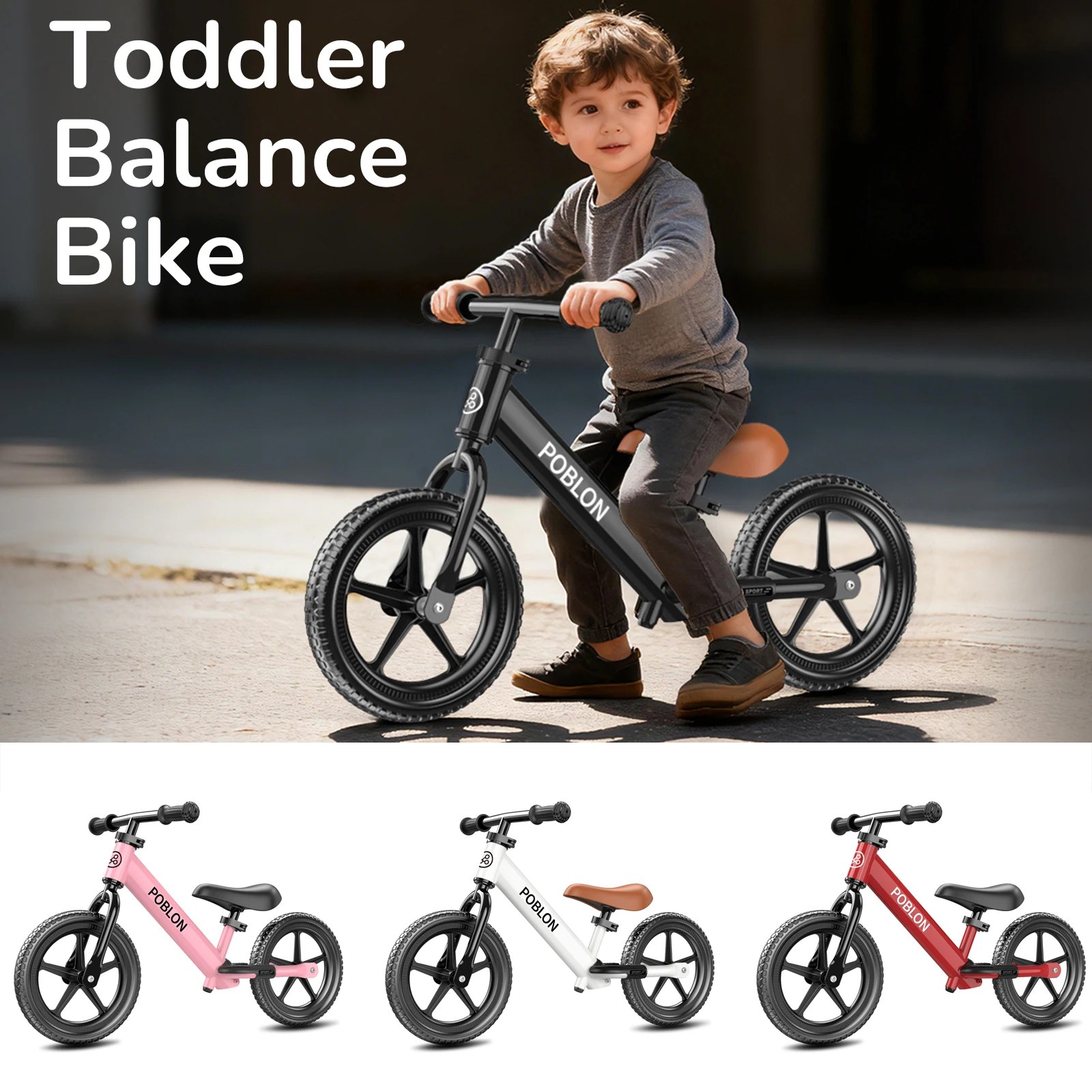
Short answer: Three balance bikes, and the age on the label is not one row. The light one has no pedals, and the seat and handlebar are adjustable. The age on the page is 18 months to 5 years. It does not need electricity. That page has no wheel diameter, no frame material, no weight of its own and no kilograms for the child. The four-wheeler has a basket, the age is 12–36 months, the load capacity is up to 20 kg, the seat is about 23 cm from the ground, the bike is about 2 kg, and the wheels are EVA. It does not need electricity. It has no pedals row, and it does have four wheels. The 30 cm bike has no pedals, the seat and handlebar are adjustable, the frame is steel, the tyre is rubber, and the age is also 18 months to 5 years. It has no weight of its own and no 20 kg row. “About” stays with the four-wheeler’s weight and seat, because the page itself writes it that way.
Products in this guide
Light balance bike, 18 months–5 years, no pedals58,90 €View
Four-wheeler, 12–36 months, up to 20 kg75,90 €View
Balance bike 30 cm, steel, 18 months–5 years84,90 €View
Age is not weight
18 months to 5 years is on the light bike’s page and on the 30 cm bike’s page. Both of those pages say “according to the manufacturer”. Those two pages do not give the child’s kilograms. 12–36 months is only on the four-wheeler, and only that page has up to 20 kg. That 20 kg is not copied onto the others only because the ages overlap in part. 18 months fits inside both ranges. 5 years does not fit inside 36 months. The age on the label is not one row across the three cards. The two longer pages share a range with each other. They do not share it with the four-wheeler, and they do not share a child-weight figure the pages never print.
If the child is, by the page, older than 36 months, the four-wheeler’s age row no longer says yes. If the child is younger than 18 months, the two longer-age pages do not name that child. 12 months is only the bottom end of the four-wheeler. These ranges are not merged into one “up to 5 years”. 5 years stays on the light page and on the 30 cm page. 12 months stays on the four-wheeler. 18 months is the point that sits inside both the 18 months to 5 years row and the 12–36 months row. Sitting inside both age rows is not the same as giving every card the same load, the same wheels or the same frame. Up to 20 kg remains the four-wheeler’s load row only.
The light page’s age and the 30 cm page’s age are the same range, and both are marked as the manufacturer’s data. The four-wheeler’s 12–36 months is the manufacturer’s data as well. Same kind of source does not make the ranges one range. A child the longer pages name at 5 years is outside the four-wheeler’s row. A child the four-wheeler names at 12 months is not named by the two pages that start at 18 months. Weight does not fill those gaps. The light page and the 30 cm page still have no kilograms for the child.
Four wheels are not the 30 cm bike
The four-wheeler’s text says that four wheels are more stable than a two-wheel balance bike. That is its sentence, not a measured test. The basket is in front, for small things, and the capacity is not given in litres. The wheels are EVA. Indoor and outdoor use is stated. The seat height is about 23 cm. The bike’s own weight is about 2 kg. It has no wheel diameter in centimetres. “About” stays on that weight and on that seat, because the page writes “about”. Four wheels, the basket, about 23 cm and about 2 kg stay on this card. They are not the 30 cm card’s lines and not the light card’s lines.
30 cm is only on the steel page, and that 30 cm is the wheel, not the seat height. The frame is steel. The tyre is rubber. Its own kilograms are not given. The 23 cm seat is not copied onto it. The light bike’s page says neither four wheels, nor 30 cm, nor steel. “Light frame” is its sentence, without a weight. The light page does not receive EVA wheels, a basket, a 20 kg load or an about-2 kg weight. The steel page does not receive a wheel count. The four-wheeler’s comparison with a two-wheel balance bike stays that page’s sentence. It does not become a wheel count printed on the light card or the 30 cm card, which do not state how many wheels they have.
The seat figures stay apart in the same way. About 23 cm from the ground is the four-wheeler’s seat height. 30 cm is the steel page’s wheel. The light page gives neither figure. An adjustable seat on the light page and on the 30 cm page is not a centimetre, so it is not turned into 23 cm or into 30 cm. The four-wheeler gives the about-23 cm seat and does not say that the seat or the handlebar adjusts. Wheel count, wheel diameter and seat height each stay on the card that writes them.
Pedals and electricity
“Pedals: none” is in the table of the light bike and of the 30 cm bike. The four-wheeler’s table does not have that row. This guide does not write pedals onto it and does not cross pedals off it. It says four wheels, a basket and the age. The absence of the row is the four-wheeler’s page. The row that says none is the other two pages. Those are not the same statement, and they are not edited into one. A reader who wants the words “pedals: none” finds them on the light card and on the steel card. The four-wheeler card does not supply those words.
“Does not need electricity” is on all three. A battery, a motor and a charger are on none of them. Indoor and outdoor use is a sentence in each text. A weather class, a brake and a helmet are on none of them. An adjustable seat and an adjustable handlebar are on the two longer-age pages. The four-wheeler gives a seat of about 23 cm and does not say that the seat or the handlebar adjusts. Electricity is the shared absence. Adjustment is not shared. The four-wheeler’s about 23 cm stays a stated seat height, not a claim that the seat moves. Indoor and outdoor stay a sentence on each page, not a measured class, and not a split that makes one bike indoor and another outdoor.
No battery is added to the light bike, the four-wheeler or the 30 cm bike. The pages already say they do not need electricity, and they already leave out a motor and a charger. That shared sentence does not add pedals to the four-wheeler, and it does not remove the “pedals: none” row from the other two. It does not add a brake or a helmet. It does not turn indoor and outdoor use into a weather class. The age rows stay different while this electricity sentence stays on every card.
What the page leaves unmeasured
Handlebar centimetres, frame length and box size are on none of the three. They are not invented. 2 kg is about, and only on the four-wheeler. 20 kg is the ceiling for the child, not the bike’s weight. The two kilogram figures are not mixed up. About 2 kg is the bike. Up to 20 kg is the load. Both lines are only on the four-wheeler. The light bike does not weigh 2 kg on its page, and the child on the light page is not given 20 kg. The steel bike does not weigh 2 kg on its page, and it has no 20 kg row. “About” is not dropped from the four-wheeler’s 2 kg or from its 23 cm seat.
The light bike and the 30 cm bike share the age and do not share the frame. One says a light frame. The other says steel and rubber. Which is heavier, the page does not weigh, because the light bike’s kilograms are not given. “Light” is the name and the frame sentence on that page. It is not a weighing against the steel page, and it is not a weighing against the four-wheeler’s about 2 kg. The steel page’s missing kilograms mean the same thing: the page does not say it is heavier or lighter than the bike that only says “light frame”. The four-wheeler is the only one of the three that prints a bike weight, and that weight is about 2 kg, which is not the child’s up to 20 kg.
The price is not the choice on this page. The price is on the product page, and the age row is what separates the three bikes here. The age row is not alone in separating them. Wheel count is written only on the four-wheeler. 30 cm and steel are written only on the third card. Up to 20 kg is written only on the four-wheeler. The price does not choose the bike. A higher or lower price is not a specification these pages use to decide age, wheels, pedals, frame or load. Those stay the lines the cards actually print.
How to choose?
If the age on the page is 18 months to 5 years and there are no pedals, and the wheel size and the frame material are not what is being looked up, it is the light bike. The child’s kilograms are not on that page. The seat and the handlebar are adjustable, and the page gives no centimetre for either. It does not need electricity. It does not say four wheels, it does not say 30 cm, and it does not say steel. “Light frame” stays its sentence without a weight. Up to 20 kg is not this card. About 2 kg is not this card. A basket is not this card.
If the age is 12–36 months and the page has to say up to 20 kg, four wheels, a basket and about 2 kg, it is the four-wheeler. It has no 30 cm wheel. The seat is about 23 cm from the ground. The wheels are EVA. There is no pedals row to quote. It does not say the seat or the handlebar adjusts. It does not need electricity. 18 months to 5 years is not this card’s age row, even though 18 months also falls inside 12–36 months. 5 years does not. The load of up to 20 kg stays here and is the child’s ceiling, not the about 2 kg of the bike.
If the age is the same 18 months to 5 years, but the wheel is 30 cm, the frame is steel and the tyre is rubber, it is the third. It has no weight of its own and no 20 kg row. Pedals are none. The seat and the handlebar are adjustable. It does not need electricity. 30 cm stays the wheel. It is not a seat of 30 cm. The about-23 cm seat stays on the four-wheeler. The light frame stays on the light bike. This card does not take either of those wordings away from them, and it does not receive their missing or present weights.
The ages do not merge into one row. 5 years is not on the four-wheeler’s page. 12 months is not on the other two. 18 months is inside both ranges, and that is an age-row fact, not a reason to copy 20 kg, four wheels or a basket onto the longer pages, and not a reason to copy 30 cm or steel onto the four-wheeler. The price does not choose among them.
Comparison
| Product | Price | What sets it apart |
|---|---|---|
| Light balance bike, 18 months–5 years, no pedals | 58,90 € | no size and no weight, adjustable seat, no electricity |
| Four-wheeler, 12–36 months, up to 20 kg | 75,90 € | 4 wheels, basket, seat about 23 cm, bike about 2 kg |
| Balance bike 30 cm, steel, 18 months–5 years | 84,90 € | 30 cm rubber tyre, steel frame, no pedals, no weight |
The price in the link is the shop’s current price and opens the product.
Who is this not for?
- 18 months to 5 years does not give the child’s kilograms. 20 kg is only on the four-wheeler.
- About 2 kg is the bike’s weight, not the load capacity. The load capacity is up to 20 kg.
- 30 cm is not the seat height. A seat of about 23 cm is on the other page.
- The pedals row is missing on the four-wheeler. It is not invented onto that card.
Frequently asked questions
Is the age the same on all of them?
No. Two pages say 18 months to 5 years. The four-wheeler says 12–36 months. Both are the manufacturer’s data. The light page and the 30 cm page also say “according to the manufacturer” on that longer range. The ranges are not merged into one “up to 5 years”. 18 months fits inside both ranges. 5 years fits only the longer row. 12 months is only the bottom of the four-wheeler’s row. If the child is older than 36 months, the four-wheeler’s age row no longer says yes. If the child is younger than 18 months, the two longer pages do not name that child. Age is on the page, and it is not the same row on every card.
Does 20 kg apply to all of them?
No. Up to 20 kg is only on the four-wheeler’s page. The other two have no kilograms for the child. 20 kg is the load ceiling on that one card, not a weight copied onto the light bike because an 18-month-old also fits the longer range, and not a weight copied onto the 30 cm bike. The light page and the steel page share 18 months to 5 years and still do not print a child weight. Up to 20 kg stays beside 12–36 months, four wheels, the basket, the seat of about 23 cm and the bike weight of about 2 kg. It does not travel.
Is 2 kg the child or the bike?
The page says the bike’s weight is about 2 kg. Up to 20 kg is a separate load row. Both are only on the four-wheeler. About 2 kg is not the child, and it is not the load capacity. Up to 20 kg is not the bike’s weight. The word about stays on the 2 kg, as the page writes it. The light bike and the 30 cm bike do not give this 2 kg, and they do not give the 20 kg. The two figures are not one figure, and they are not both the child and both the bike. One is the four-wheeler’s own weight. The other is that card’s load ceiling.
Is 30 cm the seat?
No. 30 cm is that bike’s wheel. The seat height of about 23 cm is on the four-wheeler’s page. The light bike gives neither. The 30 cm card does not call 30 cm a seat. It calls the wheel 30 cm, with a steel frame and a rubber tyre, no pedals, and an adjustable seat and handlebar without a seat centimetre. About 23 cm is not moved onto the steel card to become its seat, and 30 cm is not moved onto the four-wheeler to become a wheel diameter that page does not print. The light card stays without both numbers.
How many wheels are there?
Four is written only on one page. The light page and the 30 cm page do not say the number of wheels. The four-wheeler’s text compares itself with a two-wheel balance bike. That comparison is its sentence, not a measured test, and it is not a wheel count added to the other two cards. Those cards still do not say two, and they do not say four. Four wheels stay with the basket, the EVA wheels, the age of 12–36 months and the load of up to 20 kg. The 30 cm wheel is a diameter on the steel page, not a count of wheels, and not a count of four.
Are there pedals?
“None” is in the light bike’s table and in the 30 cm bike’s table. The four-wheeler’s table does not have that row. The row is not added, and pedals are not crossed off a row the page does not print. The four-wheeler says four wheels, a basket and the age. The light bike and the steel bike say the pedals row as none, and they also say an adjustable seat and handlebar and an age of 18 months to 5 years. Sharing “no electricity” does not fill in the missing pedals row. The words “pedals: none” stay on the two cards that print them.
Does it need a battery?
No. All three say they do not need electricity. There is no motor and no charger. A battery is not on the light bike, not on the four-wheeler and not on the 30 cm bike. That shared sentence does not make the ages one row, and it does not put a battery on a card that already says electricity is not needed. Indoor and outdoor use stays a separate sentence on each page. It is not a statement that a battery is required outdoors or indoors. No weather class is added beside it. The electricity line stays “does not need electricity” on every card.
Does the seat adjust?
The light page and the 30 cm page say an adjustable seat and an adjustable handlebar. The four-wheeler gives a seat of about 23 cm and does not say that it adjusts. Adjustment is not copied onto the four-wheeler from the other two, and about 23 cm is not copied onto the other two from the four-wheeler. The light page’s adjustable seat has no centimetre. The 30 cm page’s adjustable seat has no centimetre, and the 30 cm on that page remains the wheel. The four-wheeler’s seat figure remains about 23 cm, with the word about, and without an adjustment sentence. The handlebar is adjustable only where the page says so, which is the two longer-age pages.
What is the frame made of?
Steel is only on the 30 cm page, and the tyre is rubber. The four-wheeler has EVA wheels and no frame material. The light one says a light frame, without naming a metal. Steel is not given to the light frame. EVA is not given to the steel bike’s rubber tyre. A frame metal is not invented for the four-wheeler. “Light frame” stays a sentence without a weight and without a metal name. The 30 cm, the steel and the rubber tyre stay together on that one card. The EVA wheels stay with the four-wheeler’s four wheels, basket and about 2 kg. The cards do not share one frame material.
Is there a basket on all of them?
No. The basket is only in the four-wheeler’s text, and litres are not given. It is in front, for small things. The light page does not have the basket. The 30 cm page does not have the basket. A capacity in litres is not added to the card that already leaves litres out. The basket stays beside four wheels, EVA wheels, 12–36 months, up to 20 kg, a seat of about 23 cm and a bike weight of about 2 kg. It does not become part of the light frame, and it does not become part of the steel frame. The other two cards are not given a basket they do not mention.
Does an 18-month-old fit both?
18 months is inside both age rows. 5 years is only in the longer row. 12 months is only the bottom end of the four-wheeler. An 18-month-old is named by the light page, by the 30 cm page and by the four-wheeler’s 12–36 months. That is the age overlap the pages allow. It does not put up to 20 kg on the longer pages, and it does not put 18 months to 5 years onto the four-wheeler as that card’s printed range. The four-wheeler’s range remains 12–36 months. The other range remains 18 months to 5 years, on two cards that still differ in wheel, frame and pedals wording. Fitting the age is not fitting every other line.
Is indoor and outdoor use measured?
It is a sentence on each page. A weather class, a brake and a helmet are not on any of them. Indoor and outdoor are not split so that one card is indoor and another is outdoor. Each text says both. The sentence is not a measured test, and it is not given a weather class the pages leave out. It sits on the light page beside 18 months to 5 years and no pedals, on the four-wheeler beside 12–36 months and four wheels, and on the 30 cm page beside the steel frame and the rubber tyre. No card is moved indoors only or outdoors only. No brake and no helmet are added to make the sentence more specific than the page is.
Which is lighter, the light one or the steel one?
The four-wheeler says about 2 kg. The light one and the steel one do not give their own weight. “Light” is a name, not a weighing. The page does not weigh which of those two is heavier, because the light bike’s kilograms are not given and the steel bike’s kilograms are not given. About 2 kg is not awarded to either of them. It stays the four-wheeler’s bike weight, approximate, and separate from the child’s up to 20 kg. A light frame without a metal and without a weight stays the light card’s sentence. Steel and rubber, without a weight, stay the 30 cm card’s sentence. Neither sentence is a scale result.
Does the price choose the bike?
No. The price is on the product page. What separates them here is the age row, the wheel count, the 30 cm, the steel, and whether 20 kg is written at all. The price does not choose the bike. The link’s price is the shop’s current price and opens the product. It is not an age, not a wheel diameter, not a load and not a frame. 18 months to 5 years against 12–36 months is a separation the pages do print. Four wheels against pages that state no wheel count is a separation the pages do print. 30 cm and steel against a light frame with no size is a separation the pages do print. Up to 20 kg on one card, and no child kilograms on the other two, is a separation the pages do print. The price is none of those lines.