
Short answer: Three jump starters, and no air pump. The page for 5 litres of petrol and 3 litres of diesel, model CP-F61, weighs 0.7 kg. The peak is 1000 A, the cranking current is 400 A, and the battery is 7200 mAh, which is four 1800 mAh cells, 26.64 Wh. The output is 10.5 W and the input is 10 W. The page for 9 litres of petrol and 7 litres of diesel, model H18, weighs 1.2 kg. The peak is 3000 A, the cranking current is 600 A, and the battery is 16,000 mAh, which is four 4000 mAh cells, 59.2 Wh. The output and the input are 18 W, and there is a separate direct current of 12–16 V / 10 A. The third title says 6000 A, 12 V and 10.0 L, model Epower-237, weight 1.6 kg, battery 24,000 mAh. The type row says a jump starter without an air pump. Cranking current, watt-hours and litres are not in its table. 10.0 L is in the title, not on the table’s engine row.
Products in this guide
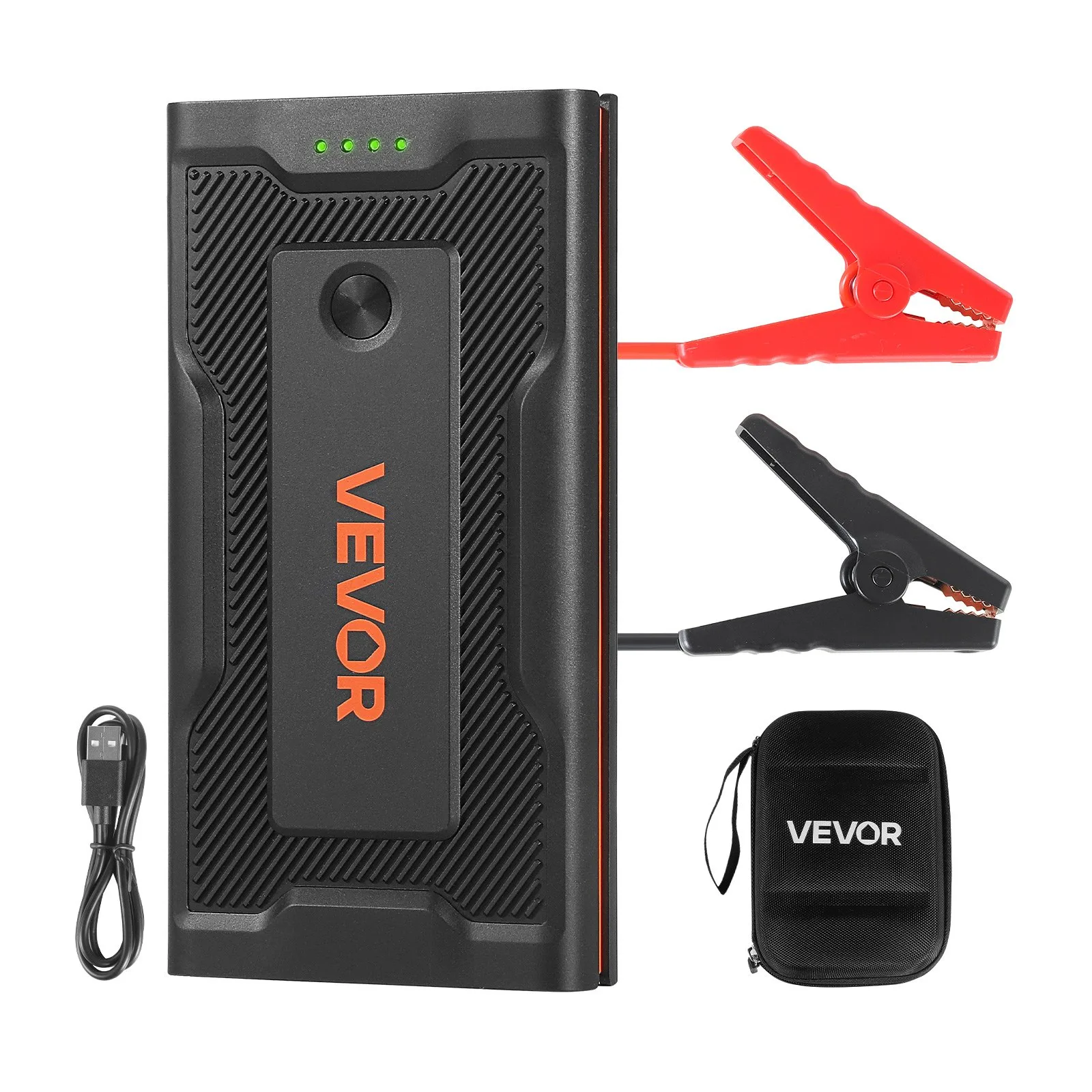 Jump starter 1000 A, 5 L petrol / 3 L diesel86,90 €View
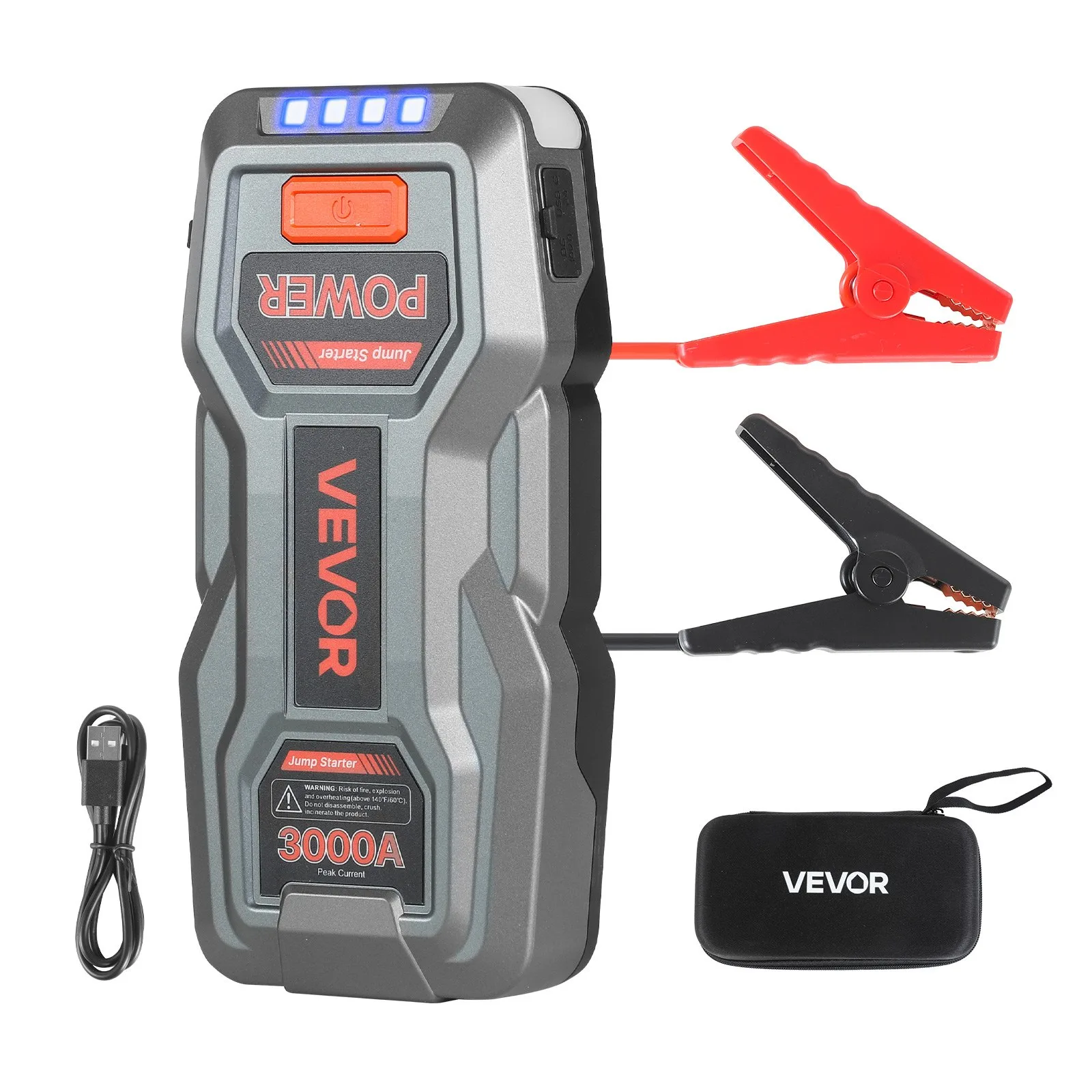 Jump starter 3000 A, 9 L petrol / 7 L diesel119,90 €View
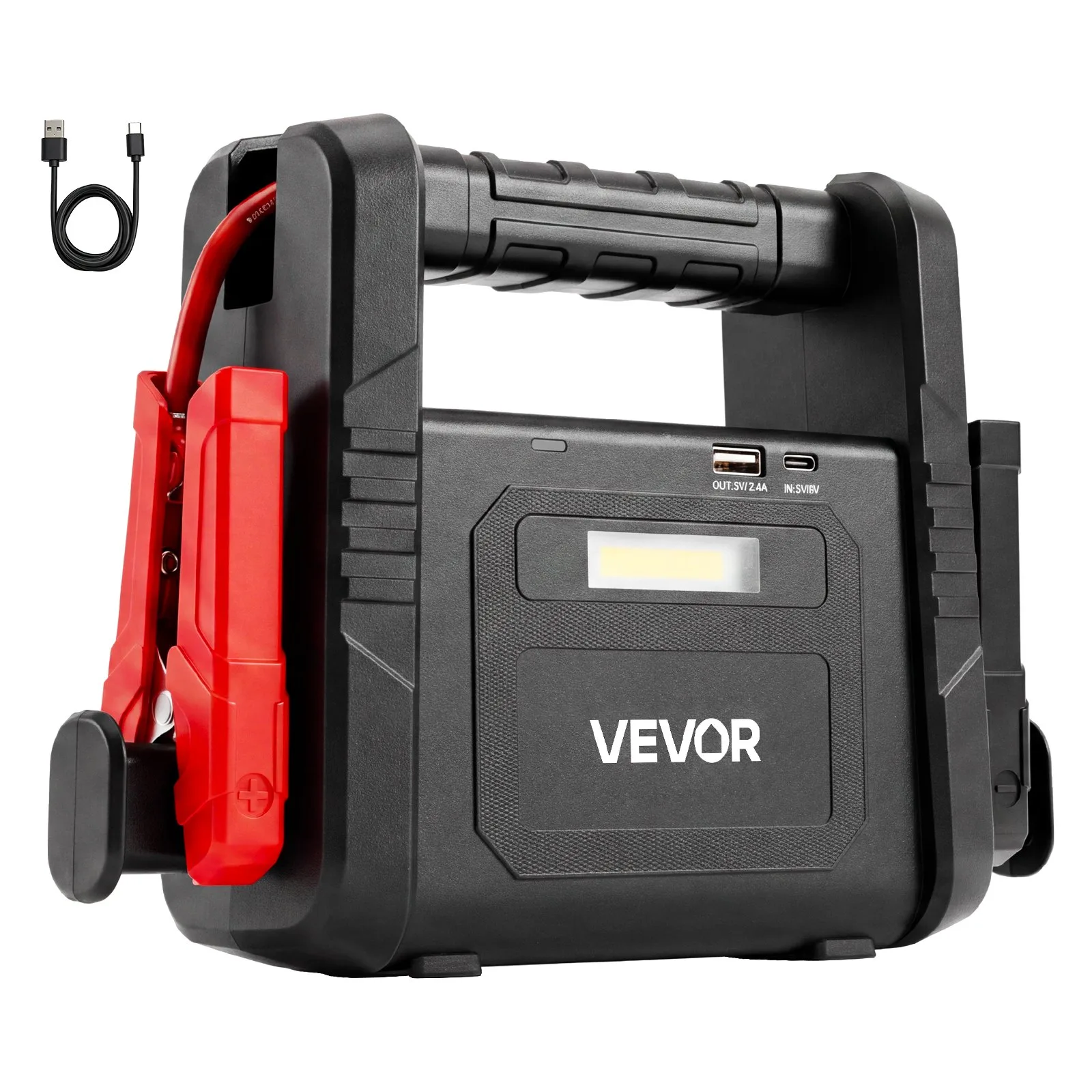 Jump starter 6000 A, title 10.0 L, no pump147,90 €View
A litre is not a tank and not a pump
5 L and 3 L are the first page’s sentence: a petrol engine up to 5 litres, or a diesel up to 3 litres. That sentence is engine displacement. 5 L is not a tank capacity, and 3 L is not a tank capacity. Neither figure is a canister on the jump starter. The page does not give a tank volume for CP-F61. The 5 litres belong to the petrol-engine sentence and the 3 litres belong to the diesel sentence beside it. Those two stay a pair on that page only. They are not copied onto H18 and they are not copied onto Epower-237.
9 L and 7 L are the second page’s sentence, in the same way: a petrol engine up to 9 litres, or a diesel up to 7 litres. That is engine displacement on H18, not a canister volume and not a tank on the unit. 9 L is not 5 L moved up, and 7 L is not 3 L moved up. The sentences stay on their own pages. H18 does not inherit the first page’s 5 L and 3 L, and CP-F61 does not inherit 9 L and 7 L. The displacement pair and the model stay together: 5 L petrol and 3 L diesel with CP-F61, 9 L petrol and 7 L diesel with H18.
The third title writes 10.0 L, together with 12 V and 6000 A. Its features say most home petrol and diesel cars, and they do not repeat the litre. The table has no litre row. 10.0 L stays in the title. The title’s 10.0 L and the empty place in the table are not combined into one measured engine limit. The page does not give Epower-237 a petrol litre and a diesel litre the way the first two pages do. 10.0 L is not a measured limit on this card. It is not a tank capacity either. Most home petrol and diesel cars is the features sentence, and that sentence does not state a litre. The first page’s 5 L and 3 L, and the second page’s 9 L and 7 L, are not written into that title and are not written into that empty table row.
An air pump is not in the first or the second features. Those features name a flashlight, a power bank, clamps and protection. The third type row says it outright: a jump starter without an air pump. No card includes a compressor. A compressor is not listed on CP-F61, not listed on H18, and not listed on Epower-237. A tyre is not inflated according to any of these pages. 5 L, 3 L, 9 L, 7 L and the title’s 10.0 L stay engine wording or a title. They do not become a pump, and they do not become a tank.
Peak and cranking current are not one number
The first page has both numbers. The cranking current is 400 A and the peak is 1000 A. 400 A stays the cranking current. 1000 A stays the peak. The page does not write 1000 A as the cranking current, and it does not write 400 A as the peak. Both figures belong to CP-F61, beside the 5 L petrol and 3 L diesel sentence, the 7200 mAh battery and the 0.7 kg weight. Peak amps and cranking amps stay different numbers on this card.
The second page has both numbers as well. The cranking current is 600 A and the peak is 3000 A. 600 A stays the cranking current. 3000 A stays the peak. The page does not write 3000 A as the cranking current, and it does not write 600 A as the peak. Both figures belong to H18, beside the 9 L petrol and 7 L diesel sentence, the 16,000 mAh battery and the 1.2 kg weight. The first page’s 400 A and 1000 A are not moved here. The second page’s 600 A and 3000 A are not moved back onto CP-F61.
The third table has only the peak, 6000 A. It has no cranking-current row. 6000 A does not mean the cranking current is 6000 A. The page does not say that. Cranking current on these pages is written only as 400 A, on CP-F61, and 600 A, on H18. Epower-237’s 6000 A stays a peak in the table and a figure in the title, next to 12 V and 10.0 L. It is not relabelled as cranking amps. The missing cranking row is left empty. A peak taken from another card is not written in to fill it.
A larger peak is not, on the page, automatically a larger engine displacement past the title. The 1000 A page names 5 L of petrol and 3 L of diesel. The 3000 A page names 9 L of petrol and 7 L of diesel. The 6000 A page names a litre only in the title, as 10.0 L, and its features speak of most home petrol and diesel cars without repeating a litre. Those sentences are not swapped between the cards. 6000 A does not start a bigger engine than 3000 A on these pages. The pages do not compare the two peaks with each other, and they do not say that the higher peak figure starts the larger engine. The 3000 A card has a displacement sentence. The 6000 A card has a title litre and no cranking current. That is the whole of what the pages give. The comparison is not supplied, so this guide does not supply it.
The battery, the watts and the plug
7200 mAh and 26.64 Wh are on the first page. The 7200 mAh is four 1800 mAh cells. 16,000 mAh and 59.2 Wh are on the second page. The 16,000 mAh is four 4000 mAh cells. 24,000 mAh is on the third page, without watt-hours and without a four-cell split. Watt-hours are not copied onto the third card. The four-cell split is not copied onto it either. 26.64 Wh stays with 7200 mAh on CP-F61. 59.2 Wh stays with 16,000 mAh on H18. 24,000 mAh stays on Epower-237 as the battery figure that page actually prints. Battery size stays on the card that states it.
The first USB output is 5 V / 2.1 A. The Type-C input is 5 V / 2 A. A Type-C output is not on that page. Those port figures belong to CP-F61 only. The second page’s QC3.0 voltages are not written back onto the first card, and the first card’s 5 V / 2.1 A output is not written onto the other two. Output power of 10.5 W and input of 10 W are on the first page as well, with the 0.7 kg weight and the 10 AWG clamps. The watts stay with CP-F61.
On the second page the USB output and the Type-C output are both QC3.0: 5 V / 3 A, 9 V / 2 A, 12 V / 1.5 A. The Type-C input is 5 V / 2 A and 9 V / 2 A. The direct-current output of 12–16 V / 10 A is only on this page. Output and input of 18 W, in both directions, are on this page. The 10 AWG clamps are on this page. All of that stays on H18. QC3.0 is not copied onto CP-F61, which has no Type-C output and a USB output of 5 V / 2.1 A. QC3.0 and 12–16 V are not copied onto Epower-237. The 12 V inside the QC3.0 list, and the 12–16 V direct-current row, are H18’s own port lines. They are not the 12 V printed in the third title.
The third page does not list ports. It does not give watts. It does not state a wire gauge. 10 AWG is on the first and the second page only. Epower-237 does not say 10 AWG, and this guide does not add a clamp gauge to it. USB is not the same on all three, because the third card does not list a USB port at all, the first lists 5 V / 2.1 A with a Type-C input of 5 V / 2 A and no Type-C output, and the second lists QC3.0 on the USB output and the Type-C output plus a direct-current output of 12–16 V / 10 A. Each of those descriptions stays on its own card.
Temperature and protection
The first and the second table write the working temperature in two ways, side by side: −15.6 to 50.0 °C, and −20 °C to 50 °C. The page does not choose between them. This guide does not choose either. Both writings stay, on CP-F61 and on H18. The third table does not have this row. Working temperature is not copied onto Epower-237. −15.6 to 50.0 °C is not assigned to one model and −20 °C to 50 °C to the other. Each of the first two pages prints both ranges and leaves them side by side.
“12 protections” is a sentence on the first and the second page, together with a list: reverse polarity, spark, overcharge, reverse charging, overcurrent, overvoltage, overload, short circuit, and low and high temperature. The number 12 and that list stay on CP-F61 and H18. The third page lists reverse polarity, spark, overcharge, overcurrent, overvoltage, overload, short circuit and temperature, and it adds “and much more”. The number 12 is not on that page. Reverse charging is in the first and second list and is not in the third list. Low and high temperature, as that phrase, is in the first and second list. The third page says temperature, and then “and much more”, and it does not give the number 12. Protection count stays on the cards that state it. “And much more” is left as the page wrote it.
Three flashlight modes, steady, strobe and SOS, are on the first and the second page. The third page says an LED flashlight and does not give the modes. SOS stays on CP-F61 and H18. It is not added to Epower-237, because that page does not name SOS, strobe or a steady light. The material on the first and the second is ABS and PC, and the page says dust-resistant, impact-resistant and fire-resistant. The material on the third is ABS and PC, V0 flame retardant. V0 is not on the first two pages. Dust-resistant, impact-resistant and fire-resistant are not copied onto the third as a substitute for V0, and V0 is not copied back onto the first two as a substitute for those words. ABS and PC are on all three. The words that follow ABS and PC are not the same words. Weight stays where it is printed: 0.7 kg, 1.2 kg and 1.6 kg. The boxes are 8.5 × 13 × 19 cm, 26.5 × 10.5 × 14 cm and 22 × 11 × 29 cm, in that same order.
How to choose?
If the page has to say 5 L of petrol or 3 L of diesel, it is CP-F61. The peak is 1000 A, the cranking current is 400 A, and the weight is 0.7 kg. The battery is 7200 mAh, four 1800 mAh cells, 26.64 Wh. The USB output is 5 V / 2.1 A, the Type-C input is 5 V / 2 A, and there is no Type-C output. Output is 10.5 W and input is 10 W. The clamps are 10 AWG. The working temperature is written as −15.6 to 50.0 °C and as −20 °C to 50 °C. The sentence “12 protections” is on this page, with steady, strobe and SOS. The material words are ABS and PC, dust-resistant, impact-resistant and fire-resistant. There is no pump. 5 L is the petrol displacement sentence, not a tank.
If the page has to say 9 L of petrol or 7 L of diesel, and direct current of 12–16 V, it is H18. The peak is 3000 A, the cranking current is 600 A, and the weight is 1.2 kg. The battery is 16,000 mAh, four 4000 mAh cells, 59.2 Wh. USB and Type-C outputs are QC3.0, at 5 V / 3 A, 9 V / 2 A and 12 V / 1.5 A. The Type-C input is 5 V / 2 A and 9 V / 2 A. Direct current is 12–16 V / 10 A, and that row is only here. Output and input are 18 W. The clamps are 10 AWG. The same two temperature writings are on this page, and “12 protections” is on this page, with steady, strobe and SOS. There is no pump. 9 L and 7 L are displacement, not a tank.
If the title says 6000 A and the type row says without an air pump, it is Epower-237. The battery is 24,000 mAh and the weight is 1.6 kg. Cranking current and watt-hours are not in the table. 10.0 L is in the title, with 12 V and 6000 A, and the table does not repeat the litre. The features say most home petrol and diesel cars. Ports, watts, wire gauge, working temperature and the number 12 are not on this page. The flashlight is named as an LED flashlight, without modes. The material is ABS and PC, V0 flame retardant. The peak in the table is 6000 A only. That peak is not a cranking current, and the page does not say it starts a bigger engine than the 3000 A card.
There is no compressor on any of them. For a tyre, this page does not give an answer. The three cards stay three descriptions: displacement sentences and both amp figures on the first two, a title litre and a peak-only table on the third, and no air pump on any card.
Comparison
| Product | Price | What sets it apart |
|---|---|---|
| Jump starter 1000 A, 5 L petrol / 3 L diesel | 86,90 € | 400 A cranking, 7200 mAh, 26.64 Wh, USB 5 V / 2.1 A, 0.7 kg |
| Jump starter 3000 A, 9 L petrol / 7 L diesel | 119,90 € | 600 A cranking, 16000 mAh, 59.2 Wh, QC3.0 and 12–16 V, 1.2 kg |
| Jump starter 6000 A, title 10.0 L, no pump | 147,90 € | peak 6000 A only, 24000 mAh, type without an air pump, 1.6 kg |
The price in the link is the shop’s current price and opens the product.
Who is this not for?
- There is no air pump and no compressor. The third type row says a jump starter without an air pump, and the first two feature lists do not name a pump.
- 5 L, 3 L, 9 L and 7 L are engine-displacement sentences. 10.0 L is a title. None of these is a canister or a tank capacity, and 10.0 L is not a measured engine limit.
- 6000 A is not the cranking current. Cranking current is written only as 400 A and 600 A. The page does not say 6000 A starts a bigger engine than 3000 A.
- The “12 protections” sentence, the three light modes and the temperature row are not on the third page. SOS, 10 AWG and the watt-hour figures stay on the cards that print them.
Frequently asked questions
Is a compressor included?
No. The first and the second page do not name a pump. Their features name a flashlight, a power bank, clamps and protection. The third type row says a jump starter without an air pump. No card includes a compressor. A tyre is not inflated according to any of these pages.
Is 5 L a tank capacity?
No. It is the page’s sentence about petrol-engine displacement, with diesel 3 L beside it, on CP-F61. The same kind of sentence is 9 L of petrol and 7 L of diesel on the second page. Those litres are not a tank and not a canister on the jump starter. 5 L is not copied onto the other cards.
Is 10 L a measured limit?
10.0 L is in the third title, together with 12 V and 6000 A. The table does not repeat the litre. The features say most home petrol and diesel cars and do not repeat a litre. The title’s 10.0 L and the empty table row are not combined into one measured engine limit. 10.0 L is not written as a petrol displacement and a diesel displacement.
What is the difference between peak and cranking current?
On the first, cranking is 400 A and the peak is 1000 A. On the second, cranking is 600 A and the peak is 3000 A. The third table has only the peak, 6000 A. Peak amps and cranking amps stay different. 6000 A is not written as a cranking current. The first two cards are the only ones that print both figures.
Does 6000 A start a bigger engine than 3000 A?
The page does not compare them with each other. The 3000 A page names 9 L of petrol and 7 L of diesel, and its cranking current is 600 A. The 6000 A page puts 10.0 L in the title and does not give a cranking current. A larger peak is not, on the page, automatically a larger engine. Those sentences are not swapped, and this guide does not add the comparison the pages leave out.
How big is the battery?
7200 mAh and 26.64 Wh, as four 1800 mAh cells, on CP-F61. 16,000 mAh and 59.2 Wh, as four 4000 mAh cells, on H18. 24,000 mAh on Epower-237, without watt-hours and without a four-cell split. Watt-hours are not copied onto the third card. Each battery figure stays on the card that states it.
Is the USB the same on all of them?
No. The first has 5 V / 2.1 A, a Type-C input of 5 V / 2 A, and no Type-C output. The second has a QC3.0 USB output and a QC3.0 Type-C output, at 5 V / 3 A, 9 V / 2 A and 12 V / 1.5 A, a Type-C input of 5 V / 2 A and 9 V / 2 A, and direct current of 12–16 V / 10 A. The third does not list ports. QC3.0 and 12–16 V are not copied onto it.
At what temperature does the page allow work?
On the first and the second, the two writings sit side by side: −15.6 to 50.0 °C, and −20 °C to 50 °C. The page does not choose. This guide does not choose. The third page does not have this row. Working temperature stays on CP-F61 and H18.
How many protections are there?
“12 protections” is a sentence on the first and the second page, with the list that names reverse polarity, spark, overcharge, reverse charging, overcurrent, overvoltage, overload, short circuit, and low and high temperature. The third page lists protections and does not say the number 12. It adds “and much more”. The number 12 stays on the two cards that write it.
Does the flashlight have SOS?
A steady light, a strobe and SOS are on the first and the second page. The third page says an LED flashlight and does not give the modes. SOS is not added to Epower-237. The three modes stay on CP-F61 and H18.
What is the material?
The first and the second: ABS and PC, and the page says dust-resistant, impact-resistant and fire-resistant. The third: ABS and PC, V0 flame retardant. V0 is not on the first two. The dust, impact and fire words are not copied onto the third, and V0 is not copied onto the first two. ABS and PC are the shared part. The words after them stay where the page puts them.
How heavy is it?
0.7 kg, 1.2 kg and 1.6 kg, for CP-F61, H18 and Epower-237. The boxes are 8.5 × 13 × 19 cm, 26.5 × 10.5 × 14 cm and 22 × 11 × 29 cm. Weight stays on the card that states it. The box is a different row from the weight.
Are the clamps 10 AWG on all of them?
10 AWG is on the first and the second page. The third page does not state a wire thickness. 10 AWG is not copied onto Epower-237. The clamps on that card are not given a gauge by this guide.
Is 12 V on all of them?
12 V is in the third title, with 6000 A and 10.0 L. The second page has a direct-current output of 12–16 V / 10 A, which is that card’s port row, and its QC3.0 list includes 12 V / 1.5 A. The first page does not give a 12 V row. Its USB output is 5 V / 2.1 A. The title’s 12 V stays on Epower-237. It is not written onto CP-F61.