
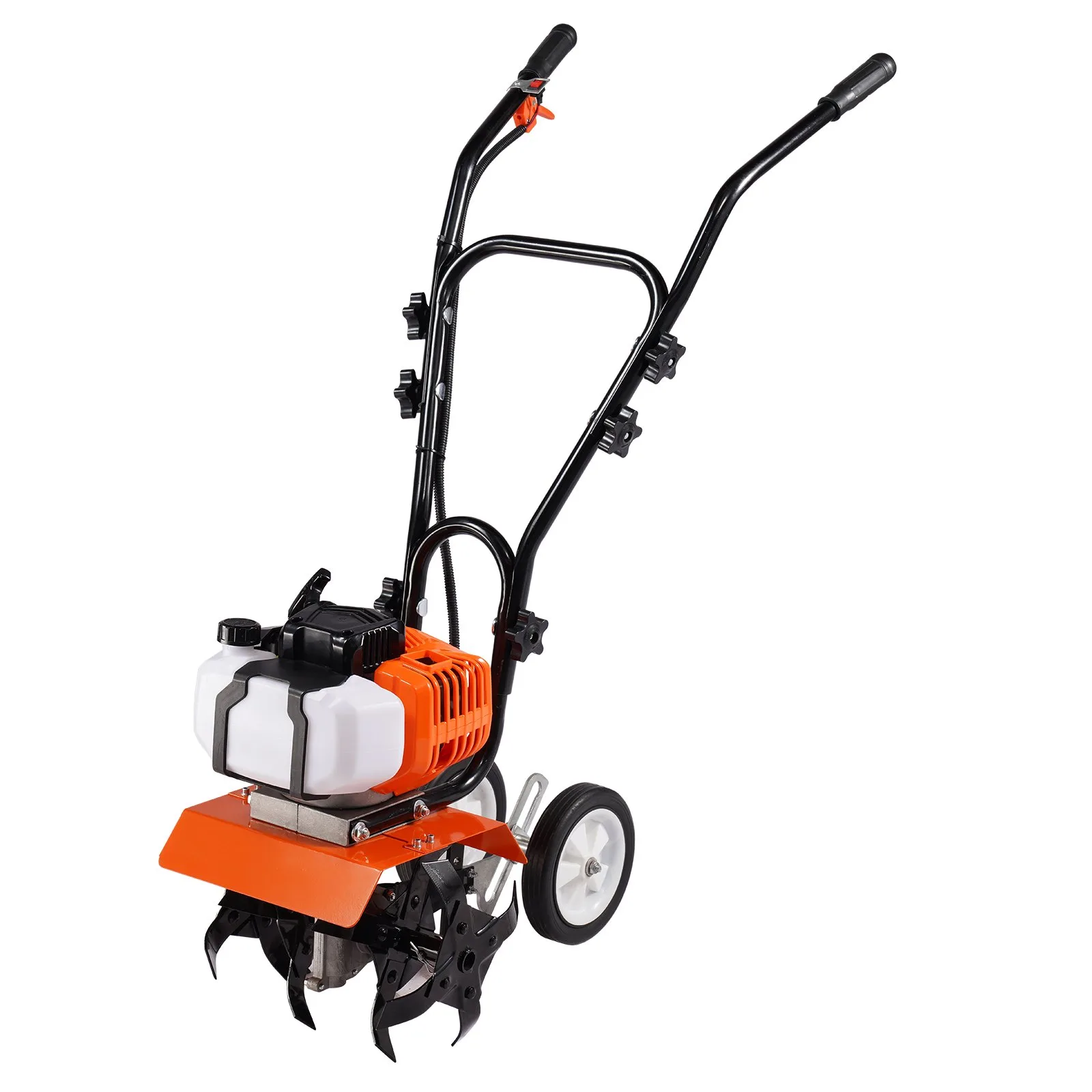
Short answer: The shop has one petrol-engine soil tiller. The engine is a two-stroke, 43 cm³. Four steel tines work a strip 300 mm wide and up to 100 mm deep. Skids adjust the depth, the drive wheels are 14.7 cm, the machine weighs 14.15 kg, and it stands upright while it works. It loosens the top layer of a bed. Grass is not mowed with it, and it does not turn a 25 cm deep furrow.
Products in this guide
What 300 mm and 100 mm mean on a bed
A working width of 300 mm is about the width of one narrow bed row. 300 mm is 30 cm, the same width written the other way, not a second machine. If the row is wider, you walk back from the other end. A second pass is the same tiller on a wider bed. It is not another model. There is one petrol tiller on this page, and one price.
A depth of 100 mm is 10 cm. That is the sowing layer and the weed layer, not an autumn deep ploughing. If a spade has to go a spade-blade into the ground, this tiller does not reach there. 10 cm is the ceiling the page gives. A 25 cm deep furrow is a different figure. The machine does not turn that furrow. 25 cm is not another way of writing 100 mm, and it is not a second depth setting.
There are four tines, and they are steel. Above them is a shield, so that soil and stones do not fly straight at the legs. A skid set raises or lowers the working depth. The 14.7 cm nylon wheels drive the machine forward. They are not lawn-mower wheels, and they do not cut anything. The wheels stay wheels. The tines stay the parts that work the soil. The shield stays the cover above the tines.
The two-stroke engine, the start and the weight
43 cm³ is a small two-stroke, not a four-stroke lawn-mower engine. A two-stroke does not run on straight petrol: oil is mixed into the fuel. The mix ratio is the manual that comes with the machine. That number is not guessed here, and it is not printed on this page. The start is a pull cord. The handle has switches and a brake.
The machine weighs 14.15 kg, and the size is 1110 × 448 × 910 mm. Lifting it into a car is doable. Working is a different matter: the tiller pulls forward, and hard dry clay tires the hands faster than a loose bed. 14.15 kg is the weight of this one machine. It is not a second, lighter tiller, and it is not a claim that the work is easy.
The gearbox is alloy metal. The body-materials row has PA6 and aluminium. The package is 49 × 39 × 50 cm. The machine is put together in three steps before work. Three steps is the assembly. It is not a count of pulls on the cord, and it is not a second product in a second box. One carton, one machine.
Whose bed, and what soil
A vegetable garden, a flower bed and a small home garden are the work the width and the depth are written for. The NRMM certificate is about the engine’s exhaust. It does not make the machine a professional field tiller. 300 mm and 100 mm stay the working limits. The certificate does not replace them with a field width or a field depth.
A couple of square metres of bed is often faster with a spade, because taking the machine out of the shed, mixing the fuel and washing it afterwards take more time than the spade work. A long bed, where the same strip is gone over several times in a season, is the place where a 30 cm wide tiller pays off. That 30 cm is the 300 mm working width. The small bed and the long bed are two jobs for this one machine, not two machines.
How you stand behind it
The work is done standing, behind the machine, not sitting. The height of 910 mm is the measurement of the machine standing upright. It is not a range for adjusting the handle. The size 1110 × 448 × 910 mm already ends in that 910 mm. The page calls 910 mm the height of the upright machine. It does not call it a handle setting, and this guide does not turn it into one.
The handle has a switch and a brake. The brake is there so the tines stop when the hand comes off. The shield above the tines is the other half of the same job: the soil stays near the ground. One sentence on the page says the handle has switches and a brake. The standing section says a switch and a brake. Both wordings stay. They are not rewritten into a parts list the page does not give.
The pull cord is long, and it is thicker than on a thin lawn mower. The first start on a cold engine takes several pulls. The page does not say how many. If the cord comes all the way out and the engine does not catch, the first things to look at are whether the fuel mix is in the tank and whether the start position in the manual is the one written on the page. Pulling with an empty tank only wears the cord. No length and no thickness are added here beyond what that sentence says.
Dust, the filter, and what happens after the bed
The page has a larger cooling opening and an air filter for a reason. A dry bed drives dust into the air intake. The filter keeps that dirt out of the engine, but a clogged filter leaves the engine without air, and then a large opening helps little. After dusty work, the filter is looked at. The page does not say a number of hours, or after how many beds to do it, and that interval is not invented here.
The tines come out of the soil muddy. They are cleaned before the machine goes in the shed, because clay that has dried by the next morning is the same as stone. Fuel mix is not left standing in a two-stroke tank over winter: the oil settles out of the mix. When the season is over, the tank is emptied and the engine is left to run until the mix is used up and it stops. That is a two-stroke habit, not a separate promise of this page.
What this machine’s page does not say
Horsepower, litres per hour, and working hours on a tankful are not on the page. They are not put here. What is on the page is the width, the depth, the displacement, the weight and the size. If someone promises a hectare a day with this 43 cm³ engine, that promise does not come from this page. 43 cm³ stays a displacement. It is not turned into horsepower, and it is not turned into a day’s area.
The page also does not write the oil-to-petrol ratio. That is in the manual that comes with the machine. A two-stroke is not started behind a closed greenhouse door: the exhaust stays in the room. Outdoors, at the end of the bed, is this engine’s place. The closed greenhouse is a place this page rules out. It is not a second working width, and it is not a second product.
How to choose?
If the question is whether this mows grass: no. The tiller loosens soil. For grass, there is a mower. The four steel tines are not a blade. This page does not become a mower because the question was asked, and there is no second shop product here that mows.
If the question is depth: the maximum working depth is 100 mm. That is 10 cm. A deeper furrow stays with a spade or with a larger machine. This page does not name that larger machine, and it does not give a depth past 100 mm. The 25 cm furrow in the short answer is the furrow this tiller does not turn.
If the question is width: one pass is 300 mm. A wider bed means a second pass. 300 mm is one narrow row. It is the same 30 cm the long-bed sentence uses. The body of the machine is wider than the 300 mm working width. That is said so a narrow gap can be measured. It is not a second width you can set.
If the question is fuel: a two-stroke wants a mix of oil and petrol. The ratio is in the manual, not in this text. Straight petrol is not what this engine runs on. There is no electric tiller beside this one. The only machine in the shop file here is this petrol tiller.
Who this is not for
- Mowing grass. The tines are not a blade.
- Deep ploughing. 10 cm is the ceiling.
- Anyone who does not want petrol, an oil mix and a pull cord. There is no electric tiller beside this one.
- A very narrow bed between trees and bushes. The working width is 300 mm, and the body is wider than that. Measure the gap first.
Frequently asked questions
Does a soil tiller mow grass?
No. Four steel tines loosen soil. A mower is what cuts grass.
How deep does a soil tiller go?
The maximum working depth is 100 mm, which is 10 cm. The skids adjust the depth inside that limit.
How wide a strip does one pass make?
300 mm. A wider bed is walked a second time. 300 mm is 30 cm, the same width, not a second tiller.
Does the engine run on straight petrol?
No. This is a two-stroke 43 cm³ engine. Oil is mixed into the fuel. The ratio is in the machine’s manual.
How heavy is the soil tiller?
14.15 kg. The size is 1110 × 448 × 910 mm. Taken out of the package, it is put together in three steps.
Does it plough like a plough?
No. 10 cm is loosening the top layer for sowing and for weeds. A plough furrow is deeper. The 25 cm furrow named on this page is one this tiller does not turn.
Do the wheels cut the soil?
No. The 14.7 cm nylon wheels drive the machine. The steel tines work the soil. The wheels are not mower wheels, and they do not cut anything.
Is a bed with stones a problem?
There is a shield above the tines so that soil and stones do not spray straight onto you. Large stones still have to be picked up first. The tines are not a stone crusher.
Is a small bed worth doing with a tiller?
At a couple of square metres, a spade is often faster. A long row that you loosen several times in a season is this machine’s work.
Does the tiller start from electricity?
No. The start is a pull cord. This model has no power cable and no battery.
How many tines does the machine have?
Four. The material is steel. There is a shield above them.
Does a ready tiller come out of the box?
No. The package is 49 × 39 × 50 cm. The machine itself is 111 cm long, which is the 1110 mm length in the size 1110 × 448 × 910 mm, the same length written in centimetres. Assembly is three steps, and only then the bed.
Is 43 cm³ a big engine?
It is a small two-stroke. The page does not give horsepower. The working limit to read is 300 mm of width and 100 mm of depth, not the cubic centimetres on their own.
May the tiller be started in a greenhouse?
Not in a closed greenhouse. A two-stroke’s exhaust stays in the room. The place for this engine is outdoors, at the end of the bed.
Does a soil tiller aerate a lawn?
No. The tines are for working soil. In a lawn they tear the turf up. They do not make air holes in the lawn. The lawn stays with a mower.
Does 14 kg mean the work is easy?
14.15 kg is the weight when lifting. At work the tiller pulls forward, and hard ground loads the hands differently from the weight on the counter. The weight says whether the machine fits in a car, not whether the clay is soft.