
Short answer: Three petrol leaf blowers. All are two-stroke and start with a pull cord. The handheld is 26 cm³, 7000 rpm, 425 CFM and 251 km/h, with a tank of 0.41 litres and a weight of 6.5 kg. It blows and it sucks, and the box has a collection bag. The 63 cm³ backpack runs at 6500 rpm and gives 1110 CFM and 354 km/h, with a tank of 1.89 litres. That page says 50–60 minutes, and the weight is 10 kg. The 79 cm³ backpack runs at 6800 rpm, but the air is less: 930 CFM and 296 km/h. What sets it apart is a 3-litre tank and, on the page, 95 minutes, at a weight of 11.27 kg. The page does not state an oil-and-petrol ratio. A mixing bottle is in the box. A fuel-consumption percentage is not taken from here.
Products in this guide
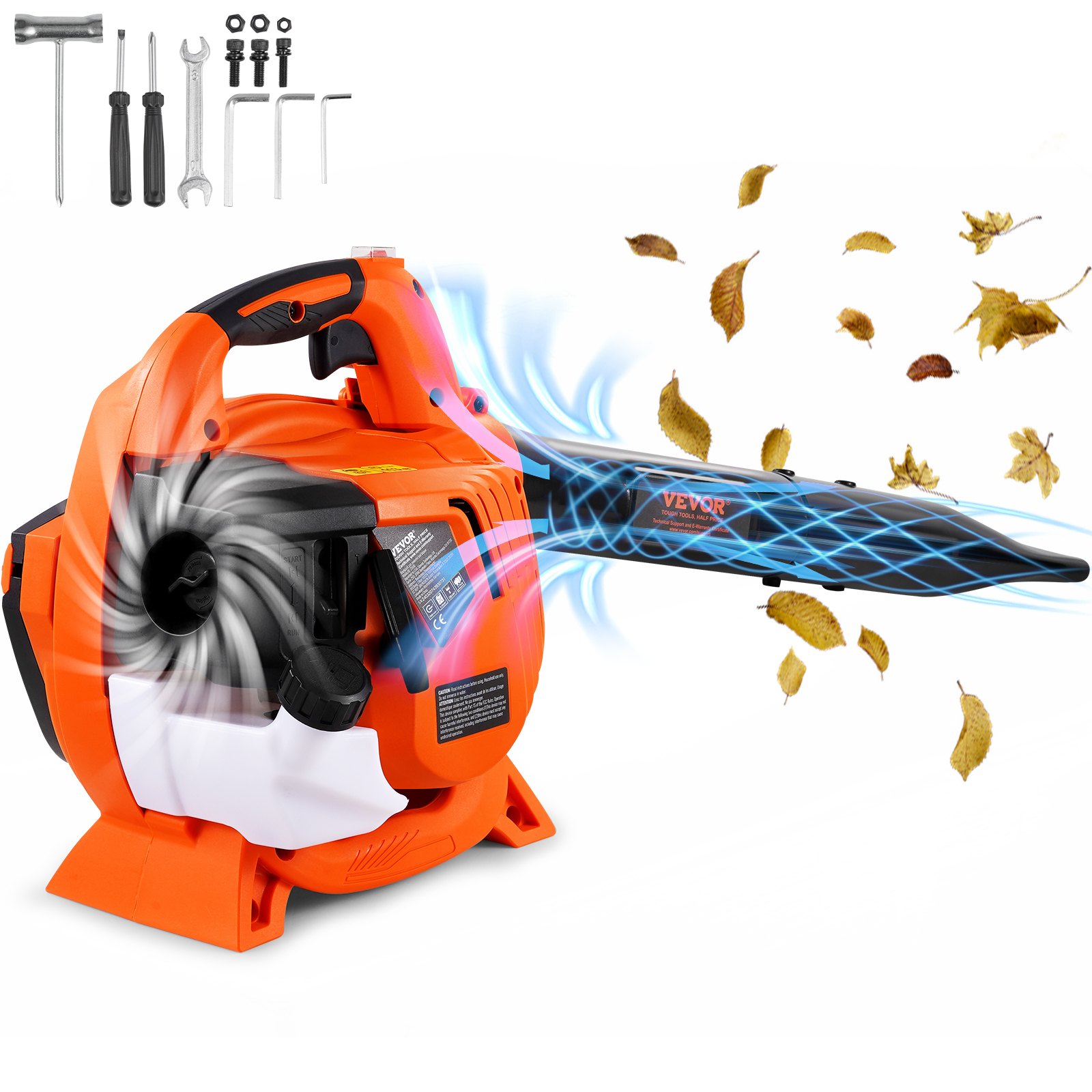 Handheld leaf blower 26 cm³, blows and sucks187,90 €View
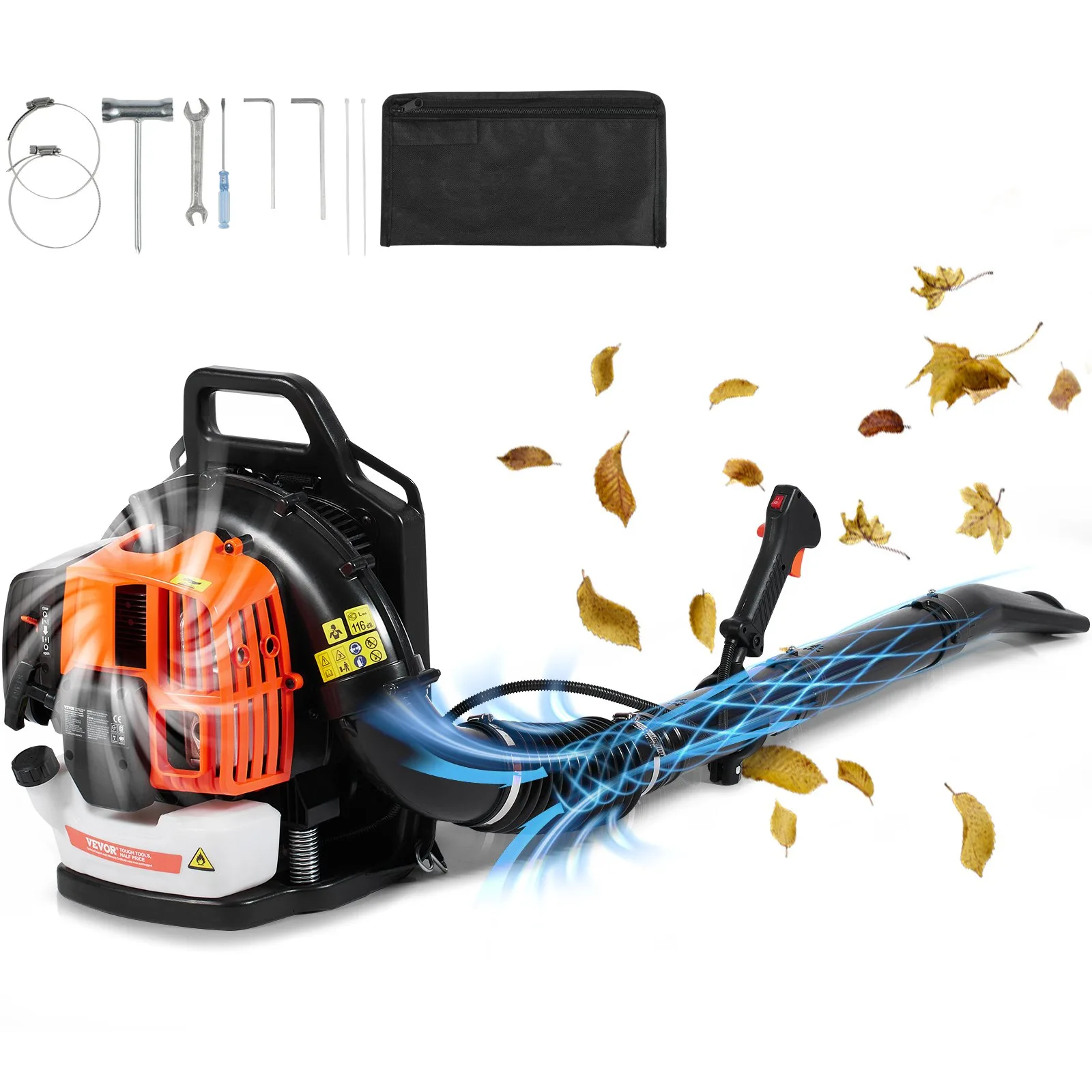 Backpack leaf blower 63 cm³, 1110 CFM262,90 €View
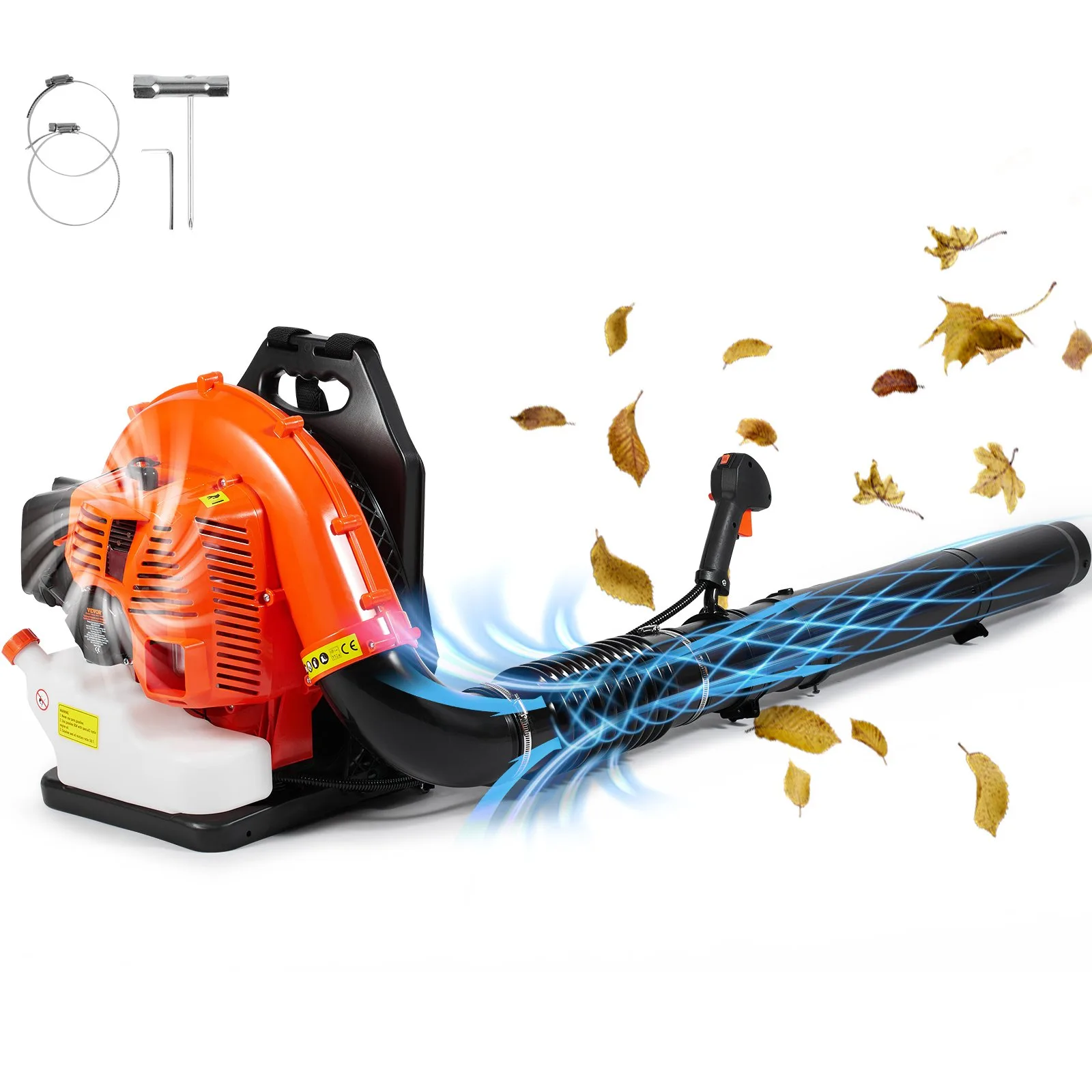 Backpack leaf blower 79 cm³, tank 3 L385,90 €View
A larger displacement is not more air
The two backpacks do not line up by engine size. A bigger engine does not always blow harder, and on these two cards it does not. The 63 cm³ machine gives 1110 CFM and an air speed of 354 km/h. The 79 cm³ machine gives 930 CFM and 296 km/h. CFM is the volume of air. Kilometres per hour is the speed of that air. They are two different figures. This page does not convert CFM into km/h, and it does not convert km/h into CFM. Both numbers, volume and speed, are larger on the smaller engine. The 79 cm³ engine does turn faster, 6800 rpm against 6500 rpm, and the air figures on that page are still the smaller ones.
What the 79 cm³ card adds is the tank. 3 litres against 1.89 litres, and the page writes a run of 95 minutes against 50–60 minutes. Those minutes are the page’s own number, not a garden measured for this guide. If the job is wet leaves and a long path, the volume of air is what counts, and that count favours the 63 cm³ machine. If the job is filling the tank less often, the tank is what counts, and that count favours the 79 cm³ machine. The higher rpm on the 79 cm³ card does not rewrite the 930 CFM or the 296 km/h. The larger tank does not rewrite them either.
The handheld sits outside that pair. Its 26 cm³, 7000 rpm, 425 CFM and 251 km/h are that card’s air figures, not a third step on the backpack scale. 425 CFM is not turned into a speed, and 251 km/h is not turned into a volume. The handheld’s tank is 0.41 litres. That page does not state a run in minutes, so no minute figure is borrowed from either backpack.
The handheld blows and sucks, the backpack only blows
The 26 cm³ machine is held in the hand. It is not worn on the back. The size with the tube is 990 × 270 × 350 mm, and the weight is 6.5 kg. The page says it blows and it sucks. In the box are a collection bag, a round suction hose and an angled suction hose, plus a flat outlet tube. Leaves and debris can be drawn into the bag, not only blown aside. The tank is 0.41 litres. A run in minutes is not on this page. Suction, the bag and the two suction hoses stay on this card. They are not read onto either backpack.
The two backpack pages do not name suction, and they do not name a bag. They have a blow tube. The 63 cm³ size is 470 × 1550 × 510 mm and the weight is 10 kg. The 79 cm³ size is 1590 × 515 × 506 mm and the weight is 11.27 kg. Each triple is left in the order the page writes it. On both backpack pages there are padded shoulder straps and a shock-absorbing back. That is a sentence about carrying. It is not a sentence about the volume of air, and it is not a sentence about kilometres per hour. The straps are not written onto the handheld card.
Weight stays where the card writes it. 6.5 kg is the handheld. 10 kg is the 63 cm³ backpack. 11.27 kg is the 79 cm³ backpack. Carrying a backpack is a question of those straps, not a claim that the backpack weighs less. The 79 cm³ machine is the heavier of the two backpacks, and both backpacks weigh more than the handheld.
What the page names as the work
On all three, the page writes wet leaves, sand, gravel and snow, and a yard, a garden, landscaping and an outdoor path. Winter snow in a greenhouse is also the page’s own sentence. It is not a separate snow machine. The 63 cm³ page adds weeds. The handheld page and the 79 cm³ page do not add that word, so weeds stay on the 63 cm³ card. None of the three is a lawn mower, and none of them is a snow blower. The snow the page names is loose material that air moves. The page does not allow milling a hard layer. This guide does not add a use the card does not name.
All three have a pull start, a choke and a cruise control that locks the setting. The page says the cruise control locks the power setting, and the choke is there for controlling the air. Ear defenders are in the kit on all three. Those lines stay on the cards that state them, which in this text is all three, and they do not add CFM above the figure already on the card. A cruise control does not turn 930 CFM into 1110 CFM. A choke does not turn 296 km/h into 354 km/h.
An oil ratio is not on the page. A two-stroke engine wants a mix, and the number that goes on the bottle is in the manual, which the page does not write out as a figure. A ratio of 1:25 is not taken from here. A ratio of 1:50 is not taken from here. No card in this trio states four-stroke. All three are two-stroke, and all three start with a pull cord. There is no electric leaf blower in this trio either.
What differs in the box
The handheld box, besides the bag and the suction hoses, has hex keys, a screwdriver, a wrench, screws, nuts, a tool bag and a small mixing bottle. The flat outlet tube is on that same card. The 63 cm³ box has a corrugated tube, a main tube, an extension, a flat nozzle, clamps, keys, a two-hole mixing bottle and a funnel. The 79 cm³ box has a mixing bottle, keys, a hose and three PE tubes. That is the 79 cm³ list. It is not lengthened with the 63 cm³ corrugated tube, main tube, extension, flat nozzle, clamps, two-hole bottle or funnel. The lists are not the same, and one machine’s bag is not inferred from another machine’s box.
A bag is not in either backpack list. The handheld’s collection bag, round suction hose and angled suction hose stay on the handheld card. The handheld’s hex keys, screwdriver, wrench, screws, nuts and tool bag are not copied into the backpack lists. The 63 cm³ flat nozzle is not the handheld’s flat outlet tube. The 79 cm³ hose in that parts list is the hose the 79 cm³ page names there. It is not rewritten as a suction hose.
The material line on the handheld and on the 63 cm³ card is PE, PA, aluminium and iron. The 79 cm³ page says aluminium and plastic. The three PE tubes are a line in the 79 cm³ box list. They do not change the 79 cm³ material line into the PE, PA, aluminium and iron line of the other two, and they do not put plastic onto the handheld or the 63 cm³ material line. A material line is not a strength grade. Horsepower is not on any of these three pages.
How to choose?
If the leaves have to go into a bag and the area is small, that is the 26 cm³ handheld. It is the only one whose page names suction and a bag. The tank is 0.41 litres, and a run in minutes is not stated. The air figures on that card are 425 CFM and 251 km/h at 7000 rpm. Those figures are not replaced with a backpack figure because the bag is useful.
If blowing is the main job and more air is what you want, that is the 63 cm³ backpack: 1110 CFM and 354 km/h, a tank of 1.89 litres, and 50–60 minutes on the page, at 6500 rpm and 10 kg. The page also adds weeds on this card only. It does not name suction, and it does not name a bag.
If filling the tank is more of a nuisance than the volume of air, that is the 79 cm³ backpack: 3 litres and 95 minutes on the page, at 6800 rpm and 11.27 kg. The air on that card is less than on the 63 cm³ machine, 930 CFM and 296 km/h. The box list on that card is a mixing bottle, keys, a hose and three PE tubes.
The oil ratio is read from the manual that comes with the machine. The product page does not give that number. A fuel-consumption percentage is not known from this text. The sales sentence that rpm increases fuel consumption is not used here as a figure, and the page does not give litres per hour.
Comparison
| Product | Price | What sets it apart |
|---|---|---|
| Handheld leaf blower 26 cm³, blows and sucks | 187,90 € | 425 CFM, 251 km/h, tank 0.41 L, 6.5 kg, with a bag |
| Backpack leaf blower 63 cm³, 1110 CFM | 262,90 € | 1110 CFM, 354 km/h, 1.89 L, 50–60 min, 10 kg |
| Backpack leaf blower 79 cm³, tank 3 L | 385,90 € | 930 CFM, 296 km/h, 3 L, 95 min, 11.27 kg |
The price in the link is the shop’s current price and opens the product.
Who is this not for?
- The 79 cm³ is not a stronger blower than the 63 cm³. A bigger engine does not always blow harder. The air figures on the 79 cm³ card are the smaller ones, 930 CFM and 296 km/h against 1110 CFM and 354 km/h.
- The backpack page does not name suction or a bag. Gathering leaves into a bag is the handheld, whose page names both.
- The page does not state an oil-and-petrol ratio. A ratio is not added here. 1:25 and 1:50 are not taken from these cards.
- None of these mows grass or mills hard snow. Air moves loose material. The snow a page names is that loose material, including the page’s sentence about winter snow in a greenhouse, and it is not a snow blower.
Frequently asked questions
Does a bigger engine blow harder?
On these two backpacks, no. A bigger engine does not always blow harder. The 63 cm³ gives 1110 CFM and 354 km/h. The 79 cm³ gives 930 CFM and 296 km/h. The 79 cm³ turns at 6800 rpm and the 63 cm³ turns at 6500 rpm, and the air figures are still smaller on the 79 cm³ card. What is larger there is the tank, 3 litres against 1.89 litres, and the page’s run, 95 minutes against 50–60 minutes. Those are not extra air.
What is the difference between CFM and kilometres per hour?
CFM is the volume of air. km/h is the speed of that air. This page does not convert one into the other. Both are larger on the 63 cm³ machine than on the 79 cm³ machine: 1110 CFM and 354 km/h against 930 CFM and 296 km/h. The handheld states its own pair, 425 CFM and 251 km/h, and that pair is not a conversion either.
Does the handheld also suck?
Yes. The page says blowing and suction, and the box has a collection bag, a round suction hose and an angled suction hose, plus a flat outlet tube. Suction stays on this card. The two backpack pages do not list suction, and they do not list a bag.
How long does one tank run?
The 63 cm³ page says 50–60 minutes from 1.89 litres. The 79 cm³ page says 95 minutes from 3 litres. The 26 cm³ tank is 0.41 litres, and that page does not say minutes. Tank time stays on the card that states it. These are the page’s numbers, not a garden measured here, and they are not turned into litres per hour.
What is the oil ratio?
The page does not say. The box has a mixing bottle, and a manual comes with the machine. The ratio that goes on the bottle is read there. A ratio of 1:25 is not taken from this guide. A ratio of 1:50 is not taken from this guide. No card among the three states the mix.
Is the engine four-stroke?
No. All three are two-stroke, and all three start with a pull cord. Four-stroke is not stated on any of these cards, so it is not added to any of them. An electric leaf blower is not in this trio either.
Does every machine have cruise control?
Yes. The page says a cruise control that locks the power setting, and a choke for controlling the air, on all three, together with a pull start. Cruise control stays on the cards that state it. It does not add CFM above the figure in the table. 1110 CFM, 930 CFM and 425 CFM stay the figures they are.
Are ear defenders in the box?
Yes. Noise-reducing ear defenders are in the kit on all three. Ear defenders stay on the cards that state them. The page does not state the noise in decibels, so no decibel figure is added.
Is the backpack lighter than the handheld?
No. The handheld is 6.5 kg. The backpacks are 10 kg and 11.27 kg. Weight stays on the card that states it. Carrying on the back is a question of the padded straps and the shock-absorbing back, which the backpack pages name. It is not a smaller weight.
What does the 79 cm³ box have less of?
The page lists a mixing bottle, keys, a hose and three PE tubes. The 63 cm³ page lists a corrugated tube, a main tube, an extension, a flat nozzle, clamps, a two-hole bottle and a funnel. The 79 cm³ list stays that list. A bag is not in either backpack’s list. The handheld’s collection bag is not moved across to fill the gap.
Can it be used on snow?
The page names snow, including winter snow in a greenhouse, together with wet leaves, sand and gravel. That is loose material the air can push. The page does not allow milling a hard layer, and none of these is a snow blower. This guide does not add a snow use the card does not name. Weeds are an extra word on the 63 cm³ page only.
Is the fuel-consumption percentage known?
No. It is unknown. The sales-text sentence that rpm increases fuel consumption is not used here as a number. The page does not give litres per hour. A percentage is not supplied to fill that gap, on the handheld or on either backpack.
What material is the machine made of?
The 26 cm³ page and the 63 cm³ page say PE, PA, aluminium and iron. The 79 cm³ page says aluminium and plastic. Those lines stay apart. The three PE tubes in the 79 cm³ box do not rewrite the material line. Horsepower is not written on any of the three.
Which backpack, if the garden is large?
If large means more air, it is the 63 cm³: 1110 CFM and 354 km/h, tank 1.89 litres, 50–60 minutes on the page. If large means filling the tank less often, it is the 79 cm³ and the 3-litre tank, 95 minutes on the page, with less air. Both are worn on the back. Neither is a vacuum with a bag. The bag and the suction stay on the 26 cm³ handheld.