
Short answer: Three home sewing machines, and none of the pages describes an overlocker: there is no knife and no cutting of the edge. The mechanical machine sews 18 stitches, among them a 4-step buttonhole. The bobbin is horizontal. Power is 42 W. Weight is 5.3 kg. Size is 410 × 160 × 305 mm. The computer machine with 60 stitches shows the choice on an LED screen. The bobbin is vertical. Power is 36 W. Weight is 5.8 kg. Size is 420 × 155 × 300 mm. That page also supports two needles. The computer machine with 200 stitches sews letters, numbers, symbols and 8 one-step buttonholes. The screen is an LCD. The bobbin is horizontal. Stitch width is up to 7 mm. Power is 36 W. Weight is 5 kg. Size is 410 × 165 × 305 mm. It also has two needles. Fabric thickness is the same on all three: the page says up to 4.06 mm, the table says up to 4 mm, and both name up to 6 layers of denim.
Products in this guide
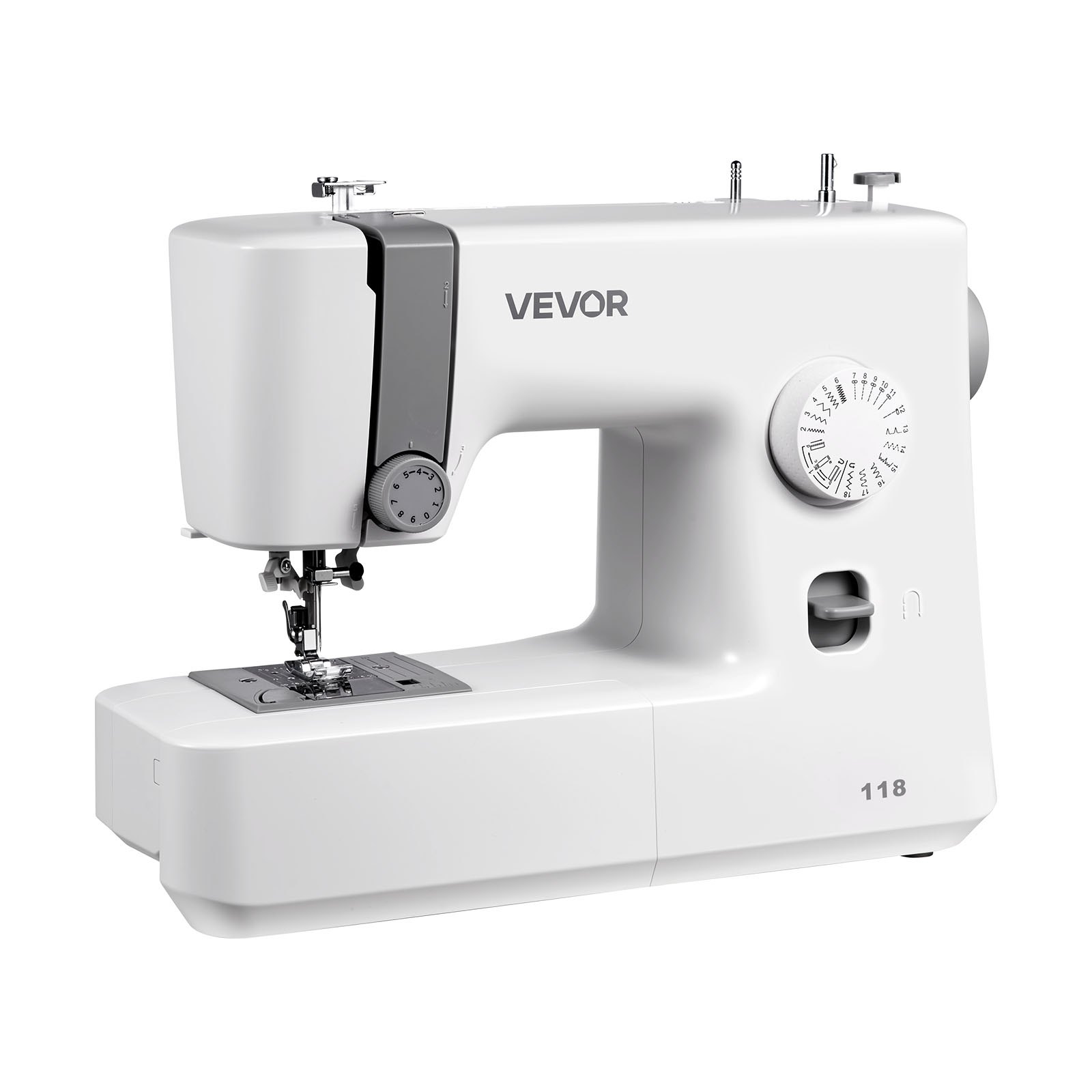 Mechanical sewing machine, 18 stitches206,90 €View →
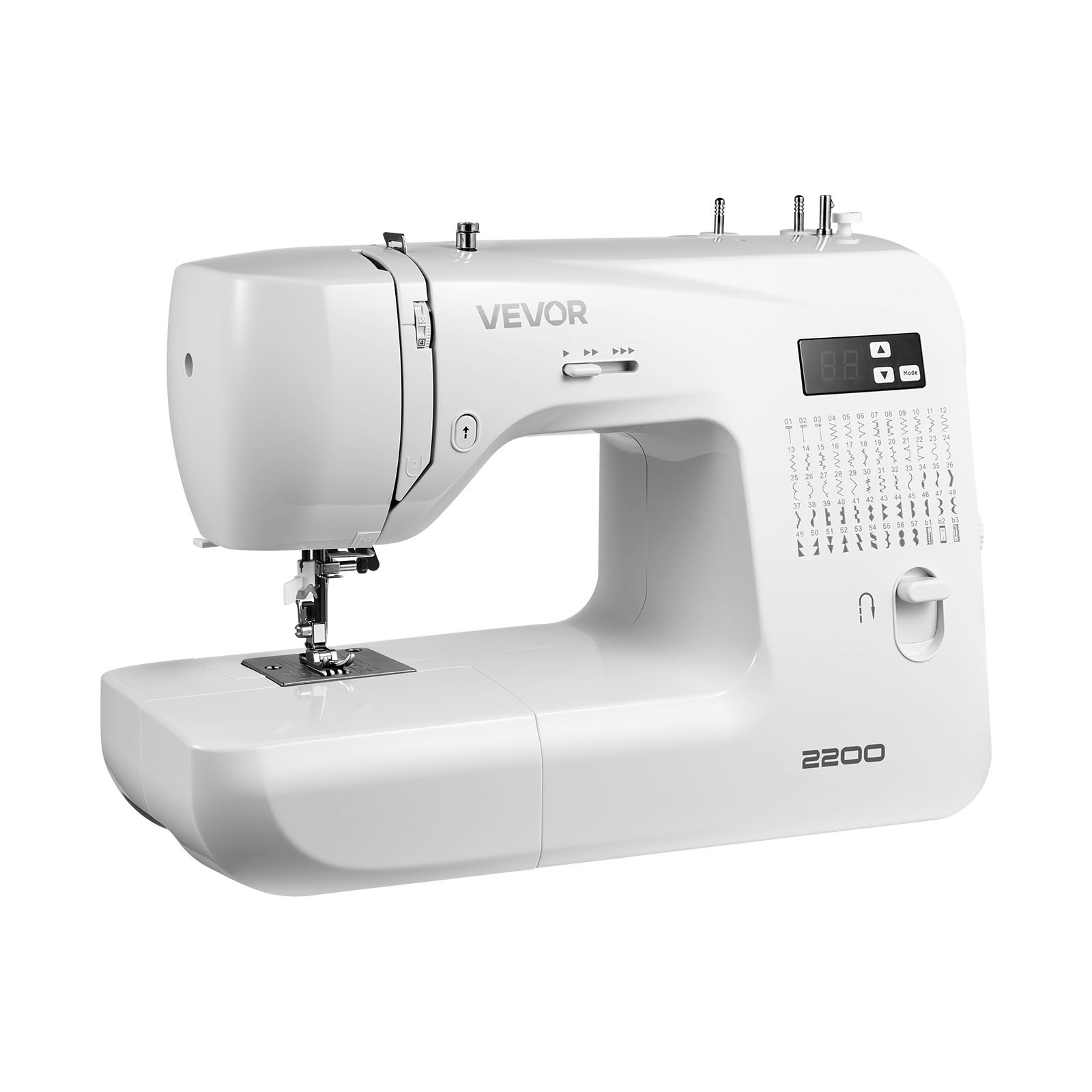 Computer sewing machine, 60 stitches, LED296,90 €View →
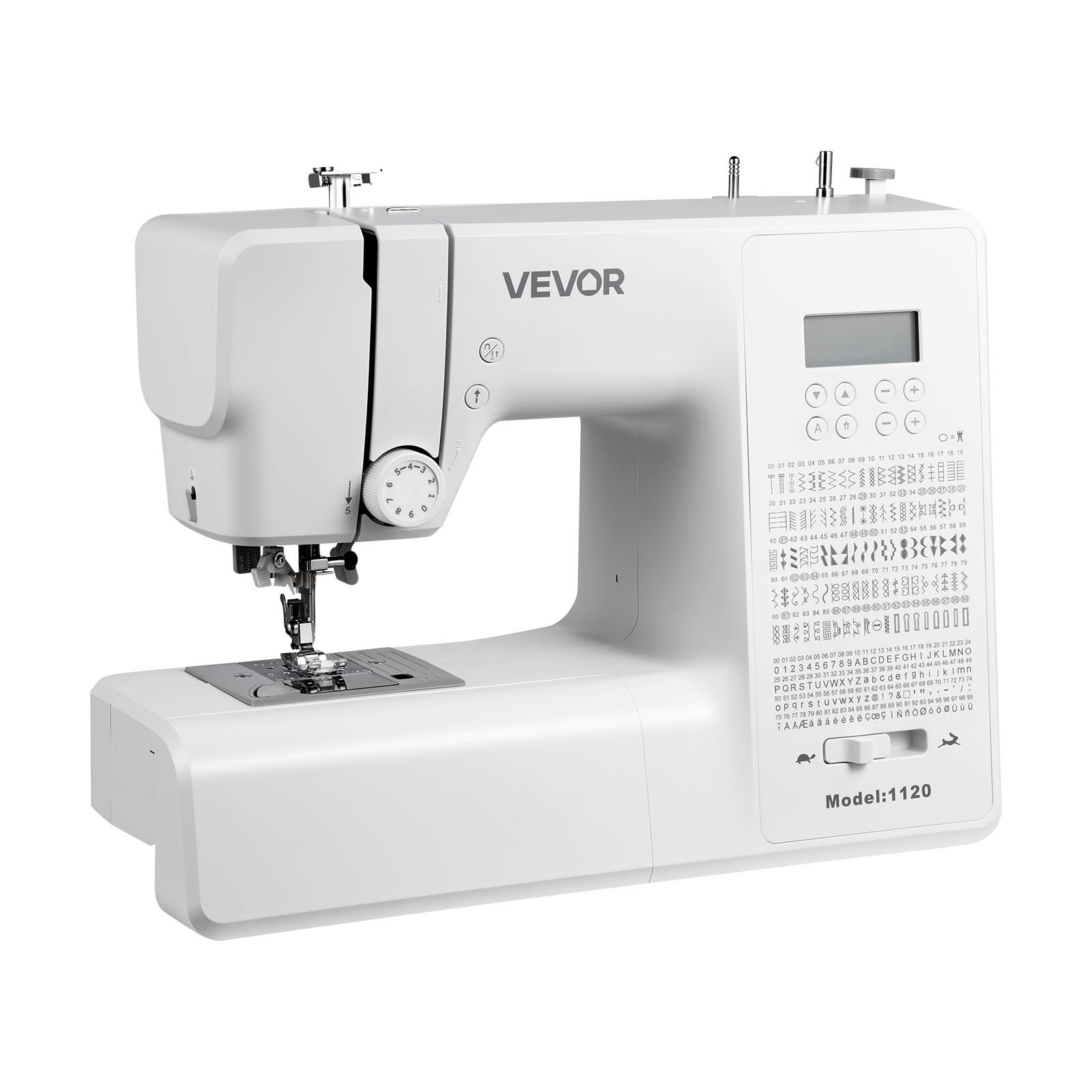 Computer sewing machine, 200 stitches, LCD319,90 €View →
Stitch count does not make the fabric thicker
All three pages allow the same fabric. The description says up to 4.06 mm. The table says up to 4 mm. Both name up to 6 layers of denim, and both name thin chiffon. 200 stitches does not cut thicker denim than 18 stitches. The extra stitches are patterns. They are not a higher fabric ceiling. The 18-stitch page already states the same 4.06 mm, the same 4 mm and the same cap of up to 6 layers of denim. A shopper who buys 200 stitches in order to sew a heavier jean than the 18-stitch card allows is reading a number the fabric row does not support.
42 W on the mechanical machine is a higher wattage than 36 W on the two computer machines. The fabric row is still the same. Watts are not turned into millimetres here. The 42 W card does not claim a thicker cloth because it draws more power, and the 36 W cards do not claim a thinner cloth because they draw less. The thickness stays the row that was written: up to 4.06 mm in the description, up to 4 mm in the table, up to 6 layers of denim, and thin chiffon.
Presser-foot lift is 5.5 mm on the mechanical machine and on the 200-stitch machine, and 5 mm on the 60-stitch machine. That figure is how high the foot rises. It is not a new ceiling for the cloth. The fabric row stays about 4 mm, written exactly as 4.06 mm and as 4 mm. A foot that lifts to 5.5 mm does not rewrite the table into 5.5 mm of fabric, and a foot that lifts to 5 mm does not rewrite it either.
Stitch length is up to 4 mm on the first two machines and up to 4.5 mm on the 200-stitch machine. Stitch width is up to 5 mm on the first two machines and up to 7 mm on the 200-stitch machine. The wider stitch is the width of the zigzag. It is not a thicker fabric. 7 mm is a stitch-width row on the 200-stitch page. It does not move onto the 18-stitch page or the 60-stitch page, and it does not change the denim line those pages share.
Buttonhole, letters and the screen
The 18-stitch machine makes a 4-step buttonhole. The page names a straight stitch, a zigzag and a decorative zigzag. This machine has no screen. The choice is made with a button, and the length and the width are preset. There is no LED screen and no LCD on this card. The work light is a separate line from the screen that is absent here.
The 60-stitch machine shows the choice on an LED screen. The page names basic stitches, stretch stitches, decorative stitches and buttonhole stitches. It does not say how many buttonholes there are, and it does not say whether the hole is one-step. That count is not copied across from the 200-stitch machine. Eight one-step buttonholes stay on the page that wrote them. The 60-stitch page says a buttonhole stitch exists, and it stops there.
The 200-stitch machine is the only one whose page names letters, numbers and symbols, and 8 one-step buttonholes. The choice is on an LCD screen. A letter on this page is a stitch. It is not an embroidery machine that moves a hoop under the fabric by itself. The page does not describe that hoop. Buying the 200-stitch card for a self-moving embroidery frame is reading a tool the page never lists. The letters, the numbers and the symbols stay stitches you select on the LCD.
Bobbin, two needles and the free arm
A horizontal bobbin is on the 18-stitch machine and on the 200-stitch machine. The page says the thread can be seen from there and can be changed. A vertical bobbin is on the 60-stitch machine, together with a vertically oscillating hook. The page’s point for that hook is to reduce the thread jamming. The hook does not change the fabric thickness. Horizontal stays on the two pages that wrote horizontal. Vertical stays on the page that wrote vertical. The 60-stitch machine is not given a horizontal bobbin, and the other two are not given the oscillating hook.
Two needles are named only on the 60-stitch page and the 200-stitch page. The 18-stitch page does not name two needles. Two needles are not assumed for the mechanical machine because the other two cards name them. If the job needs two needles, the page that has to say so is the 60-stitch page or the 200-stitch page.
All three have an automatic needle threader, an LED light, adjustable thread tension and a free arm. The free arm is the same description on each page: the accessory box comes off so you can sew a cuff, a sleeve, a trouser hem, a collar and a cylindrical piece, for example a pillow cover. Self-threading on these cards is the needle threader. It is on every one of the three. It is not an overlocker thread path, and it is not withheld from the mechanical machine. The light at the stitch is an LED on all three. That lamp is the light on the work. It is not the selection screen. The 18-stitch machine has the lamp and does not have a screen. The 60-stitch machine has the lamp and an LED screen. The 200-stitch machine has the lamp and an LCD screen.
Speed is up to 700 stitches a minute on all three, with a pedal. A low speed of 150 stitches a minute is written on the two computer machines. The mechanical page writes 700. It does not write 150. The low speed stays on the cards that state it.
What is not here in place of an overlocker
An overlocker cuts the edge of the fabric and sews that edge in the same pass. None of these three pages describes a knife, a cut edge or an overlock loop. When the job is closing the raw edge of a knit with an overlocker, that machine is not in this guide. The zigzag the 18-stitch page names is a zigzag. It is not the same thing as an overlocker. A decorative zigzag does not become a knife because the stitch looks busy. 18 stitches, 60 stitches and 200 stitches are stitch counts on home sewing machines. None of those counts is an overlocker feature the page forgot to title.
All three have a metal frame. The 60-stitch page and the 200-stitch page add a stainless-steel base. The 18-stitch page does not add that base. The stainless-steel line stays on the two computer machines. The mechanical machine keeps the metal frame the page gave it, without a stainless-steel base pasted on from the others.
Colour and weight are on the pages as three separate rows. The 18-stitch machine is white and grey, and it weighs 5.3 kg. The 60-stitch machine is white, and it weighs 5.8 kg. The 200-stitch machine is white, and it weighs 5 kg. None of them is an industrial machine. The page says home sewing machine. The model numbers on the pages are 118, 2200 and 1120, in the same order as the 18-stitch machine, the 60-stitch machine and the 200-stitch machine. An industrial speed above 700 stitches a minute is not given. 700 is the top the pages write, with the pedal, and the computer pages also write the low step of 150.
How to choose
When the work is a straight stitch, a zigzag and a 4-step buttonhole, with no screen, the machine is the 18-stitch one. Power on that card is 42 W. The bobbin is horizontal. Two needles are not on that page. Weight is 5.3 kg, and the size is 410 × 160 × 305 mm. The price on the card is 206,90 €.
When the work wants 60 stitches, an LED screen, a vertical bobbin and two needles, the machine is the middle one. The page does not state how many buttonholes, and it does not state whether the hole is one-step. Power is 36 W. Weight is 5.8 kg. Size is 420 × 155 × 300 mm. The price on the card is 296,90 €.
When the work wants letters, numbers, symbols and 8 one-step buttonholes, and a stitch width up to 7 mm, the machine is the 200-stitch one. The fabric does not get thicker because of that stitch count. The denim line stays up to 6 layers, the description stays up to 4.06 mm, and the table stays up to 4 mm. Power is 36 W. Weight is 5 kg. Size is 410 × 165 × 305 mm. The bobbin is horizontal, the screen is an LCD, and two needles are on this page. The price on the card is 319,90 €.
When the edge has to be cut and closed with an overlocker, none of these three pages does that job. There is no knife and no overlock loop to choose instead.
Comparison
| Product | Price | What sets it apart |
|---|---|---|
| Mechanical sewing machine, 18 stitches | 206,90 € | 4-step buttonhole, horizontal bobbin, 42 W, 5.3 kg |
| Computer sewing machine, 60 stitches, LED | 296,90 € | LED screen, vertical bobbin, two needles, 36 W, 5.8 kg |
| Computer sewing machine, 200 stitches, LCD | 319,90 € | letters and 8 one-step buttonholes, width 7 mm, 36 W, 5 kg |
The price in the link is the shop’s current price, and it opens the product.
Who this is not for
- None of these is an overlocker. The page does not describe a knife or cutting the edge.
- 200 stitches does not sew thicker fabric than 18 stitches. The fabric ceiling on every machine is about 4 mm: up to 4.06 mm in the description and up to 4 mm in the table.
- 42 W does not mean thicker fabric. The fabric row is the same as on the 36 W machines.
- Letters on the 200-stitch machine are not an embroidery hoop that moves under the fabric by itself.
Frequently asked questions
Is any of them an overlocker?
No. The three pages describe a home sewing machine. There is no knife, no cutting of the edge and no overlock loop. A zigzag does not stand in for an overlocker. 18, 60 and 200 stitches do not change that.
Does 200 stitches sew thicker denim?
No. All three have the same ceiling: up to 4.06 mm in the description, up to 4 mm in the table, and up to 6 layers of denim. The stitch count is patterns, not thickness. The 200-stitch card does not claim a heavier denim than the 18-stitch card.
Why is the 18-stitch machine 42 W and the others 36 W?
That is how the pages are written. 42 W stays on the mechanical card. 36 W stays on each of the two computer cards. The fabric-thickness row is the same even so. A thicker cloth is not inferred from the watts.
What is the difference in the buttonhole?
The 18-stitch machine makes a 4-step buttonhole. The 200-stitch machine makes 8 one-step buttonholes. The 60-stitch page says a buttonhole stitch is there, and it does not say the count or the step. The figure 8 is not copied onto that page.
Which one has letters?
Only the 200-stitch machine. The page names letters, numbers and symbols. It does not describe an embroidery hoop that moves by itself. A letter here is a stitch selected on the LCD.
What is the difference between a horizontal and a vertical bobbin?
A horizontal bobbin is on the 18-stitch machine and on the 200-stitch machine, and the thread can be seen. A vertical bobbin and an oscillating hook are on the 60-stitch machine. The page ties that hook to reducing thread jams, not to thicker fabric.
Do all of them have two needles?
No. Two needles are named on the 60-stitch page and the 200-stitch page. The 18-stitch page does not name them. The pair stays on the cards that state it.
How fast do they sew?
All three sew up to 700 stitches a minute, with a pedal. A low speed of 150 stitches a minute is written on the two computer machines. The mechanical page writes 700. It does not write a speed above 700, and it does not write 150.
What is a free arm?
The accessory box comes off. The page names a cuff, a sleeve, a trouser hem, a collar and a cylindrical piece, for example a pillow cover. The free arm is on all three machines. It is not withheld from the mechanical one, and it is not an overlocker.
Does the needle thread itself?
An automatic needle threader is on all three. That is the self-threading these cards state. It is not an overlocker thread path, and it is not limited to the machines that have a screen.
Does every machine have a screen?
No. The 18-stitch machine has no screen. The 60-stitch machine has an LED screen. The 200-stitch machine has an LCD. The light on the stitching is an LED on all three, and that lamp is not the selection screen.
How high does the foot lift?
5.5 mm on the mechanical machine and on the 200-stitch machine, and 5 mm on the 60-stitch machine. The fabric ceiling stays about 4 mm. The foot lift does not rewrite that row. The exact fabric lines remain 4.06 mm in the description and 4 mm in the table.
What colour are they, and how heavy?
The 18-stitch machine is white and grey, at 5.3 kg. The 60-stitch machine is white, at 5.8 kg. The 200-stitch machine is white, at 5 kg. The widths sit at about 410–420 mm: 410 mm, 420 mm and 410 mm on the three size rows.
Is any of them an industrial machine?
No. The page says home sewing machine. The model numbers are 118, 2200 and 1120. The page does not give an industrial sewing speed above 700 stitches a minute. None of the three cards calls itself an industrial machine.