
Short answer: Three brewers, and the choice is not 13 litres or 60 litres with an empty gap between them. The N30 page writes a 35-litre pot, a 34.8-litre pot, and up to 30.3 litres of beer. The table writes a pot volume of 35 L, a total brew of 30 L, and a capacity of 30 L. Power is 100–2500 W in steps of 100 W. Temperature is 25–100 °C, with a calibration of ±10 °C. The time row is 1–180 minutes. Malt for mashing is up to 7.98 kg, and malt for saccharification is up to 8.48 kg. The coil is 8.78 m in the text and 8.8 m × 48.5 cm in the table. Voltage is 220 V / 50 Hz. The package weighs 14.7 kg, and there is no net-weight row. The DM-N60 is 60 L, and the total volume is 60.6 L. The table power is 3000 W. The panel on the same page is 100–1800 W. Those two figures are not added together. Voltage is 220–240 V, 50–60 Hz. Net weight is 14.4 kg. The MBL-H-10A table writes a volume of 13 L and an output of 10 L. The text writes up to 9.99 L, and in brackets 10 litres. Power is 1500 W. Weight is 22.9 kg. This is the only page that names mashing, boiling, cooling, fermentation, dispensing and bottling. The time on that page is 5–12 days. There are 14 recipes, a tap, and 5 °C. Voltage is not on that page.
Products in this guide
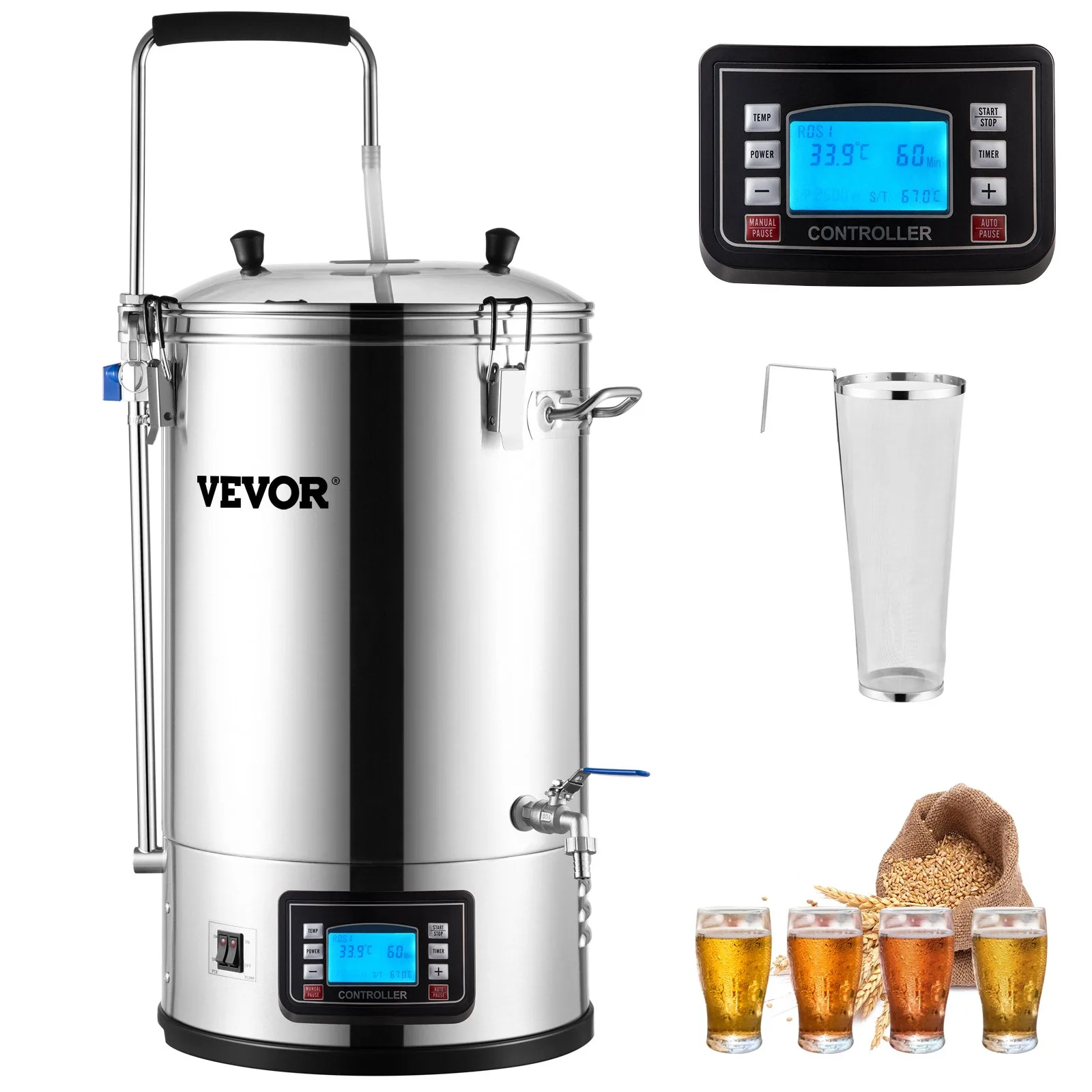 Brewer N30, 30 L in the table, 100–2500 W415,90 €View →
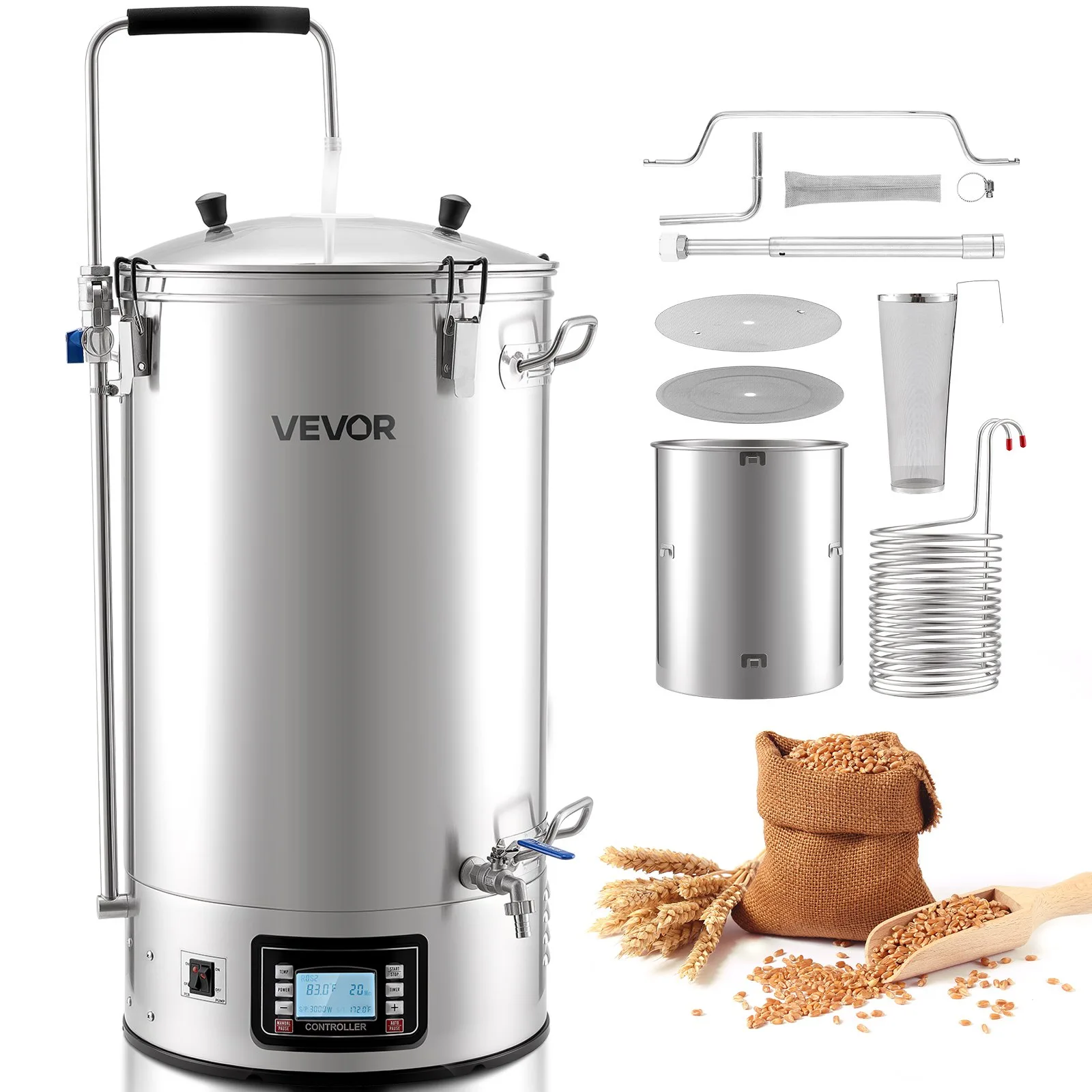 Brewer DM-N60, 60 L, 3000 W and panel 1800 W440,90 €View →
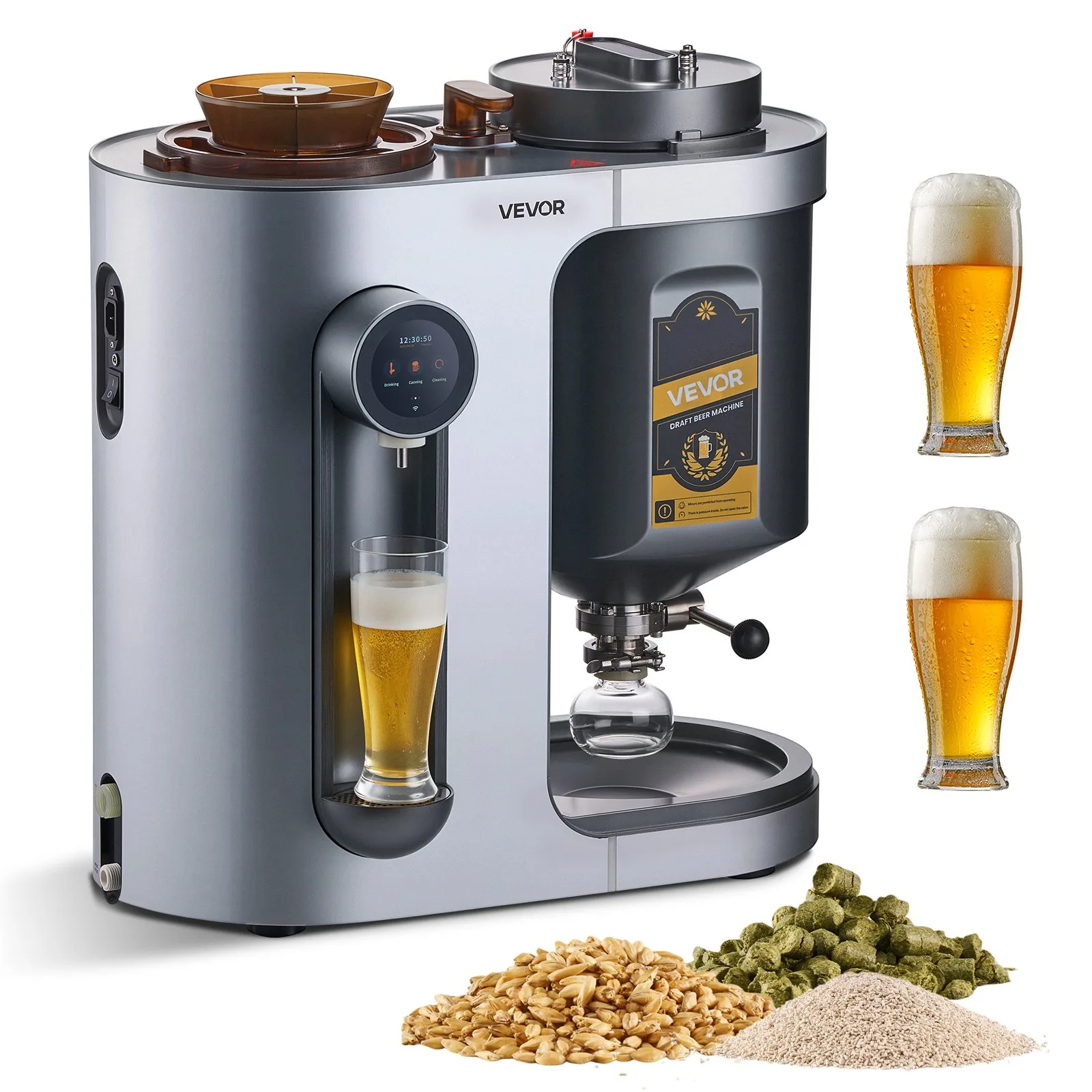 Brewer MBL-H-10A, 13 L / 10 L, ferments2 268,90 €View →
A litre on the page is not one row
The N30 carries five litre figures, and they do different jobs. The text writes 35 L. The table’s pot row also writes 35 L. The text writes 34.8 L as well. The text then writes up to 30.3 L of beer. The table writes 30 L on two further rows, one for the brew and one for capacity. 35 L stays 35 L. 30 L stays 30 L. 34.8 L stays 34.8 L. 30.3 L stays the beer figure the text actually prints. The page does not say which of those rows is the wort you are allowed to fill. A title that a shopper remembers as “30 litres” has not cancelled the pot row. A pot row of 35 L has not cancelled the beer row.
The DM-N60 writes a 60 L tank and a total volume of 60.6 L. Both stay. The table row that carries 60.6 L is named the usable beer-sugar volume. The text’s total volume is 60.6 L as well. 60 L is the tank figure. 60.6 L is the other figure, with that row name on it. Rounding 60.6 down and calling the machine simply 60 L drops a line the page printed. Stretching 60 L up and calling the tank 60.6 L does the same thing in the other direction. The page wrote both, so the guide keeps both.
The MBL-H-10A title and the volume row are 13 L. The output row is 10 L. The text writes up to 9.99 L, and in brackets it writes 10 litres. 13 L is the volume row. It is the vessel figure on the card. The output the page states is 10 L, and the prose cap is 9.99 L with 10 litres in the brackets. A 13 L machine, on this card, does not claim 13 litres of beer in the glass. The card claims 13 L as volume, then limits the output to 10 L and the text to 9.99 L (10 litres). Those three numbers are three rows. They are not three ways of saying one portion.
Malt in kilograms is on the two larger pages only. The N30 writes mashing up to 7.98 kg and saccharification up to 8.48 kg. Those are two caps. 7.98 kg is the mash figure. 8.48 kg is the saccharification figure. They are not one malt number printed twice. The DM-N60 writes up to 15.0 kg of malt per batch. The MBL-H-10A does not state a malt weight in kilograms. A kilo taken from the N30 or from the DM-N60 does not move onto the small machine.
Beer styles are named on one page. The DM-N60 names lager, IPA, ale, porter and stout. The N30 page does not carry that list. The MBL-H-10A page does not carry that list. The styles stay on the DM-N60, which is the page that wrote them.
3000 W and 1800 W are two rows on the same page
The N30 power row is one row. Text and table both write 100–2500 W, in steps of 100 W. There is no second power figure on that page to reconcile with the first. The step belongs to the N30. It is not copied onto the other two machines.
The DM-N60 table says 3000 W. The title says 3000 W. The control panel on the same page says 100–1800 W. The page does not explain how 3000 W and 1800 W sit together. It does not add them. It does not say that the panel range is a slice that sums to 3000 W. It does not say that 3000 W replaces the panel, or that the panel replaces the table. Both rows stay: 3000 W on the table and in the title, 100–1800 W on the panel. A shopper who keeps only the title has dropped the panel. A shopper who keeps only 1800 W has dropped the table and the title.
The MBL-H-10A is 1500 W. That figure stands alone. The page does not give it a range, a step, or a second wattage on a panel. 1500 W is not 2500 W, and it is not 3000 W. It is the small machine’s single power row.
Voltage is written on two pages. The N30 is 220 V / 50 Hz. The DM-N60 is 220–240 V and 50–60 Hz. The MBL-H-10A table does not write volts. 220 V is the N30 row. It is not a row on the small machine, and this guide does not borrow it. A socket check for the MBL-H-10A has nothing on the card to read.
Temperature at 25–100 °C is on the two larger pages. The N30 adds a calibration of ±10 °C. The DM-N60 does not write that plus-or-minus. The same 25–100 °C span is not a licence to paste ±10 °C onto the DM-N60. The MBL-H-10A does not give a brewing temperature range at all. The 5 °C on that page is cooling after fermentation. It is not a mash step, and it is not the bottom of a 25–100 °C scale. The two larger pages do not carry 5 °C.
The N30 time row is 1–180 minutes. That is the setting the page prints. The page does not call 1–180 minutes the length of a finished beer, and this guide does not turn the row into one. The only minutes-to-temperature line in the whole set is on the DM-N60, further down, and the page labels that line as reference data.
Only one machine ferments and dispenses
The MBL-H-10A text names six jobs: mashing, boiling, cooling, fermentation, dispensing and bottling. Hops go in automatically. The tap is electric. The bottle is 28 mm, with counter-pressure. The time the page gives is 5–12 days. There are 14 recipes, and there is a make-it-yourself mode besides those presets. The sentence “99% success rate” is a sentence on this page. It is not a test result the page shows. The N30 does not carry that sentence. The DM-N60 does not carry that sentence. The percentage stays where it was written, as a line of page text, and it is not treated here as a measured rate.
The N30 and the DM-N60 are mash-and-boil pages. Both have seven programmable stages. Both have 10 recipes. On both, hop addition is a reminder. The page tells you to add the hops. It does not add them. That reminder is not the automatic hop dose on the MBL-H-10A, and the automatic dose is not copied back onto the two larger machines.
The cooling coil is written in two places on the N30 and in one place on the DM-N60. The N30 text says 8.78 m. The N30 table says 8.8 m × 48.5 cm. 8.78 m and 8.8 m both stay, because the page wrote both. The DM-N60 text says 8.78 m, and the DM-N60 table does not give a coil measurement. The MBL-H-10A does not name a coil. A length taken from the N30 table, including the 48.5 cm, does not move onto a page that left the coil out.
Fermentation days, 5 °C and a tap are on the MBL-H-10A. They are absent from the N30 and from the DM-N60. A circulation pump is named on both of the larger machines. The MBL-H-10A does not name a pump. The pump stays on the pages that wrote it.
Weight, steel and where it stands
22.9 kg is the net weight of the machine with the smallest litre row, and it is the heaviest net weight of the three. That machine is the MBL-H-10A. The DM-N60 net weight is 14.4 kg. The N30 writes a package weight of 14.7 kg and does not write a net weight. 14.7 kg is the weight of the pack. It is not a net figure to set beside 14.4 kg, and it is not a net figure to set beside 22.9 kg. The missing net row stays missing.
Three size rows are printed with these machines: 42.0 × 35.5 × 82 cm, 480 × 450 × 920 mm and 600 × 310 × 640 mm. Three cartons are printed too: 71.0 × 43.0 × 45.0 cm, 81.0 × 47.0 × 47.0 cm and 74.0 × 45.0 × 68.3 cm. Those six lines are not captioned with N30, DM-N60 or MBL-H-10A. A centimetre stays in the list. It is not hung on one model by a guess about which body looks tallest.
Steel is not one grade across the set. The N30 is 304, at a thickness of 0.51 mm. On the DM-N60, the part that touches the wort is 304 and 0.5 mm, the body is 304, and the base is 201. 0.51 mm and 0.5 mm stay apart. They are two thicknesses on two pages. The base grade 201 stays on the DM-N60, which is the page that wrote a 201 base. The MBL-H-10A does not state a steel thickness. Double insulation is one sentence, and that sentence is on the DM-N60. It is not on the N30, and it is not on the MBL-H-10A.
The place the page allows is not the same list twice. The N30 names the kitchen, the cellar, the garage and the terrace. The DM-N60 names the kitchen, the garage and the terrace. The cellar is on the N30 list. It is not on the DM-N60 list. The MBL-H-10A page does not give this room list.
≤130 minutes to 98 °C belongs only to the DM-N60, and the page calls it reference data. It is not a brew time this guide invents for a finished batch. It is not a time on the N30, whose own time row is the separate 1–180 minute setting. It is not a time on the MBL-H-10A, whose stated span is 5–12 days. The reference-data label stays on the sentence. The minutes are not promoted into a promise, and they are not copied onto a page that does not have them.
How to choose
When the page you need is the one that states 100–2500 W, 220 V / 50 Hz, a 35 L pot and a 30 L brew, that page is the N30. Malt is 7.98 kg and 8.48 kg. The coil is 8.78 m and 8.8 m. The package weight is 14.7 kg, and a net weight is not there. Fermentation is not there. The price on the card is 415,90 €.
When the page you need is the one that states 60 L and 60.6 L, with 3000 W in the table and 100–1800 W on the panel, that page is the DM-N60. The net weight is 14.4 kg. Voltage is 220–240 V, 50–60 Hz. Malt is 15.0 kg. Fermentation is not there. The price on the card is 440,90 €.
When the machine has to ferment on its own, cool to 5 °C and fill a 28 mm bottle, that machine is the MBL-H-10A. Volume is 13 L. Output is 10 L. The text is 9.99 L. Power is 1500 W. Weight is 22.9 kg. Voltage is not on the page. The span is 5–12 days, and there are 14 recipes. The price on the card is 2 268,90 €.
13 L is not the output. 3000 W does not erase the panel’s 1800 W. 35 L is not 30 L.
Comparison
| Product | Price | What sets it apart |
|---|---|---|
| Brewer N30, 30 L in the table, 100–2500 W | 415,90 € | 7.98 and 8.48 kg, coil 8.78 m and 8.8 m, package weight |
| Brewer DM-N60, 60 L, 3000 W and panel 1800 W | 440,90 € | 60.6 L, 201 base, ≤130 min is reference data |
| Brewer MBL-H-10A, 13 L / 10 L, ferments | 2 268,90 € | 5–12 days, 5 °C, tap, 28 mm, no voltage |
The price in the link is the shop’s current price, and it opens the product.
Who this is not for
- The choice is not 13 L or 60 L. In the middle is the N30, whose table says 30 L and 35 L.
- 13 L is the volume row. The output is 10 L, and the text also has 9.99 L.
- The DM-N60 table’s 3000 W does not erase the panel’s 100–1800 W.
- Fermentation, the tap and 5 °C are only on the MBL-H-10A page.
Frequently asked questions
How many litres is the N30?
The text says 35 L, 34.8 L and up to 30.3 L. The table says a pot of 35 L, and a brew and a capacity of 30 L. All of them stay. The page does not pick one of those rows as the wort you may fill.
Is 60 L the same as 60.6 L?
The page writes both. 60 L is the tank. 60.6 L is the total volume in the text, and it is also the table row named usable beer-sugar volume. One figure does not replace the other.
Does the 13 L machine make 13 litres of beer?
The volume row is 13 L. The output is 10 L. The text says up to 9.99 L, and in brackets 10 litres. The card states 13 L as volume and then limits what comes out. 13 litres of beer is not the output the page claims.
Why 3000 W and 1800 W?
The DM-N60 table says 3000 W, and the title says 3000 W. The panel on the same page says 100–1800 W. The page does not join those rows, and it does not add them.
What voltage?
The N30 is 220 V / 50 Hz. The DM-N60 is 220–240 V, 50–60 Hz. The MBL-H-10A does not state volts. 220 V is not that machine’s row.
Which one ferments?
Only the MBL-H-10A. The page gives 5–12 days, automatic hops, a tap, 5 °C and a 28 mm bottle. On the two larger machines, hop addition is a reminder, not an automatic dose. Those two pages do not state fermentation days, 5 °C or a tap.
How many recipes?
10 recipes are on the N30 and on the DM-N60. 14 presets and a make-it-yourself mode are on the MBL-H-10A.
How much malt?
N30: up to 7.98 kg for mashing and up to 8.48 kg for saccharification. Those are two caps. DM-N60: up to 15.0 kg per batch. The MBL-H-10A does not state a weight in kilograms.
How long is the cooling coil?
N30 text: 8.78 m. N30 table: 8.8 m × 48.5 cm. DM-N60 text: 8.78 m, and the table has no coil measurement. The MBL-H-10A does not name a coil.
What temperature?
25–100 °C is on the two larger machines. The N30 adds a calibration of ±10 °C. The DM-N60 does not write that plus-or-minus. 5 °C is only the MBL-H-10A cooling after fermentation, and that page does not give a brewing temperature range.
How heavy?
22.9 kg is the MBL-H-10A, the heaviest net weight and the smallest litre row. 14.4 kg is the DM-N60 net weight. 14.7 kg is the N30 package weight, not a net weight.
What steel?
The N30 is 304, at 0.51 mm. The DM-N60 is 304 and 0.5 mm where it meets the wort, the body is 304, and the base is 201. The MBL-H-10A does not state a thickness. 0.51 mm and 0.5 mm stay as two figures.
Is the 99% measured?
It is a sentence on the MBL-H-10A page. The page does not show a test result. The other two pages do not have that sentence. The line stays as page text, not as a measured rate.
How long to reach 98 degrees?
≤130 minutes is only on the DM-N60, and the page calls it reference data. That time is not on the other two machines. It is not a brew time added for them, and the N30’s separate 1–180 minute row is a setting, not this 98 °C line.