
Short answer: for an adult beginner, or a school-age child who simply wants to start playing, 61 keys are enough. The set that saves the most time and money is the one that already has the stand, the stool and the headphones in the box. If the child takes piano at music school, or you already know you want to play classical piano later, take 88 keys now. The live shop prices are on the cards below: 61-key sets with a stand and a stool run from 140,90 € to 224,90 €, and the folding 88-key model is 173,90 €.
Shop language mixes the words up: synthesiser, keyboard, electric piano, digital piano and electronic keyboard. In everyday speech they mean the same thing: an electric instrument with a keyboard, built-in speakers and a lot of sounds. In this guide the 61-key instrument is called a synthesiser, because that is the word people search for most. The 88-key instrument, the one that is closer to a piano, is called a digital piano. Weighted hammer-action digital pianos for music school have their own guide, on choosing a digital piano for a music-school child.
61 or 88 keys?
The number of keys is the first choice and the most important one, because you cannot change it later. Everything else — sounds, rhythms, lights and connections — is an extra. The right number of keys depends on what you are going to play and how much room there is at home.
Who 61 keys are enough for
61 keys are five octaves. That covers almost every song, pop music, accompaniment and the first couple of years of learning. Two hands sit comfortably side by side, and most beginner books and apps are written for a keyboard of exactly this size. A 61-key instrument is about a metre wide, so it fits in a child’s room, in the corner of a bedroom or beside a desk.
61 keys are a good fit when:
- an adult wants to try, for themselves, whether a keyboard is their instrument;
- a child of 7–12 wants to play songs, and is not yet on a classical piano syllabus;
- the instrument is meant as a gift and the budget stays with a 61-key set;
- space is tight, or the instrument has to go back into a corner after playing.
When to take 88 keys straight away
88 keys are the full range of a piano. A music-school piano syllabus, classical pieces and later exams assume a full keyboard and keys that feel like a piano. If the child is already in piano lessons, do not buy 61 keys “for now”. A few months later the teacher will ask for a larger instrument and you will have bought twice. An adult who played the piano as a child and wants to bring old pieces back also gets a better feel from 88 keys.
An 88-key instrument is about 1.3 m wide. Where space is short, there are folding 88-key digital pianos that fold up and go into a cupboard in a bag.
Key feel: touch-sensitive, semi-weighted or hammer
The second big difference is how the key feels under the finger. It matters for learning, because the hand gets used to exactly that feel.
A touch-sensitive keyboard
A touch-sensitive keyboard (also called velocity-sensitive) means a harder press makes a louder sound and a softer press a quieter one. That is a basic property of the piano, and it matters a great deal to a beginner: without it every note sounds the same and playing feels like a toy. Choose at least a touch-sensitive keyboard. The mano 61-key set with a stand and a stool, for example, has a touch-sensitive keyboard with 7 velocity levels.
Semi-weighted keys
Semi-weighted keys have a spring that gives the finger a little resistance. That is a step toward a real piano: the hand does more work, and moving across to a piano later is easier. Semi-weighted keys are a good choice for an adult, and for a child who plays every day but is not in music school yet.
Hammer-action weighted keys
Hammer action copies the hammers of a real piano: the low keys are heavier and the high keys are lighter. That is what a music-school teacher recommends. Those instruments are heavier, usually on a furniture-style stand, and they cost more. If that is your choice, read the guide to a digital piano for a music-school child.
What has to be in the set
The most common mistake is to buy only the instrument and then discover, at home, that there is nowhere to put it and nothing to sit on. People search separately for a “keyboard stand”, “keyboard legs” and a “keyboard pedal”. A set that already includes them is almost always cheaper than buying every piece on its own.
Stand and stool: the right height
Playing on a table or on a bed is a bad idea. The arms are at the wrong height, the shoulders tighten and practice gets tiring fast. While you play, the forearms should be about level with the keyboard and the wrists straight. An adjustable stand and an adjustable stool solve that for a child and for an adult. In the mano 61-key sets the stand is 56–68 cm and the stool is 34–48 cm high. The same instrument grows with the child and still suits a parent.
Headphones and quiet practice
A headphone socket is obligatory if you live in a flat. The child can practise in the evening and the neighbours hear nothing. Many mano sets already include headphones, so you do not have to buy them separately.
Sustain pedal
A sustain pedal keeps the note sounding after the finger has left the key. It is the right-hand pedal of a piano. A beginner can manage the first months without one, but songs and piano pieces need it soon. At least check that the instrument has a pedal socket. The better sets already have the pedal in the box.
Lit keys and a lesson mode
Lit keys show which key to press next, and a lesson mode plays the piece slowly in advance. It does not replace a teacher, but for a child it is a strong reason to keep going. An adult who is learning alone from an app gets to real pieces faster because of it. If you are choosing for a child, lit keys are a genuine plus.
Music rest, microphone and MIDI
A music rest holds a music book or a tablet at eye level. A microphone is a fun extra for a child who wants to sing and play at the same time. A MIDI or USB-MIDI connection lets you join the instrument to a phone, a tablet or a computer. Then you can use learning apps and record your own playing.
Models in the mano range
Below are the mano synthesisers and digital pianos, set by set. Each price is the live shop price. If you are looking at the product page, that page is the price that applies. Every instrument ships from the manufacturer’s European warehouse.
61-key sets with a stand and a stool
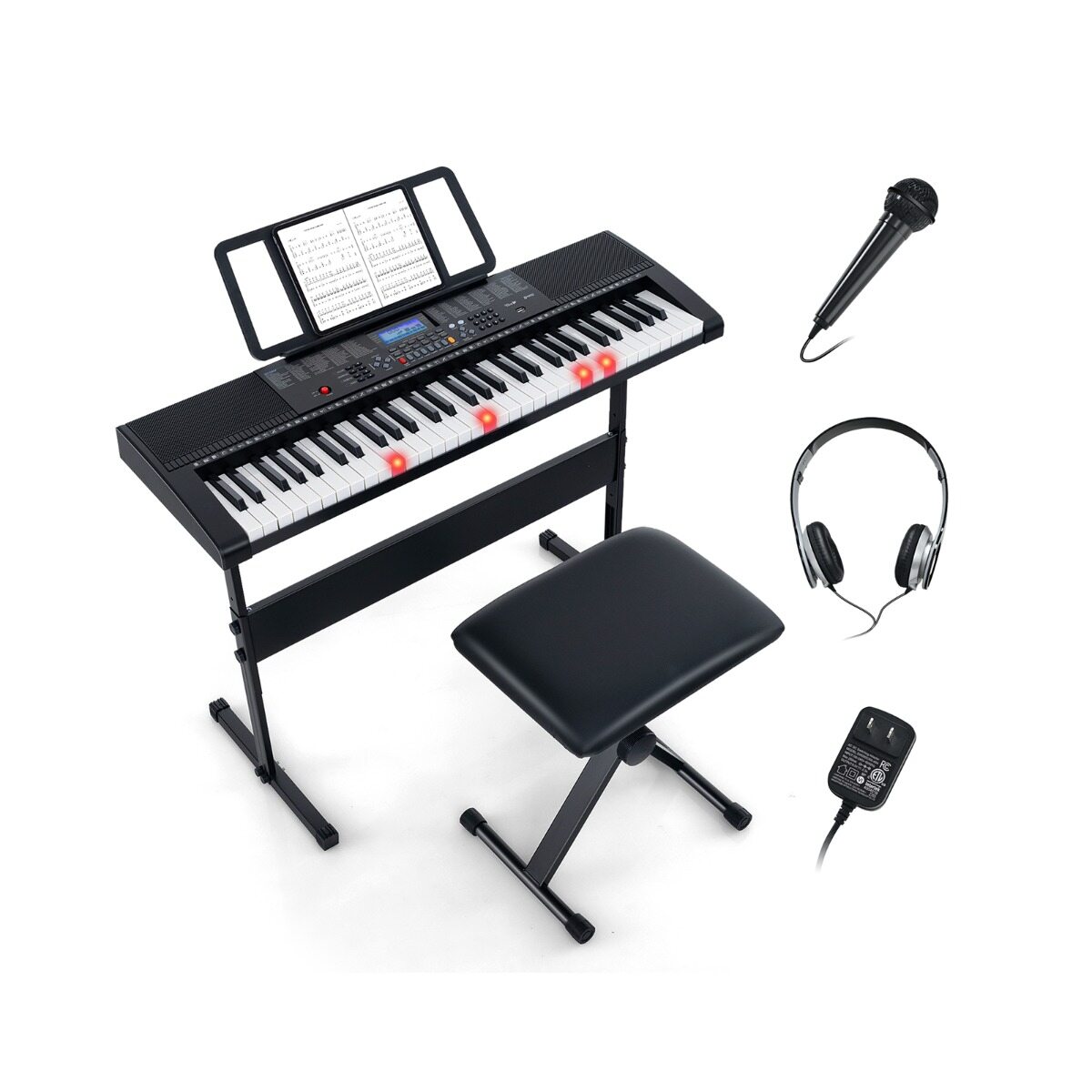
 61-key keyboard, stand, stool and microphone, 140,90 € is the lowest-priced full set: the box holds the keyboard, an adjustable stand, a stool, a music rest, headphones and a microphone. The instrument also has lit keys and a lesson mode.
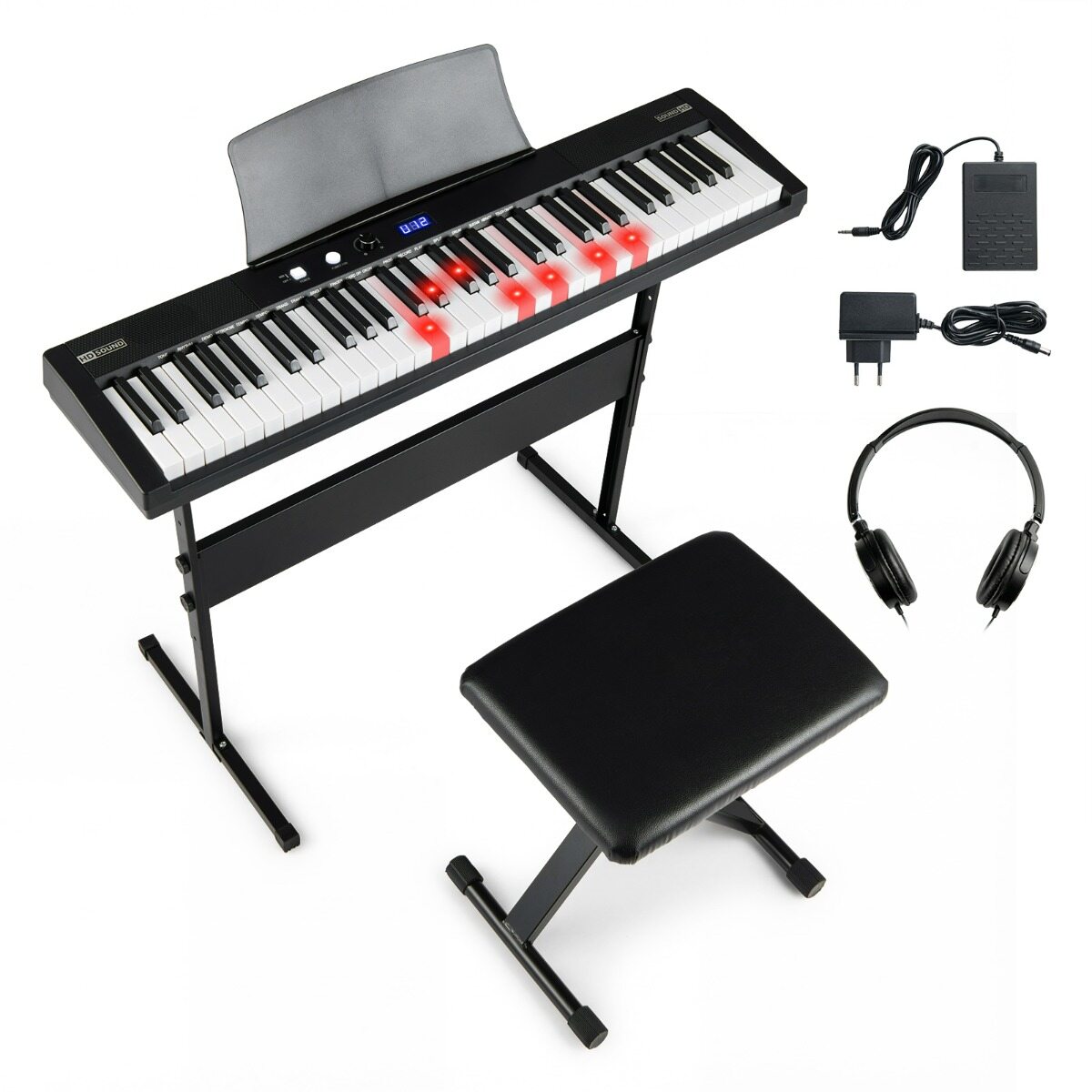 Beginner 61-key keyboard, stand, stool and pedal, 161,90 € adds a touch-sensitive keyboard with 7 velocity levels, a two-keyboard mode and a MIDI connection. The box holds a stand, a stool, a sustain pedal, a music rest, headphones and note stickers. Among the mano 61-key instruments this is the most complete set.
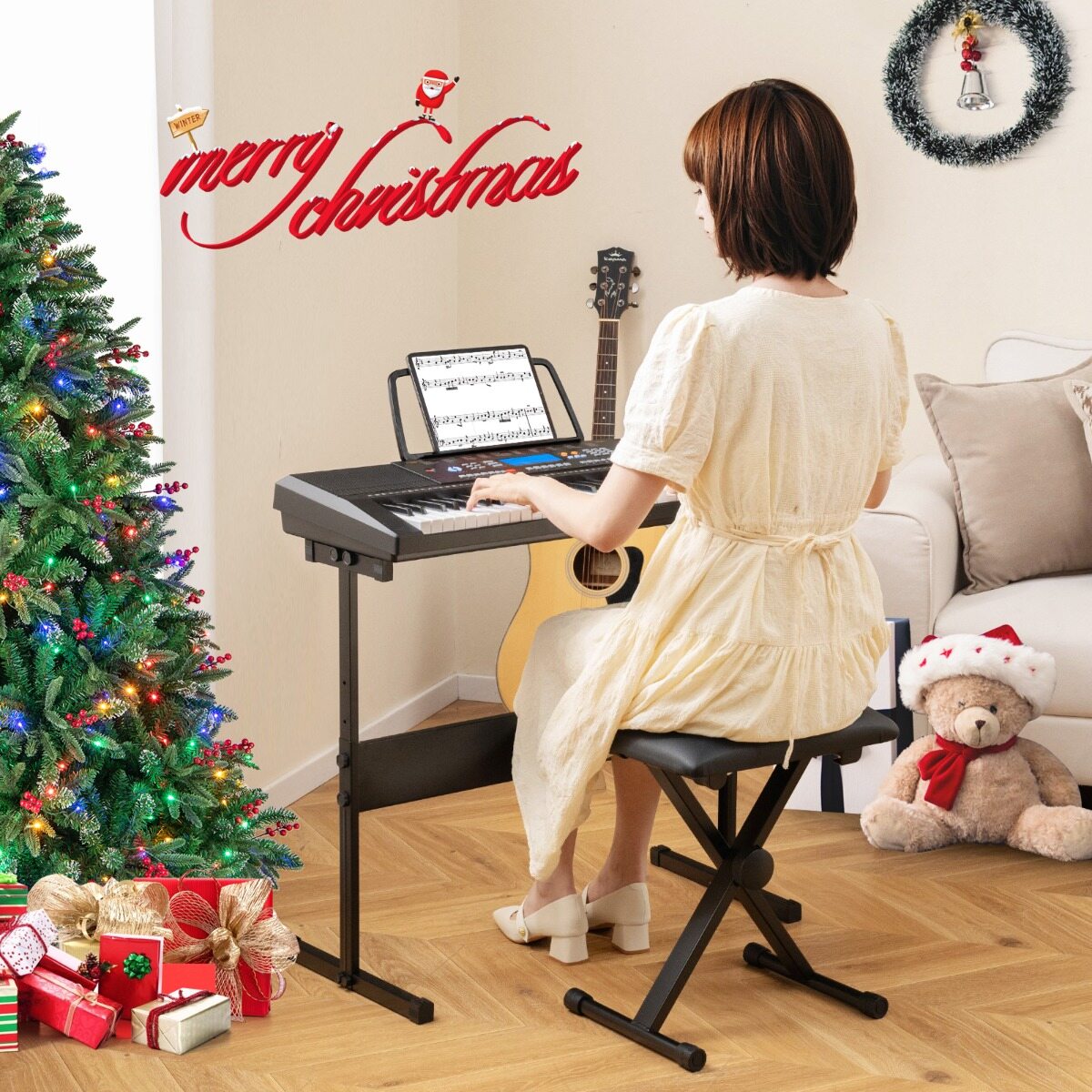 61-key keyboard, stand and stool, 300 tones, 202,90 € is for someone who wants more sounds and accompaniment rhythms: 300 tones, 300 rhythms and 50 demo songs. The stand and the stool each have three heights, and the box also includes headphones, a microphone and a music rest.
 61-key keyboard, 600 tones, stand and stool, 224,90 € is the same kind of set with 600 tones, 400 rhythms, 61 lit keys and three lesson modes.
61 semi-weighted keys
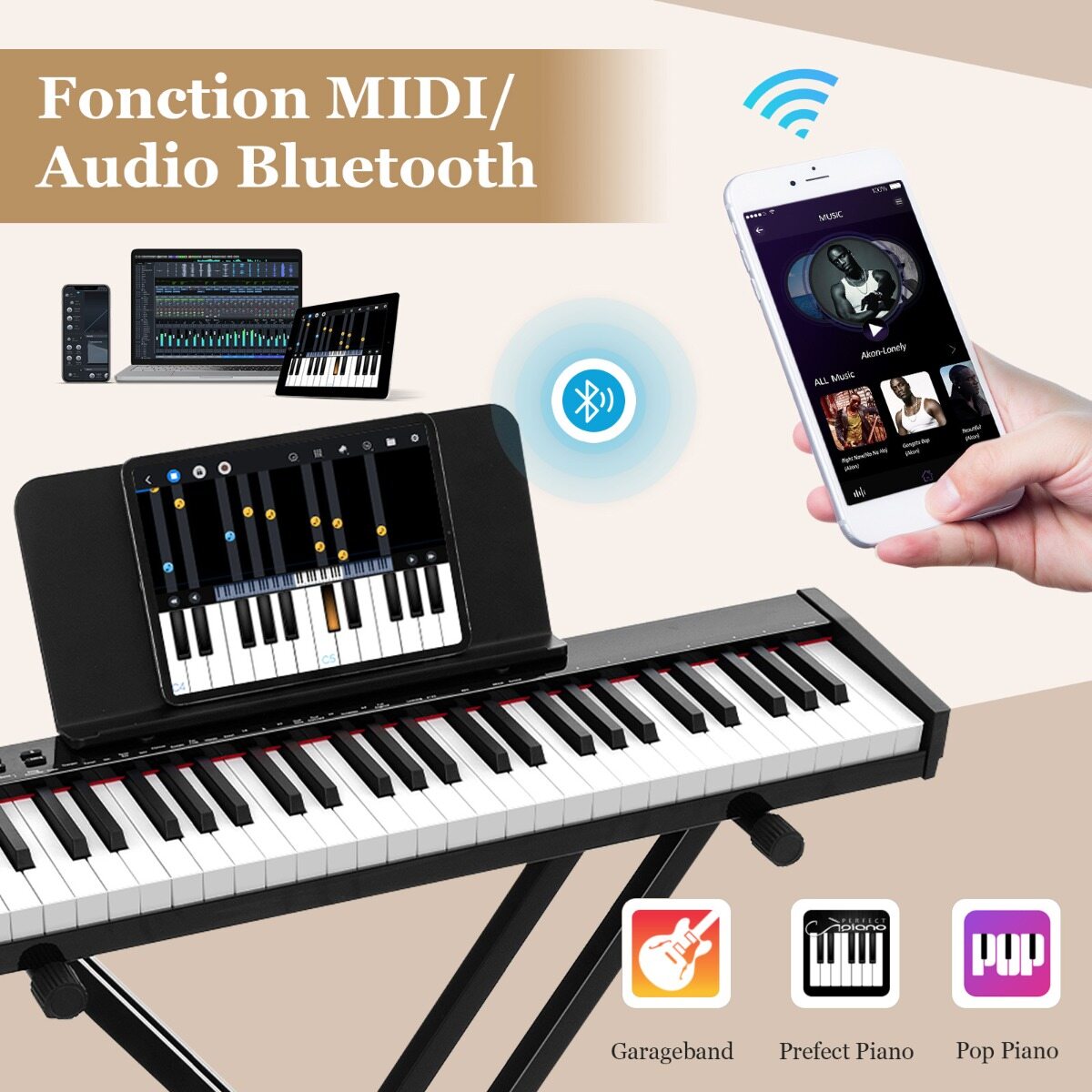 Semi-weighted 61-key keyboard, stand and stool, 203,90 € is the choice for someone who wants piano-like resistance without the size of 88 keys. The set includes a folding stand, a stool, a sustain pedal, a carry bag and Bluetooth MIDI. The rechargeable battery gives 6–8 hours of playing time.
88-key models
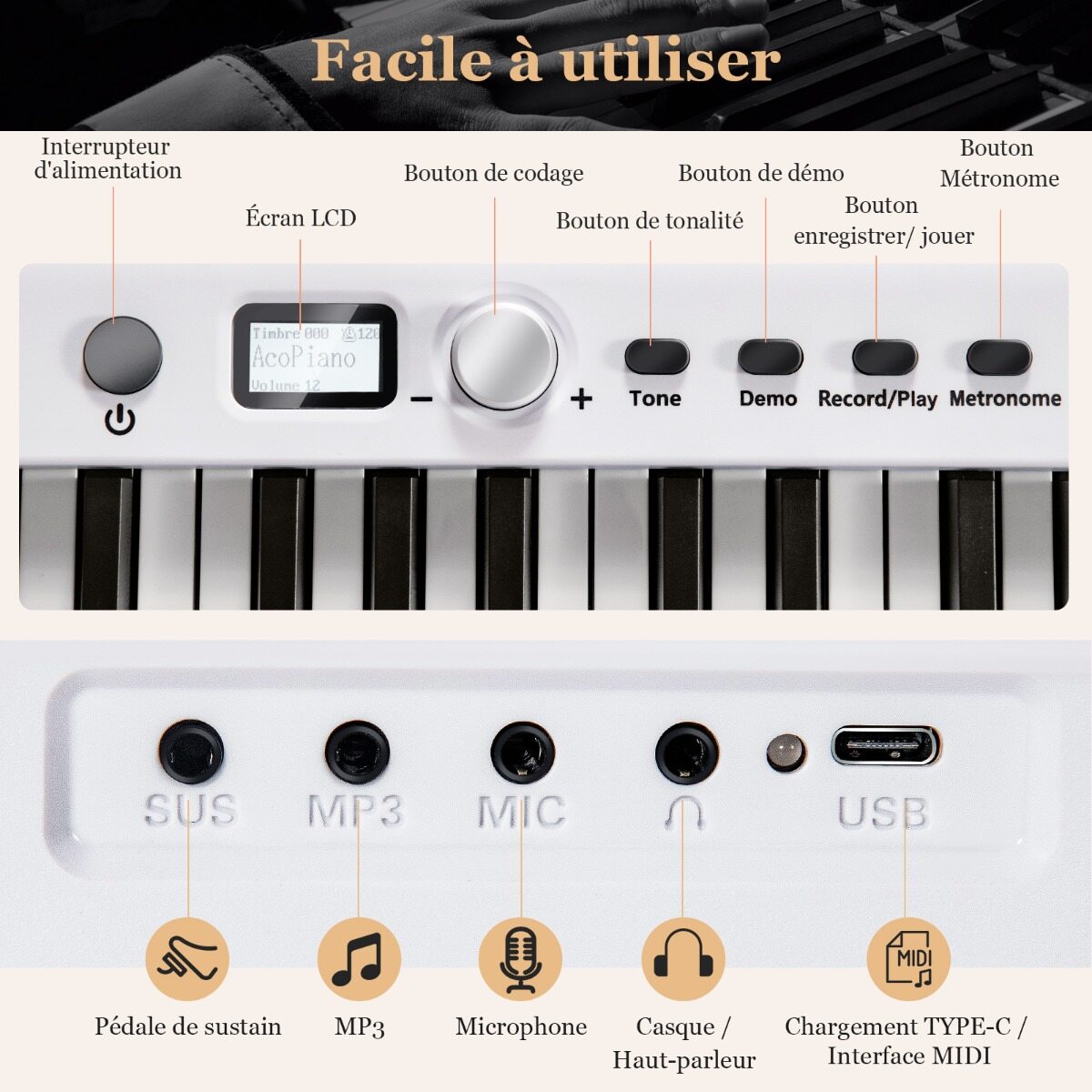 Folding keyboard, 88 lit keys, 173,90 € is 88 full-size semi-weighted keys that fold up. The battery lasts up to 12 hours and a carry bag is included. The pedal can be bought separately. Lit keys and two lesson modes help you start without a teacher.
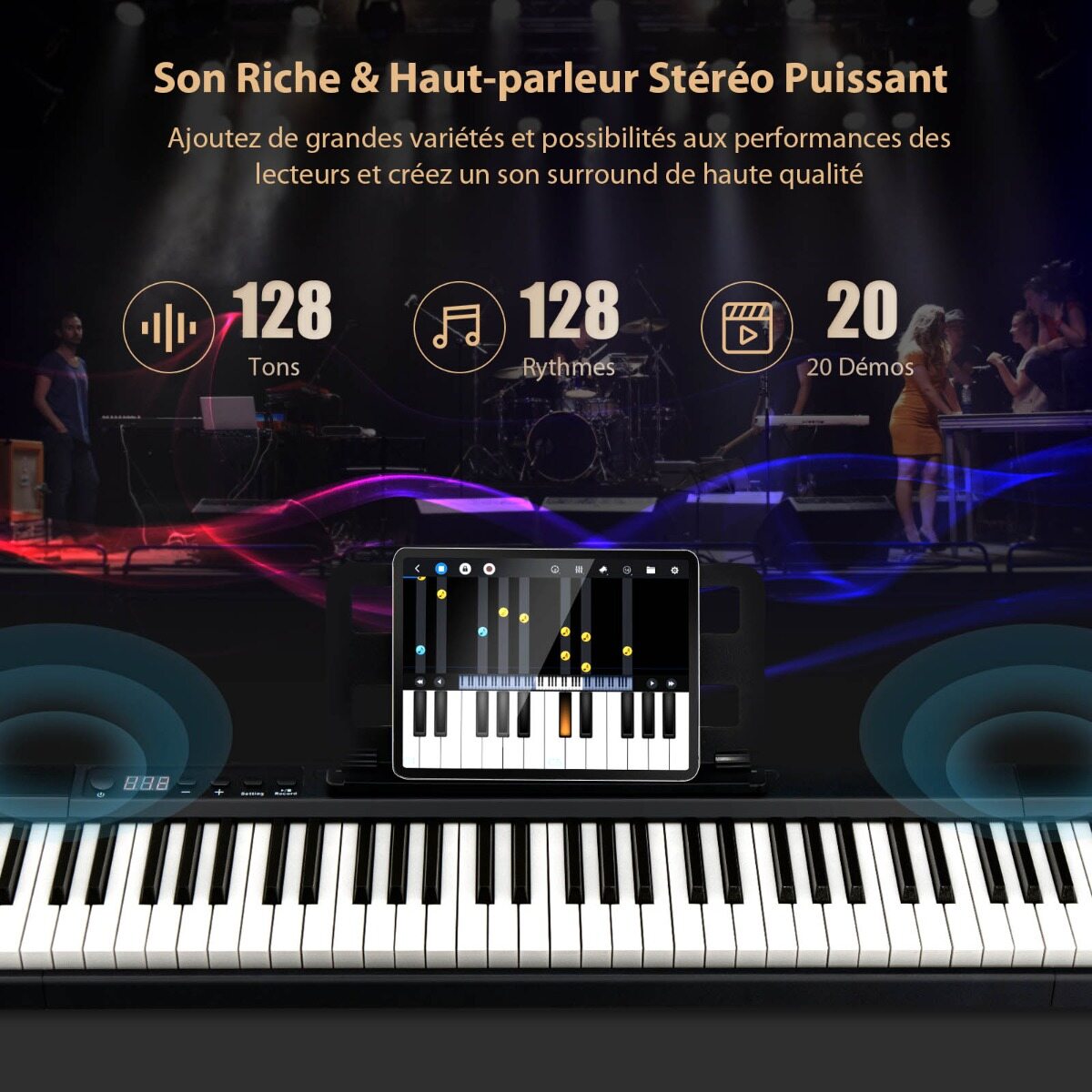 Electric piano, 88 semi-weighted keys, 179,90 € is 88 velocity-sensitive semi-weighted keys, Bluetooth, MIDI and USB, a battery of up to 12 hours, a bag and a sustain pedal.
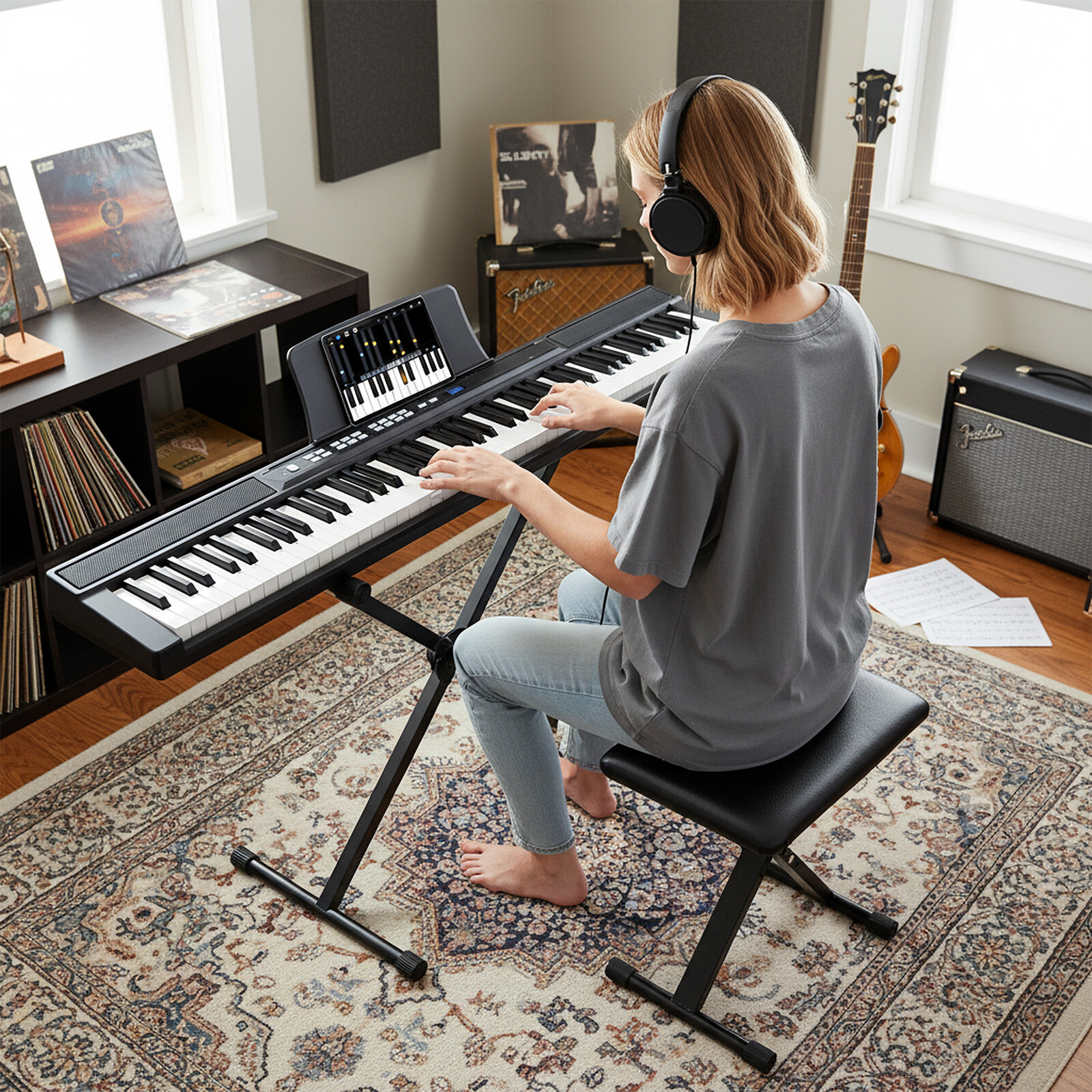 Electric piano, 88 keys, stand, stool and sustain pedal, 224,90 € is the most complete 88-key set: a touch-sensitive keyboard, lit keys, an adjustable stand, a stool, a sustain pedal, a music rest and headphones.
A stand on its own
If the instrument is already there and the stand is missing, the 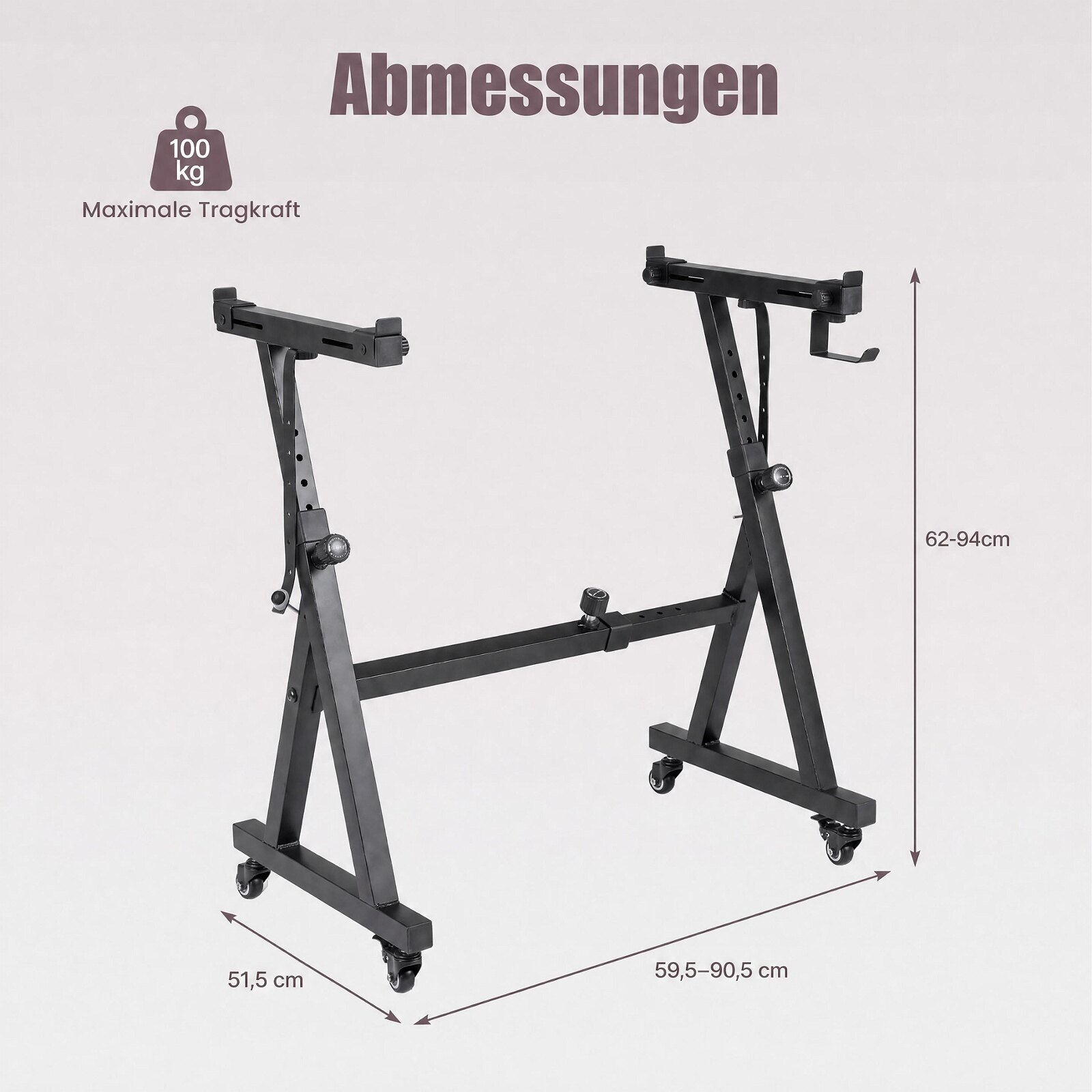 Adjustable keyboard stand for 49–88 keys, 95,90 € fits 49-, 54-, 61- and 88-key instruments. The height moves from 62 cm to 94 cm and the load capacity is 100 kg.
Who these instruments do not fit
If the child is already in music school and the teacher requires weighted keys, no 61-key synthesiser replaces a hammer-action digital piano. Look then at 88-key weighted digital pianos, in the guide on a digital piano for a music-school child. If you are looking for a stage instrument for a band, or for building synthesised sounds, these home instruments for beginners are too simple. If the child is under 5, it is easier to start on a small children’s keyboard with fewer keys and large buttons.
Questions people keep asking
What is the difference between a synthesiser and a digital piano?
For a beginner at home the difference is mostly in the keys. A synthesiser usually has 61 light keys and hundreds of sounds and rhythms. A digital piano has 88 keys, which are heavier and more like a piano, and fewer piano sounds, but better ones. Either is fine for starting to learn. For a music-school piano syllabus, choose a digital piano.
At what age can a child play a synthesiser?
A full-size 61-key synthesiser usually suits a child from about 6–7, once the child can sit and listen. A younger child is better on a smaller children’s keyboard. What matters is that the stool and the stand can change height, so the arms are at the right level.
Does a synthesiser have to be tuned?
No. An electric instrument never goes out of tune. It does not need tuning the way an acoustic piano does, and it is not afraid of dry indoor air either.
Can the instrument be connected to a phone or a computer?
Yes, if it has a MIDI, USB-MIDI or Bluetooth MIDI connection. Then you can use learning apps and record the playing onto a computer. That is listed in the specifications of each product.
Is a pedal necessary?
Not in the first months. Once you start playing piano pieces, or songs with an accompaniment, a sustain pedal becomes necessary. Choose an instrument that at least has a pedal socket. Many sets already include the pedal.
How soon does the instrument arrive at home?
The instruments come from the manufacturer’s European warehouse. The delivery time is stated on each product page. Parcel-locker delivery is free once the order reaches the minimum the shop states.