
A diesel air heater makes two flows, and they are not the same thing. One is warm air, blown into a cabin, a van or a small garage. The other is the exhaust from the burn. Warm air is why the unit is bought. Exhaust is what has to leave the room, otherwise the same room fills with carbon monoxide. Carbon monoxide has no smell. Not being able to smell anything is not proof that the pipe is sound or that the end is outside. This page says what the card allows and what it does not. It is not an installation manual: there is no hole size here, no cable cross-section, and no way to bypass a sensor.
If you are still choosing a model, start with the choice guide. If the place is still open, read the place guide. Safety does not change because the tank is separate or the body is aluminium. Aluminium and about 18% more heat on the Hcalory cards are about the warm air, not about the exhaust being allowed to stay inside.
Where the exhaust has to end
The end of the pipe is outside. It is not under a window, by a door, against a tent wall, or in the same place the unit draws combustion air. If the end is next to an opening, the room pulls back the same gas it just sent out. On a boat, “sea air” is not an end left in the bilge. In a garage, an end behind the door gap is not enough if the door is shut and the gap is the only way back into the room. A closed shelter with one side open does not make the end safe if the wind blows the gas back to where people sleep.
Sleeping in a vehicle needs two things at once. The pipe is intact and the end is outside, away from openings. A carbon monoxide sensor is working in the room, not only a hope that a smell will warn you. A smell does not warn you. If the pipe is cracked, crushed or has come off a joint, a higher step and Bluetooth do not fix it. The app shows temperature and a timer. It does not show that the end has been buried in snow overnight or has sunk against a blanket.
What the CO alarm on the card does, and what it does not
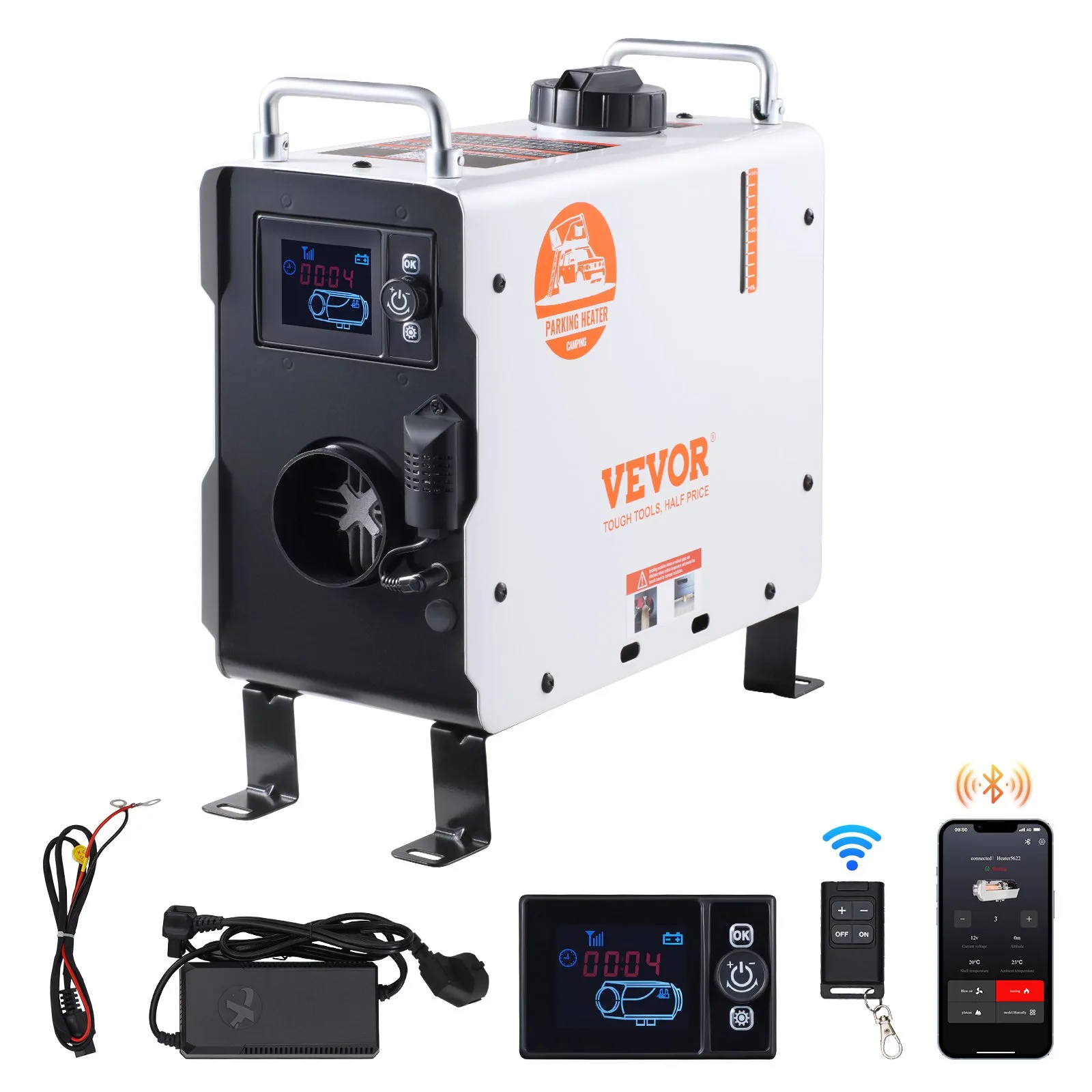 VEVOR 2 kW with a CO alarm199,90 €View is 2 kW and 199,90 €. The card has a built-in CO alarm that watches the level and can warn or switch the unit off. That is extra protection on this particular card. It does not replace the exhaust pipe. It does not replace a separate sensor by the bed. It does not give permission to run without a flue, in a tent, or in a closed cabin whose pipe ends under a window. Do not carry this alarm across to the six Hcalory models: those cards do not have that sentence. Do not read it the other way either, as if the lack of an alarm on the other cards means those models do not produce carbon monoxide. Combustion makes exhaust on every diesel air heater. An alarm is an extra line on one card, not the absence of combustion on another.
If the alarm switches the unit off, that is a sign the level has reached the limit the card watches, not that the night can continue “a little longer”. Door open, people out, and the cause — the pipe, the end, a blockage — stays with a person who knows how to check a fuel line and an exhaust. This page does not teach you to switch an alarm off or to bypass it.
What not to do yourself
Do not cover the air intake or the warm-air outlet. A blanket, a bag or a box sitting on the body takes away the air the flame and the blower need. Do not pour petrol into the tank. These are diesel heaters. The wrong fuel is not a cold-start trick and it is not a saving. Do not start a maintenance burn in a closed sleeping place.
 Hcalory HBS-3S, portable 8 kW, 3.5 L189,90 €View says a one-touch soot burn is done in a ventilated place. Hcalory ties soot to short starts, to low output and to running at altitude. The burn sends that soot along the combustion path. That path has to be outside. A closed cabin at night, where people are sleeping, is not a ventilated place just because a window is cracked. Do not make a soot burn an every-evening habit. The right step in a small room cuts short starts, and that is in the power guide and the fuel guide.
Do not lengthen the pipe on your own so that you no longer know where the end sits. Do not aim the end under a neighbour’s window, in front of an air-intake grille, or at a tent door. Do not leave the unit running in an empty vehicle with the windows shut and nobody there to hear an alarm. Do not read silence as safety.
What this page does not teach
A permanent install in a vehicle or a boat is work for a person who knows fuel lines, exhaust and electrics. There is no hole diameter here, no sheet thickness, no cable cross-section, no fuse number, and no drawing of how to bypass a sensor. If a card says 12 V or 12/24 V, that is the voltage, not an invitation to build an adapter. HBU-3 is 12 V only. It does not go in a 24 V truck, and “nearly fits” is not a safe reading.
Altitude mode from 1,000 to 5,000 m, which is on the HBS-3 card and on both HBU cards, sets the air and fuel ratio. It does not replace the pipe. The −20 °C preheat, which is only on the HBS-3S and HBH-3S cards, helps light the flame. It does not make the exhaust safer in the cold. Frost makes snow and ice at the end more likely, so a morning check that the end is clear belongs to using the unit. That is not an invitation to take the unit apart.
If the unit is not bought yet and you do not know whether anyone will sleep beside it, read the place first. A garage by day, with the door open while it runs, is a different situation from a night in a closed van. In both, the exhaust ends outside. Only one of them is sleeping.
A morning look that is not taking it apart
Before anyone goes back to sleep, look at three things, without taking the unit apart. Whether the end of the pipe is still outside and not under snow or against a blanket. Whether the air intake and the warm-air outlet are clear, not under a bag or a blanket. Whether the room has a sensor that does not depend on smell. If one of those three has failed, the night does not continue “for one more hour”. Bluetooth does not show those three things. It shows temperature and a timer.
If the night was in a garage and the door was open while it ran, the morning is different from a van where people slept. In both, the end still has to be outside in the morning. Do not take this page as a lesson in holes, cables, or bypassing a sensor. If the end has disappeared, a joint has come off, or an alarm has warned, the work stays with a person who knows fuel lines, exhaust and electrics.
Questions
Is warm air the same as exhaust?
No. Warm air goes into the room and is what the unit is there to heat with. Exhaust is the combustion pipe and it has to end outside, away from a window, a door and the air intake. They are not led into the same room.
Can the model with a CO alarm be used without a pipe?
No. The alarm on VEVOR 2 kW with a CO alarm199,90 €View can watch the level and warn or switch off. That is extra protection. The combustion gas still has to leave the room. The alarm does not replace a separate sensor by the bed.
Can a soot burn be done in the cabin at night?
The HBS-3S card says a ventilated place. A closed sleeping place, where people are asleep, is not that place, even if a window is cracked. The burn sends soot along the combustion path, and that path is outside.
Does this text replace an installer?
No. There is no hole size here, no cable cross-section, and no way to bypass a sensor. A permanent install in a vehicle or a boat is work for a person who knows fuel lines, exhaust and electrics.
If I cannot smell gas, is it safe?
No. Carbon monoxide has no smell. The lack of a smell does not prove the pipe is sound or the end is outside. A sleeping place has its own sensor, not a hope placed in the nose.
Is a pipe end under a window far enough outside?
Being outside does not help if an opening pulls the same gas back in. The end is kept away from a window, a door, a tent wall and the combustion-air intake. This page does not give an exact centimetre, because that would already be an installation lesson.
Is exhaust different on a boat?
No. Warm air and combustion gas are different pipes on a boat as well. The end does not stay in the bilge. Water all around does not replace a sensor in the cabin.
Can I sleep in a closed tent if the unit is outside?
The cards do not describe sleeping in a closed tent next to a running diesel heater. Fabric is not a cabin wall, and an end left against the tent comes back inside. That is not a use these cards cover.
Can the alarm be switched off if it disturbs sleep?
No. Switching it off or bypassing it is not a lesson here. If the alarm warns, people go outside and the cause is found, not a quieter night.
Is a tank filled with petrol only a bad start?
No. These units are for diesel. The wrong fuel is not a cold trick and not a small mistake a step will fix. Diesel goes in the tank.