
Short answer: A wet boot does not want a heated insole. An insole heats the foot while the shoe is on the foot, and it leaves the morning’s moisture where it already was. The dryer, at 20 watts, goes inside the footwear when the footwear is empty, and the timer finishes after 3, 6 or 9 hours. The set of two dryers is for a pair: one dryer in each shoe. The dryer with flexible nozzles follows the shape of the shoe and reaches the toes; the box holds one device. Both are 220–240 volts, with an EU plug, and that plug fits an Estonian wall socket. They are not socks, and they are not warmth you carry in a hand.
Products in this guide
 Dryer with timer, 2 pcs, 20 W50,90 €View →
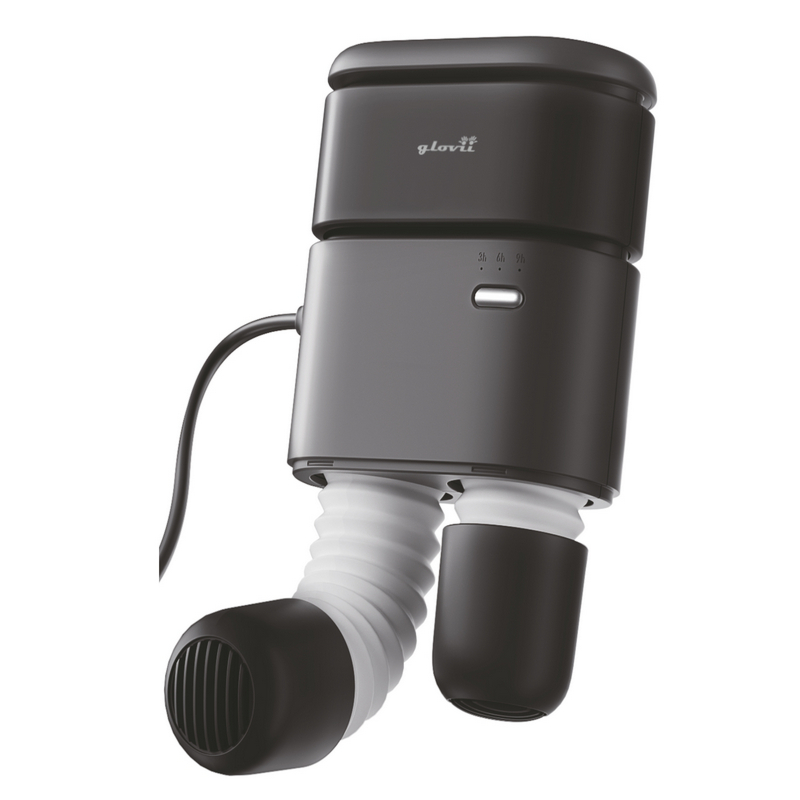 Dryer with flexible nozzles, 20 W53,90 €View →
Moisture is why a boot smells, and this is not another heater
Water that stands inside a boot feeds the smell. Once the inside is dry, there is no moisture left for that smell to grow from. That is the dryer’s job, at 20 watts. It is not a 200-watt blower, and it is not a radiator in the corner of the room with boots piled on top of it. The heat goes inside the footwear, slowly, on a timer, so you do not have to pull the device out in the middle of the night.
A heated insole and a heated sock do a different job. They heat the foot while you wear them. They do not dry wet leather or a wet lining, and a battery left inside a wet boot is not a way to dry it. The evening splits in two. The dryer stays in the hallway, the boot is dry in the morning, and if the toe is still cold after that, the insole or the sock is a separate guide. Do not wear the dryer. It is an electrical device for an empty shoe.
Two models, one power figure, different boxes
Both are 20 watts, 220–240 V, 50 Hz, with a timer of 3, 6 and 9 hours. What changes is how many devices are in the box, and what the nozzle is like. The timer set holds two dryers, one for each shoe, plus a power module and a cable. That is a pair of trainers, a pair of work boots, or a pair of ski boots at the same time. One nozzle in one boot would leave the other boot wet until morning.
The model with flexible nozzles follows the shape of the footwear. A stiff nozzle stays near the heel. A flexible one reaches the toes and under the instep, which is where the wet stays the longest. The description also gives a shorter cycle, so the material of the shoe does not take too much heat. The box holds one dryer and a cable. If the house has one pair that can dry one shoe after the other through the night, this is enough only when you dry one shoe at a time, or when you buy a second device. To have a pair dry at the same time, the set of two devices is the more direct purchase.
The two prices sit close together, so the choice is which shape of job you have, not which figure is smaller. A ski boot is long and narrow, and the flexible nozzle is the argument there. Two ordinary work boots standing side by side, and two dryers are the argument. One box does not give you both at once.
3, 6 or 9 hours, and what not to bake
The timer is there so the device switches itself off. 3 hours is the shorter cycle, for leather and for a thin trainer that you do not want to keep warm for long. 6 is an ordinary evening. 9 is a thick boot and the morning, when you switch them on before you go to sleep. Do not leave the dryer inside a boot with no timer, hoping you will remember it in the morning. The timer is in the box for that reason.
The dryer is not an oven for boots. If the leather goes hard, the time was too long, and the next time you take a shorter step. Do not cover the device with film or with a closed bag. Do not put it on a foot. Do not dry a sock that is still on a person’s foot, and do not dry gloves that still have a battery inside them. Gloves and clothes dry in the room, and the battery comes out of them before any moisture does. The dryer is for footwear.
The plug is an EU plug, French type, and it fits an Estonian wall socket. The power is 20 watts, so this is not the same load as a room heater. One device through the night is a small draw next to a boot that is wet inside in the morning and smells. The warranty is 2 years. If the cable or the housing is broken, it is not used, and it is not opened at home.
Who this is for, and who it is not
Take a dryer when boots, trainers or ski boots come in wet on the inside in the evening: snow, rain, sweat, work. Take the set of two devices when you dry a pair at the same time. Take the flexible one when one long boot will not dry past the heel. Do not take a dryer as a substitute for warm toes on the mountain. On the mountain the piece is a sock or a thin ski insole. The dryer waits in the hallway.
Do not take this in place of an animal bed, and do not take it to heat a room. 20 watts inside a shoe does not heat a room. Do not take it when the footwear is so wet that water is standing in a puddle: pour the water out first, then dry. And do not leave in a child’s hands a device that gets warm and hangs on the end of a cable. The timer makes the night safer. It does not turn the device into a toy.
A winter week, not a single morning
An ordinary week looks like this. In the evening the boots come in wet on the inside, you put the dryer in, you choose 6 or 9 hours, and you leave them in the hallway. In the morning the shoe is empty and dry, and the dryer has switched itself off. If the toe is still cold during the day, an insole or a sock goes on the foot. That same dryer does not. In the evening the same routine starts again. Moisture then does not collect in the lining across several days, and the lining is the place the smell actually comes from.
A ski boot is longer than a trainer. If the moisture stays at the toe and a stiff nozzle stays by the heel, take the flexible one. If you dry two boots before a morning drive, take the set of two devices, because one device leaves the other boot waiting. Do not dry a boot that still has the battery of a heated insole inside it. Battery out, then the dryer, then the insole back in the morning.
One dryer does not stand in for another winter piece. It does not heat a hand, it does not heat a back, and it does not keep a dog’s bed warm. 20 watts is for the inside of footwear. If the purchase is a cold toe on the mountain, go to the insole or the sock. If the purchase is a wet hallway, stay on this page.
How to choose?
A pair of boots at the same time: the set of two dryers, 20 W, timer 3, 6 or 9 hours.
A long narrow boot, with the moisture staying in the toes: the flexible nozzles. The box holds one device.
Leather and a thin trainer: the shorter time. A thick winter boot: 6 or 9 hours.
A cold toe while the boot is being worn is not the reason for this purchase. That reason belongs to an insole or a sock. The dryer works in an empty shoe.
Comparison
| Product | Price | What sets it apart |
|---|---|---|
| Dryer with timer, 2 pcs, 20 W | 50,90 € | Two devices, a pair at once, 3/6/9 h |
| Dryer with flexible nozzles, 20 W | 53,90 € | Flexible nozzle to the toes, one device in the box |
The price in the link is the shop’s current price and opens the product.
Who this is NOT for
- The dryer is not worn on a foot. It is not a heated insole.
- One flexible device does not dry two boots at the same time.
- 20 watts does not heat a room, and it does not replace an animal bed.
- Standing water is poured out first. The dryer is not a pump.
- A battery and gloves do not belong in it. Footwear, and empty.
Common questions
Does the dryer replace a heated insole?
No. The dryer works in an empty shoe and drives the moisture out. An insole heats the foot when the shoe is on the foot. A wet morning wants the dryer. A cold toe on a slope wants an insole or a sock.
Which one should you take?
A pair at the same time: the set of two devices. One long boot that a stiff nozzle does not reach: the flexible nozzles. That box is one device, not a pair.
How long does it have to stay in?
The timer is 3, 6 or 9 hours. Shorter for leather and for a thin trainer. Longer for a thick boot. The device switches itself off.
Does it suit a ski boot?
Yes. The description runs from trainers to ski boots. A long boot gets more from a flexible nozzle, because the nozzle reaches the toes. A pair of boots at the same time wants two devices.
Does the plug suit Estonia?
It is an EU plug, French type, at 220–240 V. It fits an Estonian wall socket. The power is 20 watts.
Can it be left in overnight?
With the timer, yes. You choose 3, 6 or 9 hours and the device finishes by itself. It is not on a foot, not in a bag, and not under something that holds the heat in. A broken cable is not used.
Does a shoe dryer heat a foot inside a boot?
No. The dryer works in an empty shoe and drives the moisture out. To warm a foot while the boot is on, there is an insole or a sock.
How much electricity does a shoe dryer use?
Both are 20 watts, 220–240 V, with an EU plug.
Does one dryer dry a pair of boots at the same time?
The set of two devices dries a pair at the same time. The box with flexible nozzles is one device: one long boot at a time, and the other boot waits.
Does a shoe dryer suit leather boots?
Yes. The description runs from trainers to ski boots, and that includes leather. Leather and a thin trainer take the shorter time, 3 hours. A thick boot takes 6 or 9.
Does the dryer switch itself off?
Yes. The timer is 3, 6 or 9 hours and the device finishes by itself. It is not left on without a timer.
What is the difference between the two shoe dryers?
One box is two devices, with a stiffer nozzle, for a pair of boots at the same time. The other is one device with flexible nozzles that reach the toes of a long boot. The power is 20 watts on both.
Can the dryer go into a wet sock that is still on a foot?
No. The shoe is empty. The device does not stand in for a sock or an insole, and it is not covered in a way that stops the heat getting out.