
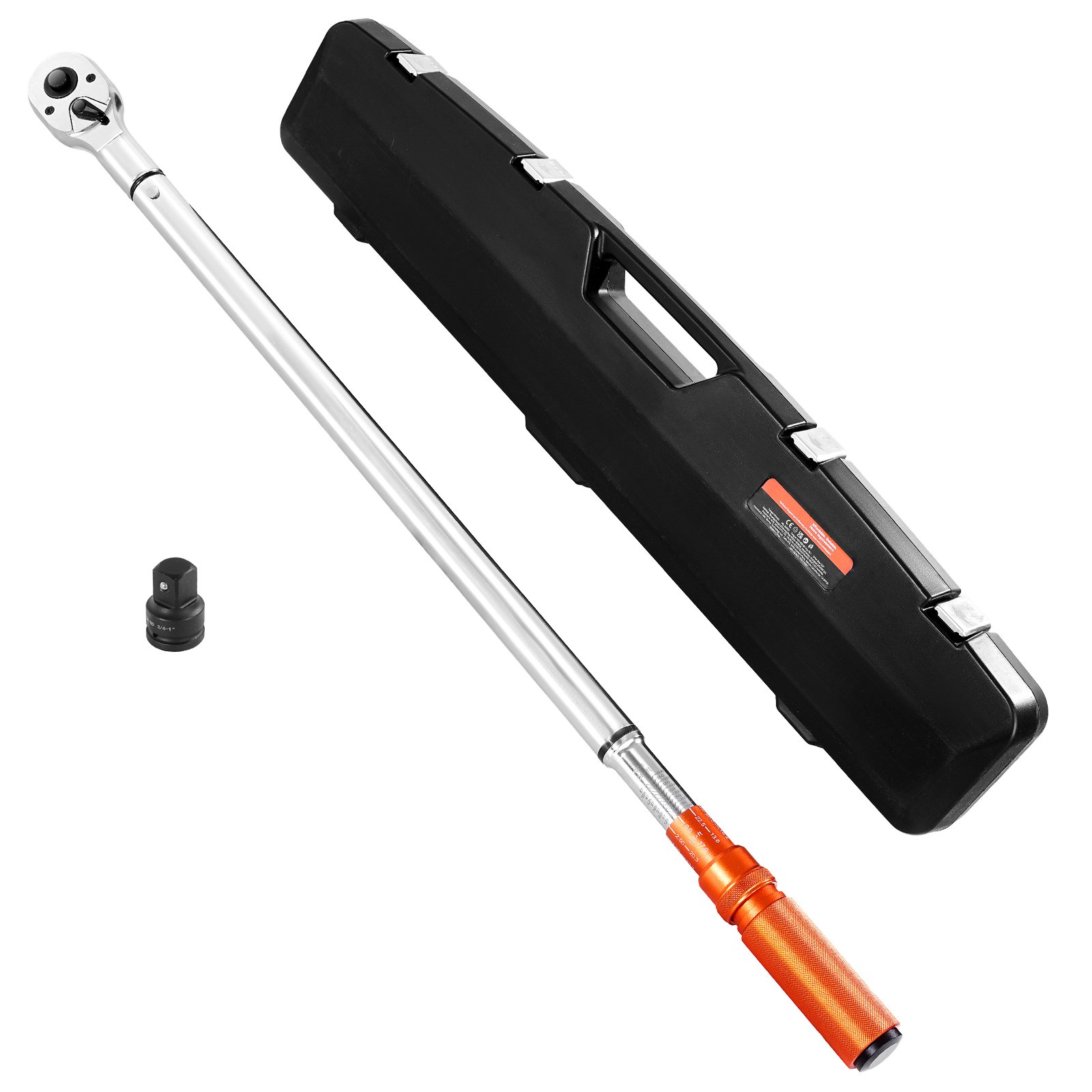
Short answer: This guide has one torque wrench, model HG-34600. The old question of which wrench to choose is not a choice between two models. The title is a click torque wrench, 1.91 cm. The drive-head size is also 1.91 cm. The page does not write that in inches. The text says ±3% accuracy and a calibration certificate. The table’s accuracy is ±3% (clockwise). Clockwise is in the table, not in the accuracy sentence of the text. The range is 100–600 lbf-ft and, on the same row, 136–814 N.m. The increment is another row: 25 lbf-ft and 34 N.m. 25 is not the start of the range. The start is 100 lbf-ft and 136 N.m. The tooth count is 48. The display units are lbf-ft and N.m, and the page says two units. The measurement is 1010 × 63 × 58.8 mm, without names for the axes. The net weight with all accessories is 7.6 kg. The style row says only a torque wrench. The product style is scale type. Those two style rows are not one sentence.
Products in this guide
±3% and clockwise are not the same sentence
The text says ±3% on every torque wrench, and a calibration certificate. That sentence does not name a direction. The table says ±3% (clockwise). Both stay. The page does not write a second percent for counterclockwise. Clockwise belongs to the table. It is not copied back into the accuracy sentence of the text, and this guide does not copy it there either.
The text also says a bidirectional wrench, a laser-etched bidirectional scale, and a reversible ratchet head that works in both directions. Bidirectional and the clockwise accuracy are different sentences. One does not erase the other. The table’s ±3% (clockwise) does not delete the bidirectional scale. The bidirectional scale does not delete the table’s clockwise limit. There is still one model, HG-34600. “Every torque wrench” is the wording of that sentence. It is not a second wrench.
±3% in the text stays a figure with no direction named. ±3% (clockwise) stays the table’s figure. A reader who wants one accuracy for both directions has to drop one of those writings. This guide drops neither. No counterclockwise percent is printed, so none is supplied here. The calibration certificate stays in the text sentence beside the ±3%. It is not a second accuracy number.
100–600 is not 25, and 136–814 is not 34
The range row is 100–600 lbf-ft and 136–814 N.m. The increment row is 25 lbf-ft and 34 N.m. The four numbers stay. 25 lbf-ft is not the bottom of the range. 34 N.m is not 136 N.m. The page does not say how many steps fit between 100 and 600. A step count is not printed, so it is not added here.
The display-units row names lbf-ft and N.m and adds a parenthesis, “two units”. The range and the increment both write both units. The page does not pick one of them. 100 lbf-ft stays on the same row as 136 N.m. 600 lbf-ft stays on the same row as 814 N.m. 25 lbf-ft stays on the increment row with 34 N.m. The increment is not the start of the range. The range starts at 100 lbf-ft and 136 N.m.
Leaving the rows separate is the whole point of the page. A single “torque” that mixed 25 into the start of 100–600 would be a third figure the page does not print. The same is true of mixing 34 into 136–814. Both units stay on each of those rows. The page’s “two units” is a note on the display-units row, not a choice of lbf-ft over N.m or of N.m over lbf-ft.
1.91 cm, three measurements, and 7.6 kg
The title and the drive head are both 1.91 cm. There is no second drive size. The page does not write 1.91 cm in inches. The text says changing the socket with one hand. The socket is not on the drive-head row. 1.91 cm is not the number of that word. The drive head stays 1.91 cm. The socket sentence stays a sentence about changing a socket with one hand. The page does not join them.
The wrench measurement is 1010 × 63 × 58.8 mm, without names for the axes. The box measurement is 1045 × 215 × 83 mm, in the order length, width, height. The pack is 9 × 23.0 × 107 cm, in the order height, width, depth. 1010 mm, 1045 mm, and 107 cm stay separate. 83 mm and 9 cm stay separate. 7.6 kg is the net with all accessories. The style says only a wrench. The carrying case is a paragraph of text, not the weight row. The pack’s 107 cm is not the wrench length. The page does not name an axis on 1010 × 63 × 58.8 mm, so 1010 mm is not labelled here as the length.
Three size writings, three objects. The wrench has 1010 × 63 × 58.8 mm and no axis names. The box has 1045 × 215 × 83 mm, and that order is length, width, height, so the box length is 1045 mm. The pack has 9 × 23.0 × 107 cm, and that order is height, width, depth, so 107 cm is the pack’s third number. 9 cm is the pack’s first number. 83 mm is the box’s third number. They are not one height written twice. 7.6 kg does not explain any of those lengths. It is the net with all accessories, and the style row still says only a torque wrench. The page does not join the weight, the style row, and the carrying case into one claim.
What is in the text, and what a row does not repeat
Alloy steel and a six-stage heat treatment are text. There is no temperature. A chrome-plated surface and rust resistance are text. There is no IP rating. 48 teeth are the table. There is no second tooth count. 48 is the tooth row. It is not the scale divisions. The display units are lbf-ft and N.m. The increment is 25 lbf-ft and 34 N.m. Those three rows stay apart.
The carrying case is impact-resistant in the text. The places are workshops, workplaces, and warehouses. Vehicles and equipment are in the accuracy sentence, at the fasteners. There is no second model in this guide. Click is a word in the title. There is no click row in the table. The product style is scale type. Click in the title and scale type on the product-style row are not merged into one table line.
The page names vehicles and equipment where it talks about accuracy and fasteners. It names workshops, workplaces, and warehouses where it talks about the carrying case. Those are the places the page writes. The page does not give a torque value for a car, and it does not set out a tightening procedure. The range remains 100–600 lbf-ft and 136–814 N.m, the wrench’s range.
The certificate, the light, and the carrying case are not a number row
The calibration certificate is a sentence in the text. There is no certificate number, no date, and no laboratory. The six-stage heat treatment is also text, with no degree. The chrome-plated surface is the rust-resistance sentence, not its own table row. Alloy steel stays in that text. No IP rating is added beside the chrome, and no temperature is added beside the six stages.
The scale is laser-etched, and the text says the reading is readable in low light. There is no lux number. The carrying-case paragraph says impact resistance and protection against collision and compression. There is no impact force in newtons. The places are workshops, workplaces, and warehouses. Those places are not an explanation of the 7.6 kg. 7.6 kg remains the net with all accessories. The style row remains “only a torque wrench”. The carrying case remains its own paragraph.
A certificate without a number, a date, or a laboratory is still only that sentence. Low light without a lux figure is still only that sentence. Impact resistance without a force in newtons is still only that sentence. None of them becomes a row next to 48 teeth, next to ±3% (clockwise), or next to 7.6 kg. The bidirectional scale is the laser-etched scale the text already named. It is not a new unit, and it does not replace lbf-ft and N.m.
How to choose?
When the wrench is HG-34600, the drive head is 1.91 cm, and the range is 100–600 lbf-ft and 136–814 N.m, this is the only model. The increment is 25 lbf-ft and 34 N.m, not the start of the range. The page does not write 1.91 cm in inches. There is no second drive size, and no second wrench in this guide.
The accuracy in the text is ±3%. In the table it is ±3% (clockwise). The scale is bidirectional. Both writings stay. The text also says a reversible ratchet head that works in both directions. That sentence is not the accuracy table. The page does not write a counterclockwise percent.
The measurement is 1010 × 63 × 58.8 mm. The box is 1045 × 215 × 83 mm. The pack is 9 × 23.0 × 107 cm. The net is 7.6 kg with the accessories. 1010 mm, 1045 mm, and 107 cm are not one length. 83 mm and 9 cm are not one height. The pack’s 107 cm is not the wrench’s length. The wrench row still has no axis names.
The style says only a torque wrench. The product style says scale type. There is no second wrench in this guide. Click stays a title word. The table has no click row. 48 stays the tooth count, not the scale divisions. The socket sentence stays off the drive-head row. The page does not set out a tightening procedure, and it does not assign a torque value to a car.
Who this is not for
- One model. There is no second drive size. 1.91 cm is not written in inches.
- ±3% in the text does not name a direction. The table adds clockwise. The bidirectional scale stays its own sentence.
- 25 lbf-ft and 34 N.m are the increment. The range is 100–600 lbf-ft and 136–814 N.m.
- 7.6 kg is the net with the accessories. The style row says only a wrench. 1010 mm, 1045 mm, and 107 cm are not one length.
Frequently asked questions
Are there several torque wrenches here?
No. The model is HG-34600. The title is a click torque wrench, 1.91 cm. The old question of which wrench to choose is not a choice between two models.
What is the drive head?
1.91 cm. The title writes the same number. The page does not write it in inches. There is no second drive size. 1.91 cm is the drive head, not the number attached to the word socket.
Does ±3% apply in both directions?
The text says ±3% and does not name a direction. The table says ±3% (clockwise). There is no second percent for counterclockwise. The bidirectional scale is a different sentence and does not rewrite the table.
Is the wrench bidirectional?
The text says a bidirectional scale and a ratchet head that works in both directions. It also says a bidirectional wrench. That sentence is not the accuracy table. The table’s accuracy remains ±3% (clockwise).
What is the range?
100–600 lbf-ft and, on the same row, 136–814 N.m. Both units stay. The increment of 25 lbf-ft and 34 N.m is not this row. The page does not say how many steps fit between 100 and 600.
Is 25 lbf-ft the smallest torque?
No. 25 lbf-ft and 34 N.m are the increment row. The range starts at 100 lbf-ft and 136 N.m. 34 N.m is not 136 N.m. 25 lbf-ft is not the bottom of 100–600.
How many teeth?
48. There is no second number. 48 is the tooth row in the table. It is not the scale divisions, and it is not the display units. The display units are lbf-ft and N.m.
What units are on the scale?
The display-units row says lbf-ft and N.m, and adds that there are two units. The range writes both, and the increment writes both. The page does not pick one. The product style is scale type, which is a different row from the units.
How long is the wrench?
The wrench measurement is 1010 × 63 × 58.8 mm. That row has no names for the axes. The page does not label 1010 mm as the length. The box length is a different writing, 1045 mm, and the pack’s third number is 107 cm.
Is the box the same as the pack?
No. The box is 1045 × 215 × 83 mm, length, width, height. The pack is 9 × 23.0 × 107 cm, height, width, depth. 1010 mm is the wrench’s first number, on a row with no axis names. The three writings stay separate. The carrying case is a text paragraph, not either of these two measurements.
Is 7.6 kg only the wrench?
The row says net with all accessories, 7.6 kg. The style row says only a torque wrench. The carrying case is a separate paragraph of text. The page does not join those three. 7.6 kg is not turned into a length, and it is not an explanation of the workshops, workplaces, and warehouses.
What is the material?
The text says alloy steel, a six-stage heat treatment, and a chrome-plated surface. Rust resistance is in that chrome sentence. There is no temperature, and there is no IP rating. The six stages have no degree. The chrome surface is not its own table row.
What does socket mean?
The text writes changing the socket with one hand. The drive head of 1.91 cm is another row. The page does not join them. 1.91 cm is not the number of the word socket. The sentence is not a tightening procedure.
Where does the page use it?
The accuracy sentence names vehicles and equipment, at the fasteners. The carrying-case sentence names workshops, workplaces, and warehouses. The page does not give a torque value for a car. The range 100–600 lbf-ft and 136–814 N.m stays the wrench’s range.
Is click its own row?
Click is a word in the title. There is no click row in the table. The product style is scale type. The style row says only a torque wrench. Those are separate writings. Click is not a procedure on this page.
Are 48 teeth the scale divisions?
No. 48 is the number on the tooth row. The display units are lbf-ft and N.m. The increment is 25 lbf-ft and 34 N.m. The three rows stay separate. The page does not say how many steps fit between 100 and 600, and 48 is not that missing count.
Is the pack’s 107 cm the wrench length?
No. 107 cm is the pack’s third number. The pack order is height, width, depth: 9 × 23.0 × 107 cm. The wrench’s first number is 1010 mm, without an axis name. The box length is 1045 mm. 1010 mm, 1045 mm, and 107 cm are not one length. 83 mm and 9 cm stay separate as well.