
Short answer: Three inverters, three different batteries. The 3000 W, model SGPE-3000W, takes 12 V direct current and gives 230 V alternating current, continuous 3000 W, surge 6000 W. The page says up to 88% at full load. Weight 4.85 kg, size 415 × 164 × 80 mm. Two alternating-current sockets, two USBs totalling 18 W, one C-port up to 30 W. There is no solar controller. The 4000 W, model GD5548JMH, is a hybrid: 230 V, 50/60 Hz, a 24 V battery, MPPT 24 V and 120 A, WiFi, weight 9.75 kg. The table’s MPPT peak is 93%. The text says 99% conversion. Both stay. The 5500 W, model EM5500-48L, is also a hybrid, but 48 V, output 230 V 50 Hz, rated power 5500 W ± 10%, a PV array up to 500 V, weight 8.35 kg. The WiFi row says “without Wi-Fi”. The 3000 W is not a solar hybrid. The 4000 W is not a larger version of the 3000 W on the same 12 V.
Products in this guide
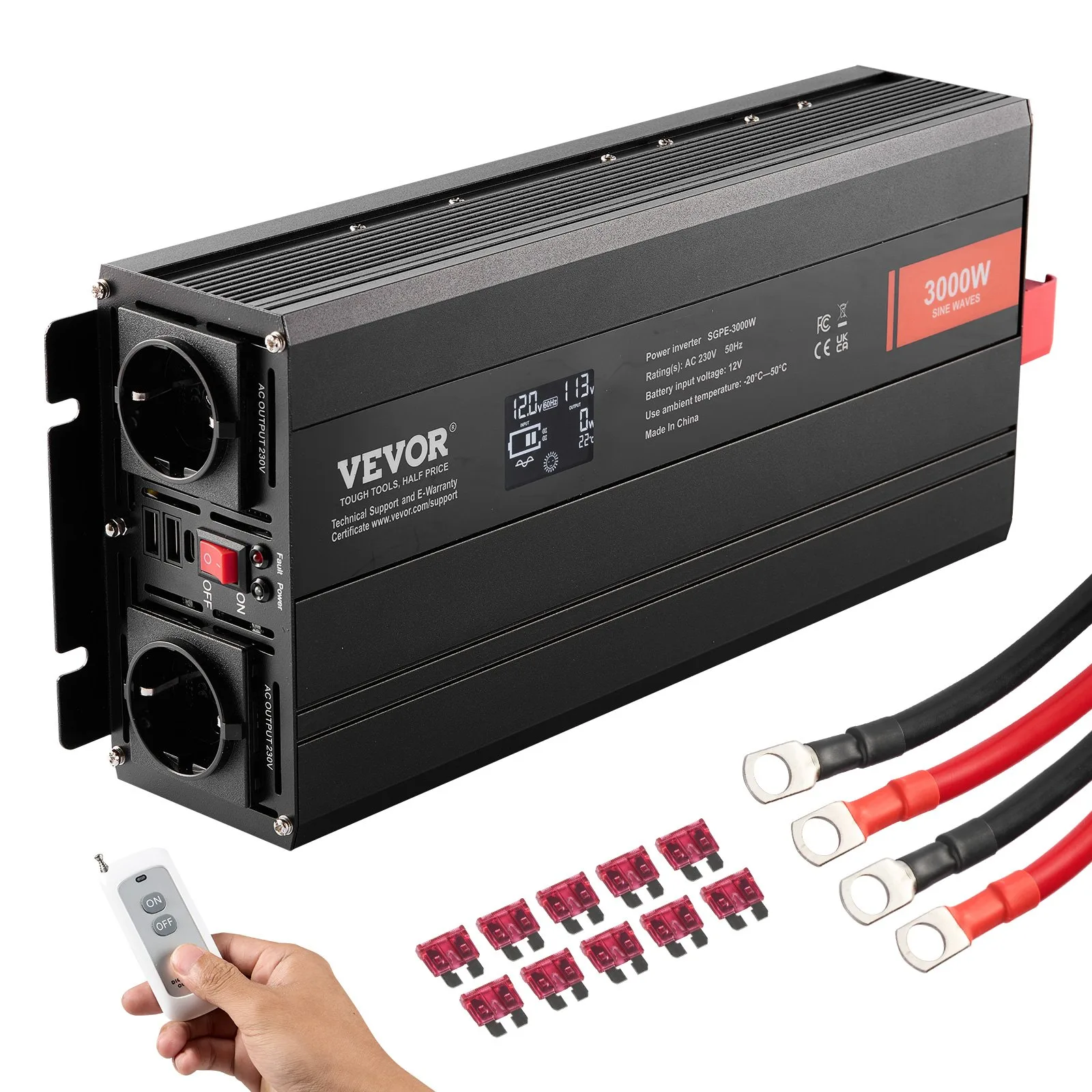 Inverter 3000 W, 12 V, peak 6000 W269,90 €View →
 Hybrid 4000 W, 24 V, with WiFi482,90 €View →
 Hybrid 5500 W, 48 V, without WiFi677,90 €View →
12 V, 24 V and 48 V do not swap
The SGPE-3000W input is 12 V direct current. The GD5548JMH battery is 24 V. The EM5500-48L battery is 48 V. On that 48 V page the table lists lead-acid, lithium and LiFePO. The text adds a lead battery, a water battery and some lithium, also without a communication connection. Those sentences are not folded into one battery type. The table’s three names stay in the table. The text’s lead battery, water battery and some lithium stay in the text, including the phrase about no communication connection. A 12 V battery is not offered on the page as something to hang on the 24 V hybrid or on the 48 V hybrid.
The 4000 W page says that another voltage needs a transformer, and that the transformer is not in the box. The 3000 W page does not mention a transformer, because its output is written as 230 V. The 5500 W output is 230 V 50 Hz. Its input row says 220/230 V alternating current. That input is the grid side, not a 12 V battery. The grid-side 220/230 V row is not the battery row. The battery row on that page is 48 V. The 24 V battery stays on GD5548JMH. The 12 V input stays on SGPE-3000W. None of the three voltages is rewritten as one of the others.
MPPT voltage is not a licence to swap the batteries. The 4000 W page says MPPT 24 V and 120 A, next to a 24 V battery. That 24 V is that page’s pair of statements. It is not copied onto the 12 V inverter, which has no solar controller and no MPPT. It is not copied onto the 48 V hybrid as if the MPPT voltage had changed with the watts. The 5500 W page states a 48 V battery and a PV array up to 500 V. It does not state the 4000 W page’s MPPT 24 V and 120 A as its own row.
Watts, the peak and the efficiency are not one number
The 6000 W surge is only on the 3000 W page. That page says continuous 3000 W and a surge of 6000 W. Continuous 3000 W and a surge of 6000 W do not mean the unit supplies 6000 W all the time. The page says the total power of the connected devices must not exceed the rated power. 6000 W is the surge. It is not the continuous row. The continuous row is 3000 W. The product line names a peak of 6000 W for that same model, SGPE-3000W. The page calls 6000 W the surge. Both wordings stay on the 3000 W side. Neither wording is a continuous 6000 W.
The 4000 W page and the 5500 W page do not give a surge in watts. They do not give a 6000 W figure, and they do not give a peak in watts to put beside the 3000 W page’s surge. The 5500 W table says a rated power of 5500 W ± 10%. That plus-minus is not on the other pages. It is not applied to 3000 W, and it is not applied to 4000 W. The model number GD5548JMH does not turn the 4000 W machine into 5500 W. The digits in the model stay the model. The power printed for that model is 4000 W.
Efficiency is three different sentences, and they are not pulled into one figure. The 3000 W page says up to 88% at full load. The 4000 W table says an MPPT peak of 93%. The 4000 W text says 99% conversion. Both of those 4000 W figures stay: 93% in the table and 99% in the text. The 5500 W text says up to 96%, and charging up to 100 A from the sun. 99% is not copied onto the 3000 W page. 88% is not copied onto the hybrids. 96% is not copied onto the 4000 W page, and 93% is not copied onto the 5500 W page. Up to 88% at full load remains a 3000 W sentence. The MPPT peak of 93% remains a table sentence on the 4000 W page. 99% conversion remains a text sentence on that same page. Up to 96% remains a 5500 W sentence.
WiFi is on the middle one, not on the largest
The 4000 W page says built-in WiFi. The 5500 W row says 5500 W without Wi-Fi. A larger watt figure does not bring remote monitoring. 5500 W is the larger watt figure of those two, and it is the one whose row says without Wi-Fi. The 3000 W page has no WiFi. What that page does have is a wireless remote of 100 m and an LCD on the case. The 100 m remote is not copied onto the hybrids. The LCD on the case is not copied onto them either. WiFi stays on GD5548JMH. The phrase “without Wi-Fi” stays on EM5500-48L. No WiFi, and a 100 m remote, stay on SGPE-3000W.
The 5500 W unit is controlled from buttons: charging from the sun, from the grid, or as a hybrid, and discharge UTL, SOL, SBU or SUB. The response is 10 ms as a UPS and 20 ms as a device. Those mode names and those milliseconds are not on the other pages. UTL, SOL, SBU and SUB are not written onto the 4000 W page, and they are not written onto the 3000 W page. 10 ms and 20 ms stay with EM5500-48L. The 4000 W page names WiFi monitoring and does not give those mode names. Naming WiFi monitoring is not the same as printing UTL, SOL, SBU and SUB.
The sockets and the ports stay on the page that lists them. The 3000 W page has two alternating-current sockets, two USBs totalling 18 W, and one C-port up to 30 W. Those port figures are not on the hybrid pages in this guide. The hybrids are not given an 18 W USB total, and they are not given a C-port of up to 30 W, because their pages here do not print those rows. The 100 m remote stays a 3000 W remote. It is not a WiFi feature, and it is not moved to the 4000 W page to sit beside built-in WiFi.
Weight and the case go against the watts
4.85 kg is the 3000 W, aluminium alloy, and the fan starts working above 40 °C. 9.75 kg is the 4000 W, powder-coated sheet metal, white, noise below 50 dB, humidity 20–95% non-condensing, temperature −10 to 50 °C in two writings. The 4000 W table does not give a product size. The box is 22.5 × 43 × 51.5 cm. 8.35 kg is the 5500 W, size 445 × 313 × 107 mm, and it is lighter than the 4000 W. The box is 20 × 38 × 56 cm. A bigger watt figure is not automatically heavier. 5500 W weighs 8.35 kg. 4000 W weighs 9.75 kg. 3000 W weighs 4.85 kg.
The material and the noise stay where they are printed. Aluminium alloy is the 3000 W case material on that page. Powder-coated sheet metal, and the colour white, are the 4000 W page. Noise below 50 dB is the 4000 W page. Humidity 20–95% non-condensing is the 4000 W page. The temperature −10 to 50 °C is written twice on that page, and both writings are that range. The 5500 W page in this guide does not repeat the aluminium alloy, does not repeat the powder-coated sheet metal, does not repeat “white”, does not repeat below 50 dB, and does not repeat −10 to 50 °C. Those rows are not filled in from the neighbouring page.
The features heading on the 4000 W page and on the 5500 W page starts with the fragment “5.08 cm”. The tables do not repeat that centimetre. The fragment is not taken as the case size. The 3000 W size is 415 × 164 × 80 mm, and that page does not have the fragment. The 5500 W product size that the page does print is 445 × 313 × 107 mm. The 4000 W page has no product-size row. What that page does give is the box, 22.5 × 43 × 51.5 cm, beside the weight 9.75 kg. The box is not the case size, and “5.08 cm” does not supply the missing case size.
How to choose?
If the battery is 12 V and the wanted output is 230 V alternating current, with a surge of 6000 W, it is SGPE-3000W. Continuous power on that page is 3000 W. The surge is 6000 W, and 6000 W is not continuous. There is no solar MPPT and no solar controller. The remote is 100 m. There is an LCD on the case. The weight is 4.85 kg. The size is 415 × 164 × 80 mm. The page says up to 88% at full load. Two alternating-current sockets, two USBs totalling 18 W, one C-port up to 30 W. The page does not give hertz. It does give 230 V alternating current. The fan starts above 40 °C. There is no WiFi on this page.
If the battery is 24 V and the page has to say WiFi and MPPT 120 A, it is GD5548JMH. The power is 4000 W. The table says an MPPT peak of 93%. The text says 99% conversion. Both stay. The frequency is 50/60 Hz. The output named on the page is 230 V. Another voltage needs a transformer, and the transformer is not in the box. The weight is 9.75 kg. The box is 22.5 × 43 × 51.5 cm. A product size is not in the table. The model number does not change the watts to 5500. GD5548JMH remains the 4000 W model. Built-in WiFi is on this page. The mode names UTL, SOL, SBU and SUB are not.
If the battery is 48 V and the power is 5500 W ± 10%, it is EM5500-48L. There is no WiFi. The row says without Wi-Fi. The weight is 8.35 kg, which is less than the 4000 W page’s 9.75 kg. The size is 445 × 313 × 107 mm. The box is 20 × 38 × 56 cm. The PV array on the page is up to 500 V. The output is 230 V 50 Hz. The input row of 220/230 V alternating current is the grid side. Discharge modes on this page are UTL, SOL, SBU and SUB, with charging from the sun, from the grid, or as a hybrid. The response is 10 ms as a UPS and 20 ms as a device. The text says up to 96%.
The 3000 W and the 5500 W are not two ends of the same hybrid. The 3000 W is not a solar hybrid. In the middle is the 4000 W, and only that one is 24 V. Only that one has WiFi in this set. Only the 5500 W prints UTL, SOL, SBU and SUB. Only the 3000 W prints a surge of 6000 W, a 100 m remote, and up to 88% at full load. The fragment “5.08 cm” in two features headings is not the measurement that chooses among them.
Comparison
| Product | Price | What sets it apart |
|---|---|---|
| Inverter 3000 W, 12 V, peak 6000 W | 269,90 € | not solar, remote 100 m, 88% on the page, 4.85 kg |
| Hybrid 4000 W, 24 V, with WiFi | 482,90 € | MPPT 120 A, table 93% and text 99%, 9.75 kg |
| Hybrid 5500 W, 48 V, without WiFi | 677,90 € | 5500 W ± 10%, 500 V PV, 8.35 kg, modes UTL SOL SBU SUB |
The price in the link is the shop’s current price and opens the product.
Who is this not for?
- The 3000 W is not a solar hybrid. There is no controller on that page.
- The 4000 W model number GD5548JMH does not make it a 5500 W machine. The wattage is 4000.
- WiFi is on the 4000 W page. The 5500 W page says without Wi-Fi.
- 99%, 96% and 88% are three different sentences. They are not pulled into one efficiency.
Frequently asked questions
Is the 3000 W a solar hybrid?
No. It makes 230 V alternating current from 12 V direct current. There is no MPPT on that page, no solar-panel volt, and no WiFi. There is no solar controller. The model is SGPE-3000W, continuous 3000 W, surge 6000 W, up to 88% at full load, 4.85 kg, 415 × 164 × 80 mm. A wireless remote of 100 m and an LCD on the case are on this page. They are not a solar hybrid. The hybrid pages are the 24 V 4000 W and the 48 V 5500 W.
Why does the 4000 W model number look like 5500?
The table says model GD5548JMH and power 4000 W. The number is not rewritten as the power. The model can be misread because the digits sit near 5500. The page still prints 4000 W. EM5500-48L is the other model, and that is the page whose rated power is 5500 W ± 10%. GD5548JMH stays 4000 W, 24 V, with WiFi, MPPT 24 V and 120 A, weight 9.75 kg. The model string is not a watt rating.
Is a larger watt figure heavier?
No. The 4000 W weighs 9.75 kg. The 5500 W weighs 8.35 kg. The 3000 W weighs 4.85 kg. The larger watt figure of the two hybrids is the lighter of those two. 8.35 kg stays with EM5500-48L and with the size 445 × 313 × 107 mm. 9.75 kg stays with GD5548JMH. 4.85 kg stays with SGPE-3000W and with 415 × 164 × 80 mm. Watts are not used as a stand-in for the weight.
What is the battery voltage?
12 V is the 3000 W. 24 V is the 4000 W. 48 V is the 5500 W. They are not swapped with one another. The 3000 W input is 12 V direct current. The 4000 W battery is 24 V, and that page also says MPPT 24 V. The 5500 W battery is 48 V: the table lists lead-acid, lithium and LiFePO, and the text says a lead battery, a water battery and some lithium, also without a communication connection. A 12 V battery is not offered for the 24 V or the 48 V hybrid.
Is 6000 W continuous?
No. 6000 W is the surge on the 3000 W page. The continuous row is 3000 W. The page says the total power of the connected devices must not exceed the rated power. The other pages do not give a surge in watts. 6000 W is not written onto the 4000 W page, and it is not written onto the 5500 W page. The 5500 W rated power is 5500 W ± 10%, which is its own row, not a surge taken from SGPE-3000W. The product line says a peak of 6000 W for the 3000 W model. The page says surge. Neither one is a continuous 6000 W.
How high is the efficiency?
The 3000 W page says up to 88% at full load. The 4000 W table says an MPPT peak of 93%, and the text says 99%. The 5500 W text says up to 96%. One number is not made out of them. 88% stays with SGPE-3000W. 93% and 99% both stay on GD5548JMH, one in the table and one in the text. 96% stays with EM5500-48L. The 5500 W charging figure of up to 100 A from the sun is a charging sentence, not a fourth efficiency that replaces 96%.
Which one has WiFi?
The 4000 W page has built-in WiFi. The 5500 W row says without Wi-Fi. The 3000 W page has no WiFi. It does have a wireless remote of 100 m and an LCD on the case. The remote is not copied onto the 4000 W page, and WiFi is not copied onto the 5500 W page or onto the 3000 W page. A larger watt figure does not bring remote monitoring. 5500 W is larger than 4000 W and is the page that says without Wi-Fi.
What is the frequency?
The 4000 W page says 50/60 Hz. The 5500 W output says 50 Hz. The 3000 W page does not give hertz. It does give 230 V alternating current. 50/60 Hz is not copied onto SGPE-3000W. 50 Hz from the 5500 W output is not copied onto the 3000 W page either, and it is not used to replace the 4000 W page’s 50/60 Hz. The 5500 W input row of 220/230 V alternating current is the grid side, not a frequency for the 12 V inverter.
Does the 5500 W charge the battery from the sun?
The page says up to 100 A from the sun, 80 A from the grid, and 100 A together. The PV array voltage is up to 500 V. The 4000 W page says MPPT 120 A and 24 V. Those are different sentences. 120 A is not the 5500 W page’s 100 A, and 100 A together is not a sum calculated past what the page prints. The 3000 W page has no solar controller and no charging-from-the-sun row. Charging from the sun, as these amp figures, stays on the page that writes the figures.
What are UTL, SOL, SBU and SUB?
Those four discharge modes are only in the 5500 W text, together with charging from the sun, from the grid, or as a hybrid. The other pages do not use those names. The 4000 W page names WiFi monitoring and does not name UTL, SOL, SBU or SUB. The 3000 W page does not name them. On the 5500 W page the response is 10 ms as a UPS and 20 ms as a device. Those milliseconds stay with the same page as the four mode names. They are not added to GD5548JMH or to SGPE-3000W.
Does the fan run all the time?
The 3000 W page says the fan starts above 40 °C and stops below. The other pages do not repeat that 40 °C. The 4000 W page says noise below 50 dB. It does not say the fan’s temperature. The 5500 W page does not print the 40 °C sentence and does not print below 50 dB. The fan behaviour stays on SGPE-3000W. The noise sentence stays on the 4000 W page. One is not used to answer the other.
What protection is there?
The 3000 W page lists six protections, including overvoltage and undervoltage, overload, overheating, short circuit, reverse polarity, and CE/FCC. The 5500 W page lists overtemperature, overcurrent, overvoltage and undervoltage, short circuit and overload. The 4000 W page does not give a separate row of six protections. The six-protection list stays on SGPE-3000W. The 5500 W list stays on EM5500-48L. CE/FCC stays where that page puts it, with the 3000 W protections. Reverse polarity is part of the 3000 W list, not a row the hybrids are given here. Overtemperature and overcurrent are in the 5500 W list.
Is “5.08 cm” the case size?
No. That fragment is in the features heading of the 4000 W and of the 5500 W. The tables do not repeat it. It is not the case size. The 3000 W size is 415 × 164 × 80 mm, and that page does not carry the fragment. The 5500 W size the page does print is 445 × 313 × 107 mm. The 4000 W table does not give a product size. “5.08 cm” does not fill that blank.
Is the 4000 W size known?
It has no product-size row. What is known is the weight, 9.75 kg, and the box, 22.5 × 43 × 51.5 cm. The 5500 W size is 445 × 313 × 107 mm, and that size is not the 4000 W case. The 5500 W box is 20 × 38 × 56 cm. The 3000 W size is 415 × 164 × 80 mm. The fragment “5.08 cm” in the features heading is not a substitute for the missing 4000 W product size. The box measurement stays a box measurement.