
Short answer: Three blenders, all 2 litres and all with a peak of 2200 W. That peak is not the difference. The 4 kg black machine is rated 1400 W, the page says 2600 revolutions per minute and six 304 blades, size 240 × 198 × 440 mm, model HS-210D-US. The power supply on this page is alternating current 120 V 60 Hz. The two 8.3 kg machines are rated 1600 W, four 304 blades, size 280 × 245 × 480 mm, model HS-608C on both. The black one of them says 26000 revolutions per minute in the text. The white one says 2600 in the same place. Those two pages do not write a voltage. A sound cover and one-touch self-clean are on the two heavier ones, not on the 4 kg machine.
Products in this guide
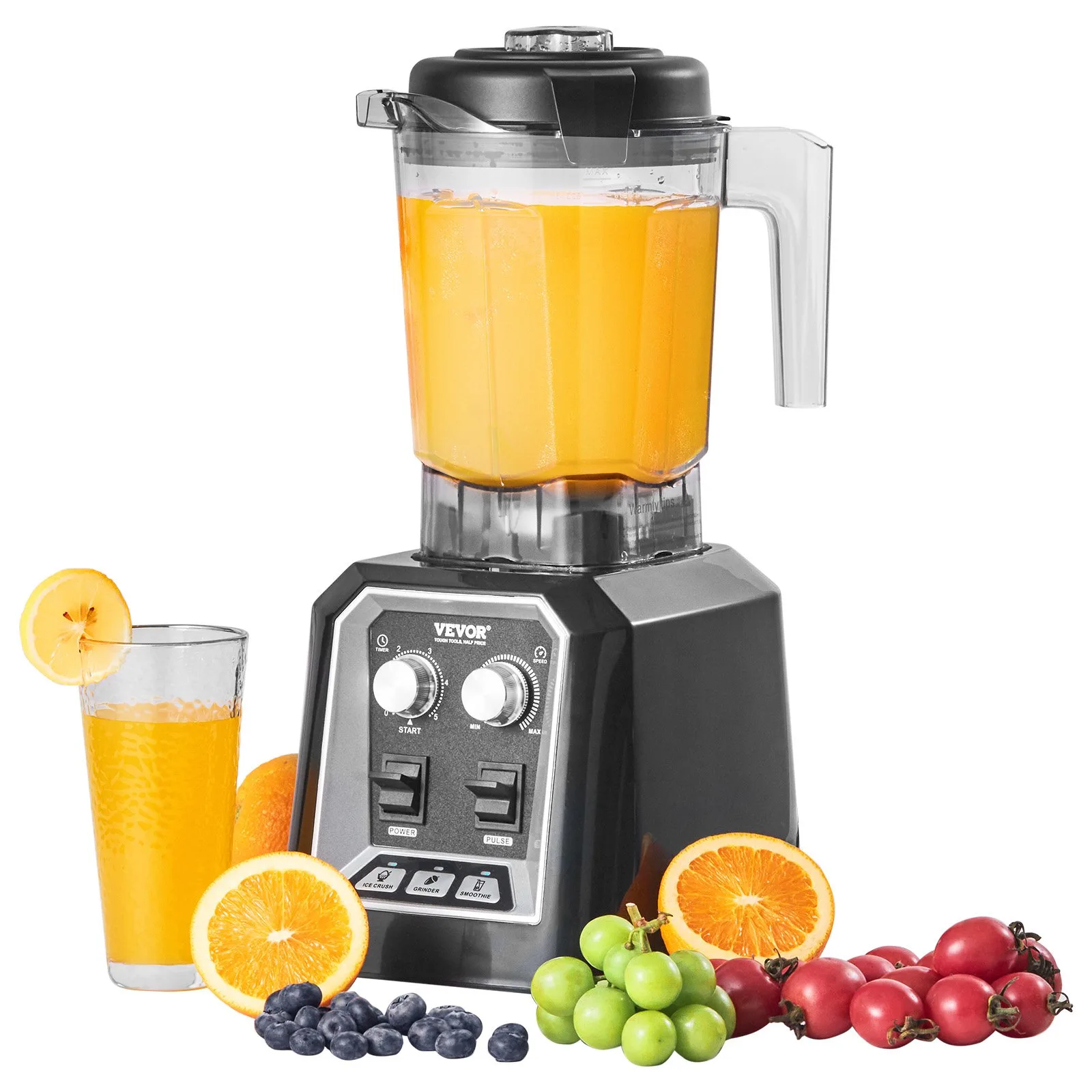 Blender 4 kg, 6 blades, 120 V on the page110,90 €View →
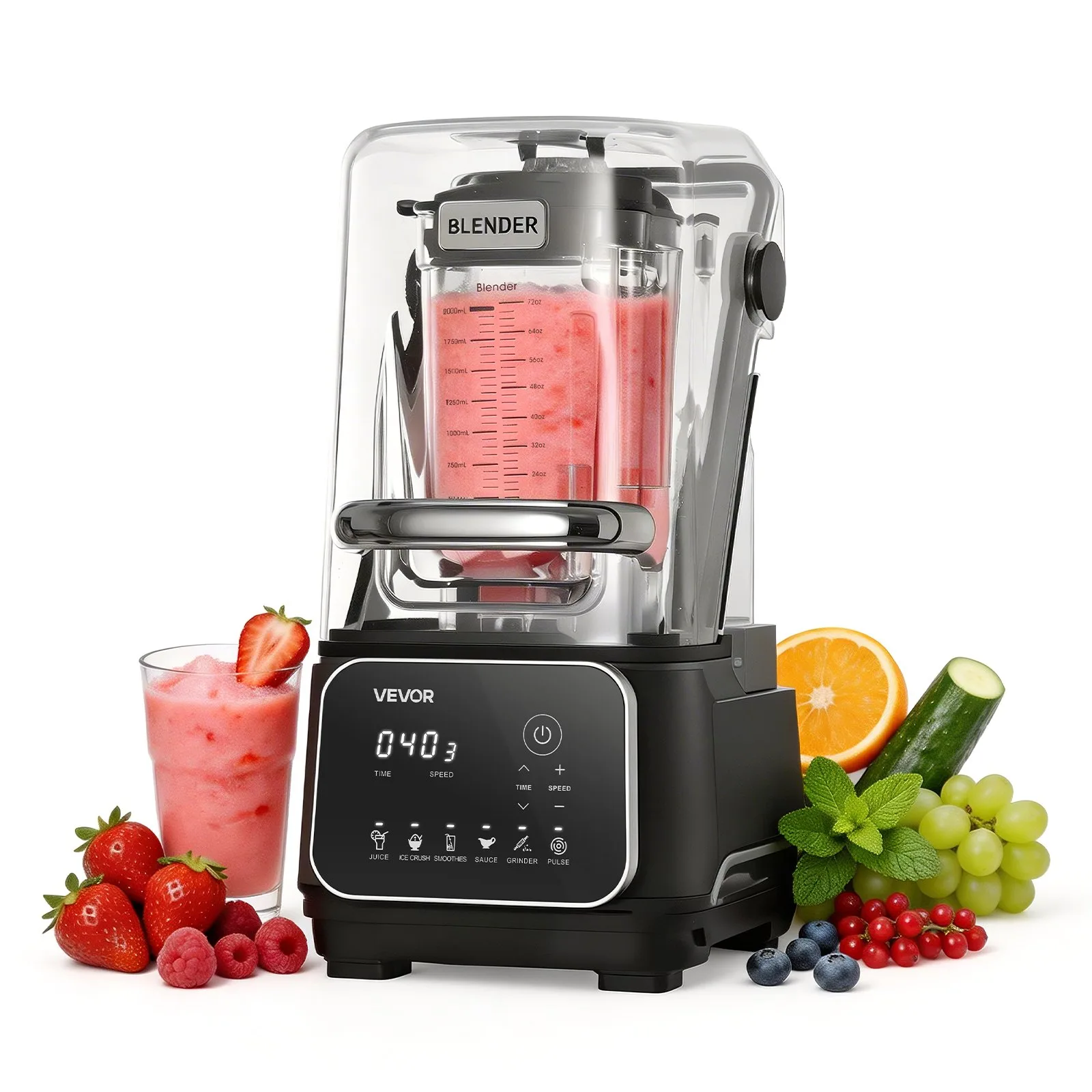 Blender 8.3 kg, black, 4 blades213,90 €View →
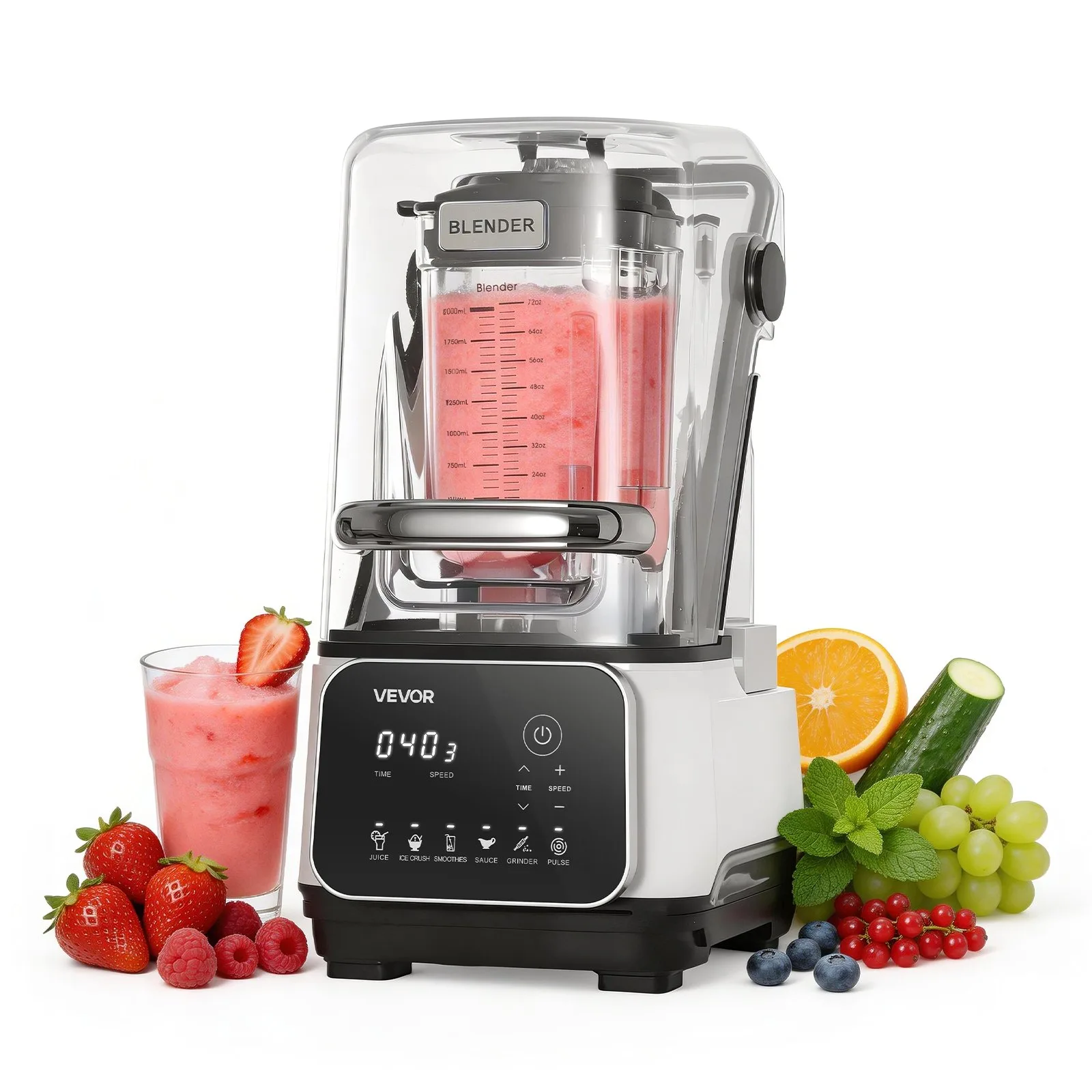 Blender 8.3 kg, white, 4 blades216,90 €View →
2200 W is the ceiling, not the difference
All three tables list a maximum power of 2200 W. That figure is the peak. It is the same ceiling on the 4 kg machine and on both 8.3 kg machines. The rated power is not that ceiling. The 4 kg machine is rated 1400 W. Each of the two heavier machines is rated 1600 W. A search that lines the three up by 2200 W only is comparing the same peak. The difference the pages actually print is the rating, the blade count and the weight.
The peak is not a continuous rating, and it is not the rated power. 2200 W does not replace 1400 W on the light machine. 2200 W does not replace 1600 W on the black 8.3 kg machine or on the white 8.3 kg machine. The rated row stays 1400 W where the page puts it, on the 4 kg machine, and 1600 W where the pages put it, on the two heavier machines. Nothing in the shared peak makes those rated rows the same row.
Speed is not one number either. The 4 kg page says 2600 revolutions per minute. The black 8.3 kg text says 26000 revolutions per minute. The white 8.3 kg text says 2600 in the same place, although the model number is the same HS-608C and the rest of the table is the same as the black. Those two speed sentences, 26000 and 2600, are not pulled into one number. They stay as written. Neither heavy machine has a separate revolutions row of its own in the table. The speed on those two pages is the sentence in the text, not a table row that could be averaged.
The white machine’s 2600 is not edited into 26000. The black machine’s 26000 is not edited into 2600. The same model number does not give permission to pick one sentence and delete the other. HS-608C is on both heavier pages. The speed sentence is not the same sentence. The 4 kg page’s 2600 is that page’s own number. It is not a copy of the white machine’s sentence, even though the digits match.
120 volts is only on one page
The power supply of the 4 kg machine is written as alternating current 120 V 60 Hz. The model number is HS-210D-US, and it ends in US. An Estonian wall socket is a different voltage and a different frequency. The page does not name an adapter, and it does not name a 230 V version. If that power-supply row does not match the wall, six 304 blades do not fix it, and the 2200 W peak does not fix it. The page’s own row is the row that has to be read.
The two 8.3 kg pages do not give a voltage row. 230 V is not taken from those pages, because they do not print it. 120 V is not taken from those pages either, because they do not print it. Someone who wants to know which plug the wall is expected to feed reads the page again: the row is missing. The 4 kg machine’s 120 V 60 Hz does not carry over onto the black HS-608C page, and it does not carry over onto the white HS-608C page. A shared peak of 2200 W is not a shared voltage. A shared jar of 2 litres is not a shared voltage.
The not-for line on the 4 kg machine is the same fact from the other side. The page is 120 V 60 Hz. That row does not describe an Estonian 230 V socket. The heavier pages still do not fill the gap. They do not print a voltage, so the gap stays a gap. It is not closed by the model number HS-608C, by four 304 blades, by 8.3 kg, or by the size 280 × 245 × 480 mm.
Six blades or four, and what covers the noise
The 4 kg machine has six 304 blades. Each of the two heavier machines has four 304 blades. The blade count is not the jar. The jar is 2 litres on all three. Six blades do not make a larger jar, and four blades do not make a smaller jar. 2 litres stays the jar on the light page and on both heavy pages. The 4 kg machine weighs 4 kg and measures 240 × 198 × 440 mm. The heavy machines weigh 8.3 kg and measure 280 × 245 × 480 mm. Black and white are the same weight and the same size. The colour does not change 8.3 kg, and it does not change 280 × 245 × 480 mm.
A noise cover is described only on the two heavy pages: a thickened soundproof cover which, according to the page, reduces noise and limits splash. The 4 kg page does not name that cover. The sales text says “quiet” beside the 4 kg machine as well. That word is not a decibel, and it is not a cover the page forgot to specify. No page gives a decibel figure. The absence of a decibel stays on all three. The sound cover stays on the two 8.3 kg pages. It is not copied onto the 4 kg page because the sales text used the word “quiet”.
One-touch self-clean is on the two heavier machines. The 4 kg page does not name one-touch self-clean. That page says detergent in warm water and starting, and it says the bottle goes in the dishwasher. Those are the 4 kg page’s own cleaning sentences. They are not the one-touch sentence from the heavier pages, and the one-touch sentence is not moved onto the 4 kg page. Blade count, the sound cover and the self-clean stay only where each page puts them.
A knob, a touch, and what the page allows as a drink
The 4 kg machine has a rotary knob that adjusts speed and time, and it has pulse. The two heavier machines have touch: speed, time and pulse. The knob stays on the 4 kg page. Touch stays on the two 8.3 kg pages. Pulse is on all three, for ice, as the page says. The pages do not give an ice-crushing time in seconds. A shared pulse for ice is not a shared way of setting the speed. The light machine is set from the knob. The heavy machines are set from touch. That split stays.
All three texts allow juice, a cocktail, a milkshake, a smoothie, vegetable juice, ice, nuts and puree, and they also call the machine a grinder. That is the page’s use list. It is not proof that a bone goes in, and it is not proof that hot soup goes in. The list is printed on each of the three pages. It does not become a different list on the white page because the speed sentence is 2600, and it does not become a different list on the black page because the speed sentence is 26000.
The body material is not one row. The 4 kg page says food-grade PC, without bisphenol A, impact-resistant, with certificates ETL and CE. The material row in the table of the two heavier machines is the word “Computer”. A sound cover and a food-grade cup are in their text. Those pages do not repeat PC, and they do not repeat BPA. “Computer” is left as the table’s word. It is not rewritten as PC. The food-grade cup in the heavier text is not the same sentence as the 4 kg page’s food-grade PC body. ETL and CE stay on the 4 kg page. They are not copied onto HS-608C.
How to choose?
If the lighter machine is the one wanted, 4 kg, with six 304 blades and a knob, the power-supply row is read first: alternating current 120 V 60 Hz, model HS-210D-US. Without that voltage the machine does not run, according to the page. The rated power on that page is 1400 W. The peak on that page is 2200 W. The page says 2600 revolutions per minute. The size is 240 × 198 × 440 mm. The jar is 2 litres. The page does not name a thickened soundproof cover, and it does not name one-touch self-clean. It does say detergent in warm water and starting, and that the bottle goes in the dishwasher.
If the wanted machine is 8.3 kg, with four 304 blades, a sound cover and touch, the black page and the white page are the same table. Both are model HS-608C. Both are rated 1600 W. Both show a peak of 2200 W. Both are 280 × 245 × 480 mm. The black text says 26000 revolutions per minute. The white text says 2600. No other number on those two pages fails to match. The speed sentences are the disagreement, and they stay. Neither page prints a voltage.
If the voltage has to be written on the page and 120 V does not suit, the two heavier pages do not give a voltage row. That voltage is not inferred from the 4 kg machine. 120 V 60 Hz stays on HS-210D-US. It is not moved to HS-608C to fill a blank. A blank voltage row is still a blank after the colour is chosen, after the sound cover is noted, and after the touch control is noted.
2 litres and the 2200 W peak do not choose the machine. Those rows are on all three. The choice is the rated power, 1400 W or 1600 W, the blade count, six or four, the weight, 4 kg or 8.3 kg, the control, knob or touch, the sound cover, which the heavier pages describe and the 4 kg page does not, and the voltage, which only the 4 kg page prints. The white and black heavier machines still have to be read as two speed sentences, 2600 and 26000, not as one corrected figure.
Comparison
| Product | Price | What sets it apart |
|---|---|---|
| Blender 4 kg, 6 blades, 120 V on the page | 110,90 € | rated 1400 W, 2600 rpm, knob, 240 × 198 × 440 mm |
| Blender 8.3 kg, black, 4 blades | 213,90 € | rated 1600 W, 26000 rpm in the text, sound cover, touch |
| Blender 8.3 kg, white, 4 blades | 216,90 € | rated 1600 W, 2600 rpm in the text, same model HS-608C |
The price in the link is the shop’s current price and opens the product.
Who is this not for?
- The 4 kg machine is alternating current 120 V 60 Hz on the page. That row does not describe an Estonian 230 V socket.
- The 2200 W peak does not tell them apart. The difference is the rating, 1400 W or 1600 W.
- The white and the black are not the same speed sentence, although the model number is HS-608C on both.
- The 4 kg page does not name a sound cover or a one-touch wash.
Frequently asked questions
Are they all 2200 W?
The peak is 2200 W on all three. That is the maximum power in each table. The rated power is 1400 W on the light machine and 1600 W on the two heavy machines. The peak is not the difference, and it is not the rated power. Comparing only 2200 W compares the same ceiling. The 4 kg page still says 1400 W as the rating. Each 8.3 kg page still says 1600 W as the rating. Those rated figures stay on their own pages.
What voltage is the 4 kg machine?
The page says alternating current 120 V 60 Hz. The model is HS-210D-US. The page does not add a 230 V row, and it does not add an adapter. Six 304 blades, a rated 1400 W and a peak of 2200 W do not change that power-supply row. The size 240 × 198 × 440 mm does not change it either. The row that is printed is 120 V 60 Hz, and the page stops there.
What voltage are the two heavy ones?
Their pages do not give a voltage row. 120 V is not copied there from the light machine, and 230 V is not inferred there. The black page is model HS-608C, rated 1600 W, 8.3 kg, 280 × 245 × 480 mm, four 304 blades. The white page is the same table. None of those rows is a voltage. The missing row stays missing on both. The 4 kg page’s alternating current 120 V 60 Hz belongs to HS-210D-US.
How many blades are there?
The 4 kg machine has six 304 blades. Each of the two 8.3 kg machines has four 304 blades. The jar is 2 litres on all three. The blade count is not the jar capacity. Six stays on the light page, with the knob and the rating of 1400 W. Four stays on the black page and on the white page, with touch and the rating of 1600 W. The pages do not move six blades onto HS-608C, and they do not move four blades onto HS-210D-US.
Why do the black and the white state different speeds?
The black 8.3 kg text says 26000 revolutions per minute. The white text says 2600. The model is HS-608C on both, the weight is 8.3 kg and the size is 280 × 245 × 480 mm. The pages themselves do not make those sentences into one. 26000 stays on the black text. 2600 stays on the white text. There is no separate revolutions row in the table for either heavy machine. The rest of the table matches. The speed sentences do not. 26000 and 2600 stay as two writings.
What speed is the 4 kg machine?
The text says 2600 revolutions per minute. That is the 4 kg page’s number, not a copy of the white machine’s sentence. The white page also says 2600, and that sentence stays on the white page, on model HS-608C. The black page says 26000, and that sentence stays on the black page. The 4 kg figure is read from the 4 kg page, next to six 304 blades, a rated 1400 W, a peak of 2200 W and alternating current 120 V 60 Hz.
Is the sound cover on all of them?
No. A thickened soundproof cover, which the page says reduces noise and limits splash, is described by the two 8.3 kg machines. The 4 kg page does not name a cover. The sales text says “quiet” beside that machine as well, and that word is not a cover and not a decibel. There are no decibels on any of the three pages. The sound cover stays with the black HS-608C and the white HS-608C. It is not added to the 4 kg page.
How is the speed set?
The 4 kg machine has a rotary knob for speed and for time, and it has pulse. The two heavier machines have touch for the same things: speed, time and pulse. Pulse is on all three, for ice, as the page says. An ice-crushing time in seconds is not given. The knob is not written onto the 8.3 kg pages. Touch is not written onto the 4 kg page. How the speed is set stays on the page that describes it.
Does the cup go in the dishwasher?
All three pages say the body or the cup is removable and can be washed in the dishwasher or separately. The page does not name a programme. Separately, the 4 kg page says the bottle goes in the dishwasher, in the same stretch where it says detergent in warm water and starting. That bottle sentence stays on the 4 kg page. The programme is still unnamed on all three. A dishwasher sentence is not a named cycle.
What is the difference in the self-clean?
One-touch self-clean is on the two heavier pages, with the sound cover and the touch control. The 4 kg page says warm water, detergent and starting. It does not say one touch. The heavier pages’ one-touch sentence is not copied onto the 4 kg page, and the 4 kg page’s warm-water sentence is not copied onto them as if it were the same control. Self-clean stays where each page writes it.
Are these juicers?
The page calls them a juicer, a blender and a grinder, and it lists juice, a smoothie, ice, nuts and puree. There is no separate citrus press here, and there are no sugarcane rollers. The pages’ use list also names a cocktail, a milkshake and vegetable juice. Calling the machine a juicer is the page’s wording, not a separate press, and that list is not proof that a bone or hot soup goes in.
What material is the body?
The 4 kg page says food-grade PC, without bisphenol A, impact-resistant, and ETL and CE. The material row in the table of the two heavier machines is the word “Computer”. They do not repeat PC, and they do not repeat BPA. Their text does mention a sound cover and a food-grade cup. The word “Computer” stays the table’s word on both HS-608C pages. It is not replaced with the 4 kg page’s PC sentence. ETL and CE stay on the 4 kg page.
How big are they?
The 4 kg machine is 240 × 198 × 440 mm. Both 8.3 kg machines are 280 × 245 × 480 mm. Black and white are the same size, and they are the same weight, 8.3 kg. The 4 kg weight stays with the 240 × 198 × 440 mm page. The size is not the jar. The jar is 2 litres on each page, including the smaller body and both larger bodies. Blade count does not change the millimetres.
Is 2 litres a family jug?
2 litres is the jar, and it is on all three pages. The page says this suits a family event. The page does not calculate how many drinks that is. The jar capacity is not turned into a family jug by the event sentence, and it is not turned into one by the shared 2200 W peak. How many drinks come out of 2 litres is not a figure on these pages. The jar stays 2 litres where the pages print it, on the 4 kg machine and on both 8.3 kg machines.