
Short answer: Three 12 V pages, and only two are amp chargers. The solar panel’s model number is 20W and the maximum power is 20 W. The compatible battery voltage is 12 V. The panel size is 521 × 370 × 215 mm. The post’s outer diameter is 40–80 mm, and the 80 mm in the title is the top of that range, not a side of the panel. The tilt angle is 0–60°. IP67 is only here. The net is 3 kg. The glass row is written in the form läbipaistv karastatud klaas. The SDC-30A charging current is 30 A, and the electric-current row is also 30 A. The maximum output is 375 W. The input voltage is 12 V, and the input-battery range is direct current 8–16 V. The charging voltage is 13.2–14.7 V on a lead-acid battery and 12.6–14.6 V on a lithium battery. The temperature row is −15.6 to 50.0 °C and, in the same row, −20 °C to 50 °C. The net is 1.2 kg. SDC-60A repeats the same voltage, the same range and the same temperature row, but the current is 60 A on both current rows and the power is 750 W. The net is 1.96 kg. Neither direct-current charger writes 20 A. The solar page writes no amp.
Products in this guide
 Solar 20 W, post 40–80 mm, IP6781,90 €View →
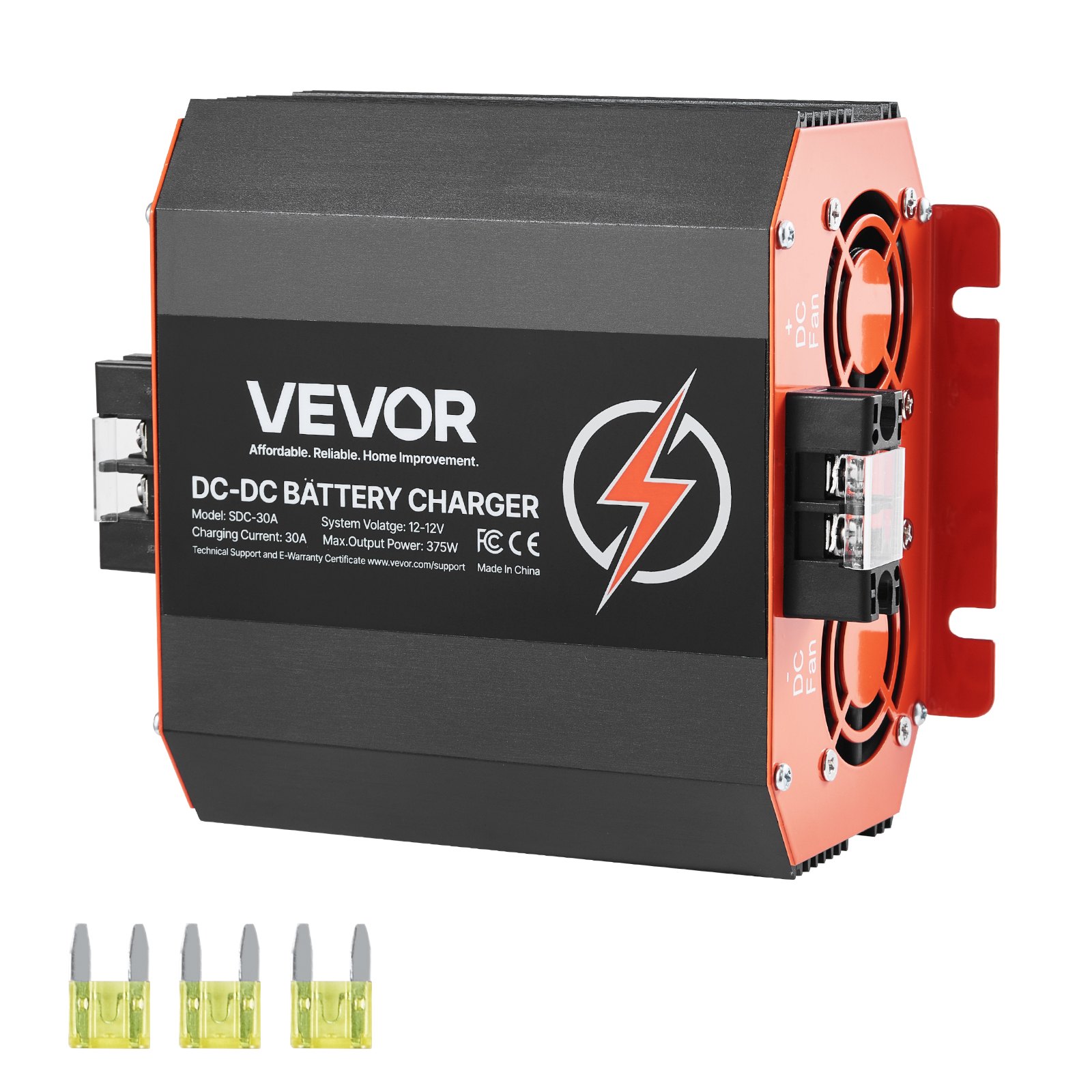 SDC-30A, 30 A and 375 W134,90 €View →
 SDC-60A, 60 A and 750 W227,90 €View →
20 W is not 20 A, and 80 mm is not the panel
The solar page’s maximum power is 20 W. The model-number field is also 20W. Those are two writings of the same designation, not an amp. 20W in the model field and 20 W on the power row stay as those two writings. Neither one is 20 A. A charging-current row is absent on this page. An electric-current row is absent on this page. The solar page does not write an amp at all. 30 A and 60 A are on the two other pages. There is no 20 A card among the three. An older question that asks “20 A or 60 A” leaves out 30 A and counts watts as amps. 20 W stays watts. 30 A stays the SDC-30A current. 60 A stays the SDC-60A current.
The panel is 521 × 370 × 215 mm. That is the panel size the page writes. The 80 mm in the title is a title figure. The page separates it from the panel size. It is the top end of the compatible tube’s diameter, the range 40–80 mm, which the opening also calls the post’s outer diameter. 80 mm is not a confirmed side, thickness or height of the panel. The confirmed panel writing is 521 × 370 × 215 mm. 40 mm and 80 mm stay the ends of the post range. They are not rewritten as a second panel size.
The opening calls 0–60° a tilt angle. The later line calls 0–60° the clamp angle. Both names stay on the solar page, on that same 0–60° figure. The angle is not written onto SDC-30A or SDC-60A. The colour is white, on the solar page. White is not written onto the SDC pages. The net of 3 kg is the heaviest of the three, and the power of 20 W is the smallest of the three. The package is 44.2 × 23.0 × 50.5 cm, and that package is not the panel size. 521 × 370 × 215 mm stays the panel. 44.2 × 23.0 × 50.5 cm stays the solar package. The glass row is written in the form läbipaistv karastatud klaas. The row is kept in that printed form. It is not given a completed first word, and it is not copied onto the SDC pages.
12 V and 8–16 V are both on the SDC row
SDC-30A and SDC-60A each have an input-voltage row of 12 V. Each also has an input-battery range of direct current 8–16 V. The page does not pick one of those rows in place of the other. 12 V stays the input-voltage row. 8–16 V stays the input-battery range. They are two rows on both SDC pages. The solar page has 12 V as the compatible battery voltage, and it does not have 8–16 V. 8–16 V is not added to the solar panel. The solar 12 V is not replaced by the SDC range.
The charging voltage is the same on both SDC pages: 13.2–14.7 V on a lead-acid battery and 12.6–14.6 V on a lithium battery. 30 A does not get a different voltage from 60 A. The current rows change from 30 A to 60 A. The voltage rows do not. 13.2–14.7 V stays lead-acid on both. 12.6–14.6 V stays lithium on both. 12 V and 8–16 V stay on both. None of those voltage writings is an amp, and none of them is a watt.
The power is written as 375 W on SDC-30A and 750 W on SDC-60A. The short answer calls 375 W the maximum output, and the later line calls 375 W and 750 W the written powers. The page does not write a product of volts and amps. 375 W is not presented as 12 times 30. 750 W is not presented as a multiple of 60. The page writes the watt figure and the amp figure separately. This guide does not multiply them. 30 A is on the charging-current row and on the electric-current row. 60 A is on those two rows in the same way. Each pair is the same number twice, not two different currents. The rows themselves stay different rows: a charging-current row and an electric-current row. On SDC-30A both rows say 30 A. On SDC-60A both rows say 60 A. The second row is not a second, different amp value.
−15.6 °C and −20 °C are one temperature row
Both SDC pages write the operating temperature as −15.6 to 50.0 °C and, after a slash, −20 °C to 50 °C. That is one row. The lower end is two numbers, −15.6 and −20. The upper end is two writings, 50.0 °C and 50 °C. The page does not merge them into one number. −15.6 is not replaced by −20. −20 is not replaced by −15.6. 50.0 °C is not replaced by 50 °C. The same double row is on SDC-30A and on SDC-60A. 60 A does not get a different temperature from 30 A. The solar page has no temperature row. The SDC temperatures are not copied onto the solar panel, and the solar page is not given a blank degree that this guide then fills in.
The housing is aluminium alloy on both SDC pages. Aluminium alloy is not written onto the solar page. The nets are 1.2 kg on SDC-30A and 1.96 kg on SDC-60A. The packages are 14.5 × 20.0 × 25.0 cm and 14.5 × 20.0 × 29.0 cm. The product’s own length, width and height are not on the SDC pages. The only size written there is the package. The solar net of 3 kg does not carry over to either SDC page. The panel’s millimetres, 521 × 370 × 215 mm, do not carry over either. 1.2 kg stays with 30 A and 375 W. 1.96 kg stays with 60 A and 750 W. 3 kg stays with 20 W.
Which battery, which protection, and where it works
The solar page is compatible with 12 V batteries in this list: LiFePO4, Li-ion, AGM, Gel, SLA and EFB. That list is the solar list, at 12 V. SDC is compatible with a lead-acid battery and a lithium battery. On SDC, LifePo4 is a two-stage mode, spelled LifePo4. The lead-acid battery has three stages: bulk, absorption, float. The names AGM, Gel, SLA and EFB are not on the SDC page. The name Li-ion is not on the SDC page. The solar spelling LiFePO4 stays in the solar list. The SDC spelling LifePo4 stays the name of the two-stage mode. The stage counts are not added to the solar list. The solar chemistry names are not added to the SDC page.
The solar protection sentence names overvoltage, overcurrent, a short circuit, overheating, and the word overcharge twice. Overcharge stays written twice, not collapsed to one mention. IP67 is only on the solar kit. SDC protection is overvoltage and undervoltage, high temperature, reverse polarity, and an isolated input and output. The SDC page has no IP class. IP67 is not written onto SDC-30A or SDC-60A. The protections the solar card does not have, and the SDC page does, are undervoltage, reverse polarity, and an isolated input and output. The solar page names a short circuit. The SDC page does not name a short circuit. High temperature on the SDC page and overheating on the solar page stay the words each page uses.
The solar page names a gate opener, an electric fence, garden lighting, a farm device and a street surveillance camera. SDC names a caravan, a truck, a boat and a generator. Those place lists stay on the pages that write them. Amp-hours, minutes and a cable length are on none of the three pages. A charging time is not written. The sentence about waking a flat lithium battery is only on the SDC page, and it has no minute. The solar page does not have that sentence. The wake sentence is not given a duration, and it is not moved onto the solar panel.
How to choose?
If the page is a solar panel, the model is 20W, the power is 20 W, the rating is IP67 and the post is 40–80 mm, this is not a 20 A charger. The panel is 521 × 370 × 215 mm. The net is 3 kg. The angle is 0–60°, called a tilt angle and a clamp angle. The colour is white. The glass row is written läbipaistv karastatud klaas. The package is 44.2 × 23.0 × 50.5 cm and is not the panel. The compatible batteries named here are LiFePO4, Li-ion, AGM, Gel, SLA and EFB, at 12 V. There is no 8–16 V row, no amp row, no temperature row and no wake sentence. The 80 mm in the title stays the top of 40–80 mm.
If the current is 30 A on both current rows and the power is 375 W, it is SDC-30A. The input is 12 V and the input-battery range is direct current 8–16 V, as two rows. The charging voltage is 13.2–14.7 V lead-acid and 12.6–14.6 V lithium. The net is 1.2 kg. The temperature is −15.6 to 50.0 °C and −20 °C to 50 °C in the same row, with a slash between them. The housing is aluminium alloy. The package is 14.5 × 20.0 × 25.0 cm, and the page does not give the product’s own millimetres. LifePo4 is two-stage. Lead-acid is three stages: bulk, absorption, float. There is no IP class. 375 W stays the written power. The page does not write it as volts times amps. The two 30 A rows stay a charging-current row and an electric-current row.
If the current is 60 A and the power is 750 W, it is SDC-60A. The voltage ranges and the temperature row are the same as on the 30 A page. Input 12 V and direct current 8–16 V both stay. Lead-acid stays 13.2–14.7 V. Lithium stays 12.6–14.6 V. −15.6 to 50.0 °C and −20 °C to 50 °C stay one row with two lower numbers. The net is 1.96 kg. The package’s third figure is 29.0 cm, not 25.0 cm, so the package is 14.5 × 20.0 × 29.0 cm. Both current rows are 60 A. The housing is aluminium alloy. There is no IP class and no product millimetre. 750 W is the written power. It is not a voltage, and it is not produced in this guide by multiplying the amps.
20 A is not on these three pages. 20 W is not an amp. 80 mm is not a side of the panel. 12 V and 8–16 V both stay on the SDC pages. The two temperatures both stay. 30 A and 60 A are different currents on different pages, and they are not different voltages. The solar page remains the only IP67 page, the only 3 kg page, and the only page with no amp.
Comparison
| Product | Price | What sets it apart |
|---|---|---|
| Solar 20 W, post 40–80 mm, IP67 | 81,90 € | panel 521 mm, net 3 kg, no amps |
| SDC-30A, 30 A and 375 W | 134,90 € | 8–16 V, net 1.2 kg, package 25.0 cm |
| SDC-60A, 60 A and 750 W | 227,90 € | same voltage, net 1.96 kg, package 29.0 cm |
The price in the link is the shop’s current price and opens the product.
Who is this not for?
- 20 W and model 20W are not 20 A. The amps are 30 A and 60 A.
- The 80 mm in the title is the end of the post diameter. The panel is 521 × 370 × 215 mm.
- 12 V and 8–16 V both stay. −15.6 °C and −20 °C both stay.
- 375 W and 750 W are the page’s powers. The page does not write volts times amps.
Frequently asked questions
Is 20 W the same as 20 A?
No. 20 W is the solar panel’s maximum power, and 20W is the model number. They are two writings of that designation. An amp row is absent on that page. 20 W is not a current. The solar page does not write 20 A, 30 A or 60 A. The amp figures live on the SDC pages only. Calling the solar panel a 20 A charger uses the watts as if they were amps, which the page does not do.
Where is 20 A?
On none of the three pages. There is no 20 A card. The current rows are 30 A and 60 A, each written twice: once as charging current and once as electric current. SDC-30A has 30 A on both of those rows. SDC-60A has 60 A on both of those rows. The solar page has no current row to put an amp on. 20 W remains the solar power.
What is the 80 mm in the title?
The compatible tube’s diameter is 40–80 mm, and the opening calls that range the post’s outer diameter. 80 mm is the top of that range. It stays a title figure. The page does not confirm 80 mm as a side of the panel. The panel is 521 × 370 × 215 mm. The solar package, 44.2 × 23.0 × 50.5 cm, is a third writing and is not the panel either. 80 mm is not carried onto the SDC pages as a product size. The SDC pages do not write product millimetres at all.
Are 12 V and 8–16 V the same row?
No. The input voltage is 12 V. The input-battery range is direct current 8–16 V. Both are in the SDC table, on SDC-30A and on SDC-60A. The page keeps both rows. The solar page has only 12 V, as the compatible battery voltage. 8–16 V is not added to the solar page. 12 V is not deleted from the SDC pages in favour of the range. The charging voltages, 13.2–14.7 V and 12.6–14.6 V, are further rows. They are not a substitute for 12 V or for 8–16 V.
Does 30 A charge at a different voltage from 60 A?
No. Both have 13.2–14.7 V on a lead-acid battery and 12.6–14.6 V on a lithium battery. Both have input voltage 12 V and an input-battery range of direct current 8–16 V. 30 A and 60 A are the current figures. They are not two voltages. The power figures differ, 375 W and 750 W, and those watts are not voltages either. The page does not give SDC-60A a higher charging voltage because the current is 60 A.
Why are there two temperatures?
The row is −15.6 to 50.0 °C and, in the same row, −20 °C to 50 °C. A slash stands between them. The lower end is two numbers. The upper end is 50.0 °C and 50 °C. The page does not merge the two temperatures into one. This row is on both SDC pages. The solar page does not have this row. 30 A and 60 A share the row as written. Neither temperature is dropped.
Is 375 W equal to 12 times 30?
The page writes 375 W and 30 A separately and does not write a product. 375 W is the maximum output on SDC-30A. 30 A is the current, written on two rows. The page does not say that one was multiplied out of the other. The 60 A page writes 750 W, again as its own figure, not as a product this guide is invited to calculate. 12 V stays a voltage row. 30 A stays a current row. 375 W stays a power row.
What is the difference between the two 30 A rows?
The charging-current row and the electric-current row are both 30 A on SDC-30A. They stay two rows. On SDC-60A both rows are 60 A, and they stay two rows there as well. The same number twice is not two different currents. The difference the page gives is the name of the row, charging current beside electric current, not a second amp value. Nothing in those rows is a voltage.
Which batteries?
Solar: LiFePO4, Li-ion, AGM, Gel, SLA and EFB, at 12 V. SDC: lead-acid and lithium. LifePo4 on the SDC page is two-stage. The lead-acid battery is three stages, bulk, absorption and float. The name AGM is not on the SDC page, and Gel, SLA, EFB and Li-ion are not there either. The solar list does not gain the stage counts. The SDC page does not gain the solar names. LiFePO4 on the solar list and LifePo4 as the SDC mode keep the spellings the pages use.
Is IP67 on all of them?
No. IP67 is only on the solar kit. The SDC page has no IP class. SDC-30A does not receive IP67 from the solar page, and SDC-60A does not either. The absence is the same on both amp chargers. IP67 does not change the solar panel size, and it does not turn 20 W into an amp. The SDC protections stay the SDC list, without an IP number added beside them.
Which protection does the SDC have that the solar does not?
Undervoltage, reverse polarity, and an isolated input and output. Those are the protections named on the SDC page and not on the solar card. The solar sentence names overvoltage, overcurrent, a short circuit, overheating, and the word overcharge twice. The SDC page does not name a short circuit. SDC also names overvoltage and high temperature, in its own words, beside the protections the solar card lacks. IP67 remains solar only, and it is not one of the SDC protection names.
Which one is heavier?
The solar panel is 3 kg, SDC-60A is 1.96 kg, and SDC-30A is 1.2 kg. The heaviest has the smallest wattage. 3 kg goes with 20 W. 1.96 kg goes with 750 W. 1.2 kg goes with 375 W. The weights are the nets. They are not the packages. The solar package is 44.2 × 23.0 × 50.5 cm. The SDC packages are 14.5 × 20.0 × 25.0 cm and 14.5 × 20.0 × 29.0 cm. 3 kg is not an SDC weight, and 1.2 kg is not the solar weight.
Is the SDC measurement the package?
Yes. The only size on the SDC pages is the package: 14.5 × 20.0 × 25.0 cm on SDC-30A and 14.5 × 20.0 × 29.0 cm on SDC-60A. The SDC pages do not give the product’s millimetres. Those centimetres are the pack, not a case length written as the charger itself. The solar page is different: the panel is 521 × 370 × 215 mm, and the package 44.2 × 23.0 × 50.5 cm is not that panel. The solar millimetres are not pasted onto the SDC package line.
Where does it go?
The solar places named in this question are a post, a gate, a fence, a farm, a lawn, a gate opener, an electric fence, garden lighting and a camera. The solar page’s own list names a gate opener, an electric fence, garden lighting, a farm device and a street surveillance camera. SDC names a caravan, a truck, a boat and a generator. Amp-hours and a charging time are not there. Minutes and a cable length are not on any of the three pages either. The places are not shared across the solar page and the SDC pages except where a word actually appears on that page.
Does the solar wake a flat lithium battery?
The wake sentence is only on the SDC page, and it has no minute. The solar page does not have that sentence. Waking a flat lithium battery is not added to the 20 W panel. No duration is added to the SDC sentence, because the page does not write a minute. The sentence is not a charging time, and a charging time is one of the figures none of these pages gives.