
Fuel use is not one number you can multiply by the night and relax. The card gives a range, because a low step and a high step do not burn the same amount, and some cards do not give litres an hour at all. They give hours on a low burn. On the cards: HBH-3S is 0.1–0.36 L/h, both HBU-3 cards are 0.11–0.36 L/h, and the VEVOR 8 kW 220 V model is 0.15–0.38 L/h. HBS-3 instead says 5 litres lasts about 41.6 hours. That is not the same sentence in another unit. Do not take the middle of a range and call it a guarantee.
Frost is a separate sentence, and that sentence does not cover every model. HBS-3S and HBH-3S say a one-minute preheat helps them start down to −20 °C. The HBU cards do not have that sentence. Some other VEVOR card in the same category lists a working temperature from −40 °C to +50 °C. That is that card’s line, not a promise for the whole shop and not a Hcalory promise. Altitude is a third sentence: HBS-3 and both HBU models name a mode from 1,000 to 5,000 m. Below that is ordinary running.
Why a range is not an average
A diesel air heater burns what the step is asking for at that moment. If the thermostat holds the room near the target, the flame is small and use sits at the bottom of the range. If the door keeps opening, it is bitter outside and you hold a high step, you are at the top of the range. HBH-3S says 0.1–0.36 L/h. The bottom end is not a promise that the night uses 0.1 litres an hour. The top end is not a promise that more than 0.36 never happens outside the card’s conditions. It is that card’s band.
If someone says “about a quarter of a litre an hour”, they have invented a number in the middle of the range that the card did not write. For a decision, leave the band as a band. A small cabin that reaches the target and stays there lives at the bottom end. A cold garage at full power lives at the top. If you want to know whether 8 kW is even the right size for that garage, read the power guide before you multiply litres.
What is actually printed on each card
 Hcalory HBS-3, upright 8 kW, 5 L, 12/24 V159,90 €View does not give litres an hour. It gives a time: about 41.6 hours from 5 litres. That is a low-burn claim. At full power the same tank runs out sooner. Ten steps and a thermostat at about ±2 °C are what make a low burn possible at all: the unit does not have to sit at maximum all night if the room is inside 20–25 m² and the door is shut. Altitude mode at 1,000–5,000 m is on this card. Price 159,90 €.
 Hcalory HBH-3, 8 kW, 5 L, 12/24 V159,90 €View holds the set temperature to about ±2 °C and switches itself off when the room is warmer. An hour switched off does not burn what an hour at full power would burn. That is why a night’s use is smaller than eight hours at maximum. The card does not give this model its own L/h line. Do not borrow the HBH-3S range onto this card just because both are 8 kW and 5 litres. Price 159,90 €.
 Hcalory HBH-3S, horizontal 8 kW, 5 L189,90 €View is the one where 0.1–0.36 L/h is written, with a 5 litre tank and preheat down to −20 °C. A horizontal shape does not make the range narrower. If you hold a high step you are on the 0.36 side. If the thermostat cycles you are on the 0.1 side. 5 litres divided by 0.36 is about 14 hours of continuous top-end burn, and that is arithmetic from the top of the card, not a promise that the tank lasts 14 hours in every weather. Price 189,90 €.
 Hcalory HBU-3, separate 10 L tank, 12 V only139,90 €View says 0.11–0.36 L/h and about three days on a low burn from 10 litres. Three days is not 10 divided by 0.36. 10 / 0.36 is about 28 hours, which is the top end. Three days is the bottom-end story. Both sentences can be true on the card at once, because they are not about the same step. Do not choose the purchase by which sentence sounds longer. Price 139,90 €.
Hcalory HBU-3, separate 15 L tank, 12 V only144,90 €View is the same range, 0.11–0.36 L/h, and up to 136 hours on a low burn from 15 litres. 136 hours is again a small flame, not full power. 15 litres at the top end ends much sooner than 136 hours. Five litres more than the 10 L unit buys a longer low burn, not a different kind of fuel. The price gap with the 10 L is 5,00 €. Prices are 144,90 € and 139,90 €.
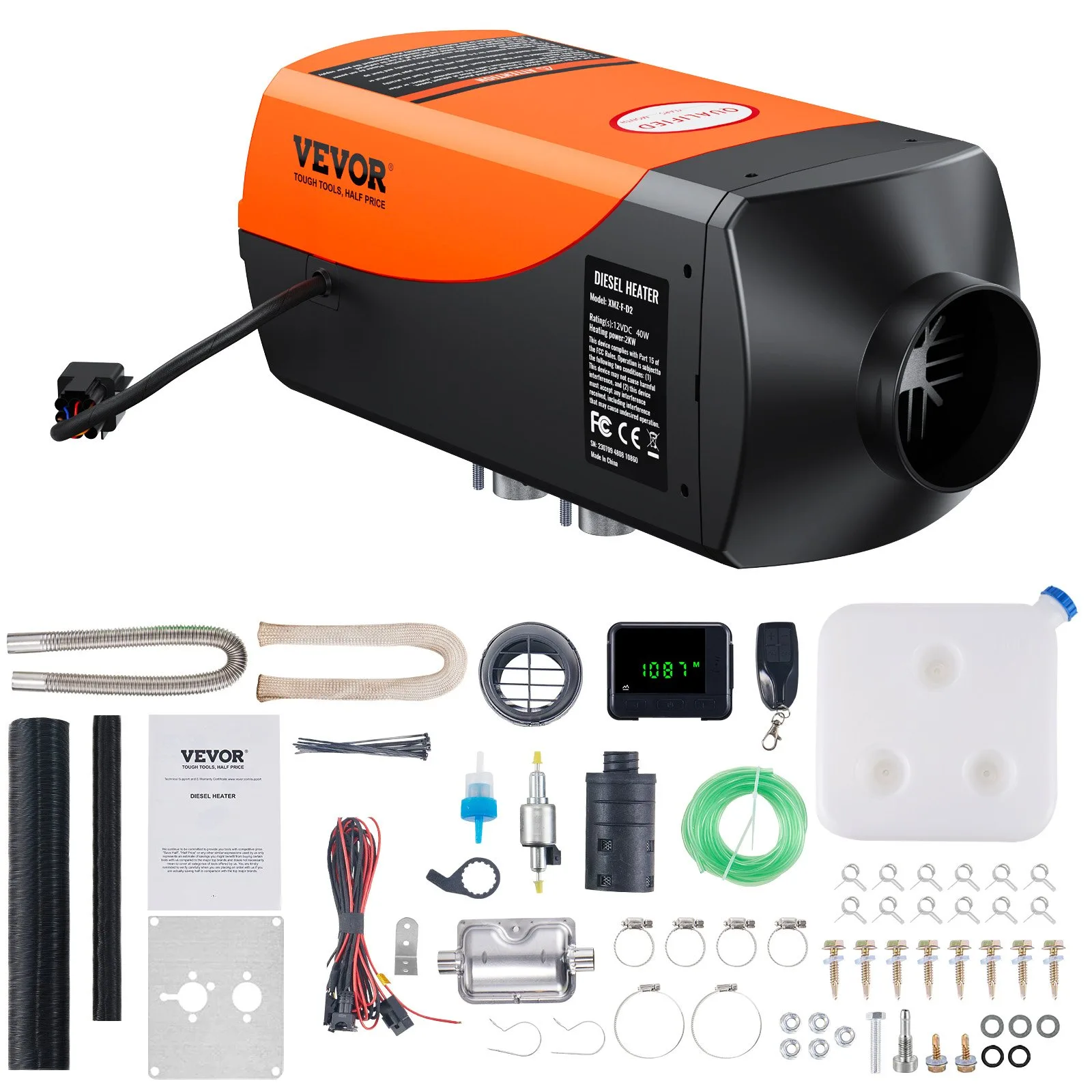 VEVOR 2 kW, 10 L tank, 12/24 V149,90 €View is 2 kW, not 8 kW. The card says use stays under 3.79 litres a night, the tank is 10 litres, voltage is 12/24 V, price 149,90 €. That night is this unit’s night in a small room, the 10–15 m² decision. Do not read it as an 8 kW garage using under 3.79 litres. They are different machines.
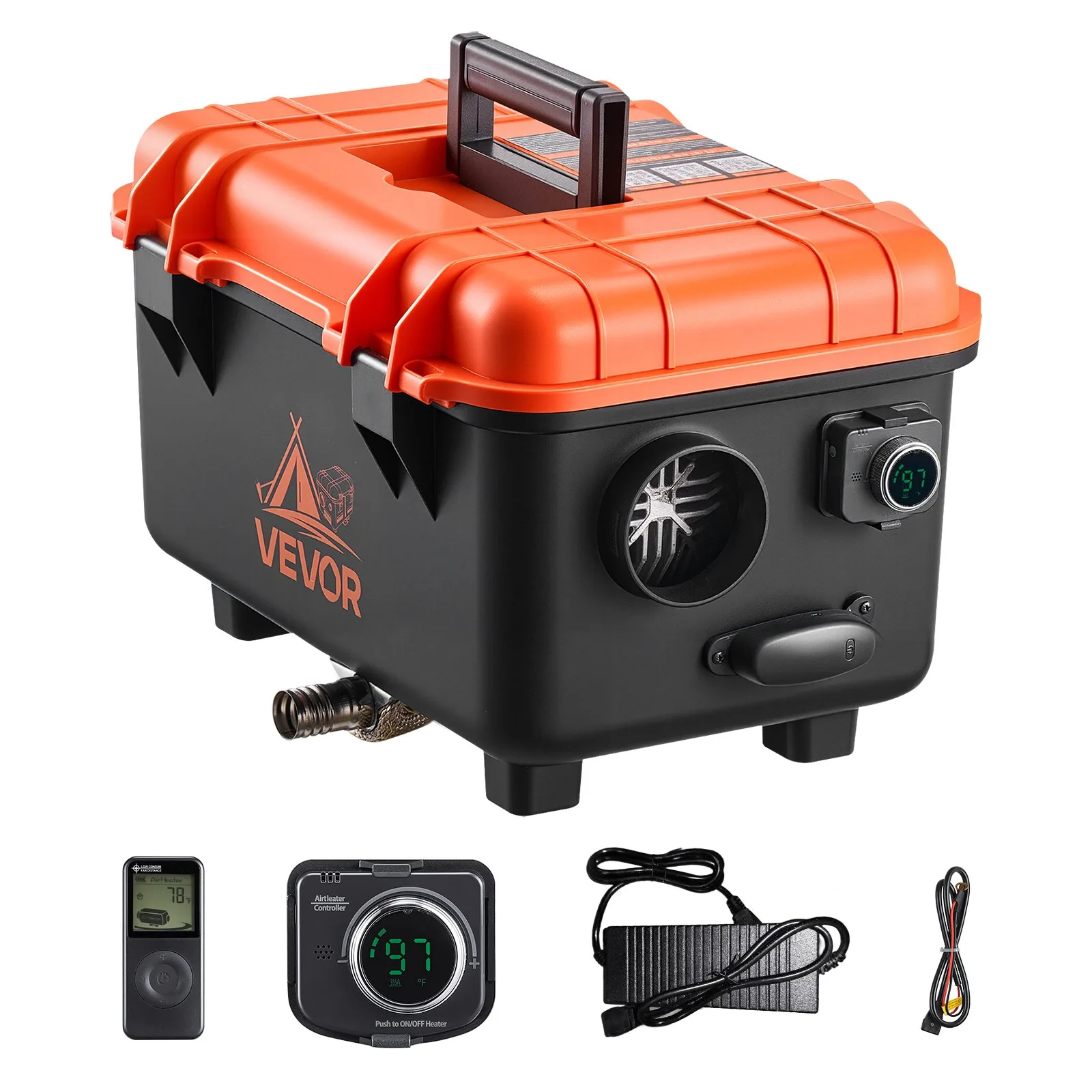 VEVOR 8 kW, also runs from a 220 V socket, 4 L251,90 €View says 0.15–0.38 L/h and the tank is 4 litres. Price 251,90 €. It runs from 12/24 V or from a 220 V socket. A plug does not lower the fuel use. 4 litres at the top end is a short night if the step is high. The point of this model is the power supply, not a bigger tank.
Frost: which sentence belongs to which card
Cold diesel lights worse than warm diesel. Preheat is a minute of help before the flame, not a promise that the unit heats a −20 °C room as fast as a +5 °C room. The HBS-3S card ties that help to starting down to −20 °C, and warm air comes in about 3.5 minutes. HBH-3S states the same cold limit. HBS-3 and HBH-3 say the outlet is near 50 °C in about three minutes, but they do not give a −20 °C sentence. HBU does not give that sentence at all.
−40 °C is the bottom of the working range on some other VEVOR card, with +50 °C at the top. Do not stick that onto the six Hcalory models, and do not stick it onto the 2 kW with a CO alarm if that line is not on its own card. If you buy a specific VEVOR card and the line is there, it applies to that card. The product next to it on the shelf does not inherit the neighbour’s number.
The fuel is diesel. Petrol is not a cold-weather substitute and it is not a “cleaner” option. The wrong fuel is not a saving. A tank that is half empty and has been standing does not behave in the cold like a fresh full tank. The card does not prove that last sentence with a number: it is the reason the cold-start sentence must not be stretched to models that do not say it.
Altitude and soot
Thinner air changes the burn mixture. HBS-3 and both HBU models say altitude mode works from 1,000 to 5,000 m and sets the air and fuel ratio itself. Five steps on the HBU are that same range, not five different fuel figures. At sea level and under 1,000 m, ordinary mode is the one. Switching the mode on in country with no mountains does not add litres or take them away: the card simply does not say you need it there.
Hcalory’s maintenance text ties soot to short starts, to low output, and to running at altitude. A high step in a small room that keeps switching off is a short start. Altitude adds a second reason.  Hcalory HBS-3S, portable 8 kW, 3.5 L189,90 €View allows a one-touch soot burn only in a ventilated place. That is not an evening button in a closed cabin. The burn sends soot along the combustion path, and that path has to be outside, not in a sleeper’s nose. The detail is in the safety guide.
The shape and tank size that make this fuel use possible at all are in the tank guide. A 2 kW night and an 8 kW night are not the same multiplication, and that gap is in the power guide.
| Model | Price | Voltage | Tank | What else the card says |
|---|---|---|---|---|
| Hcalory HBS-3, upright 8 kW, 5 L, 12/24 V159,90 €View |
159,90 € | 12/24 V | 5 L | about 41.6 h on a low burn, not L/h |
| Hcalory HBH-3S, horizontal 8 kW, 5 L189,90 €View |
189,90 € | 12/24 V | 5 L | 0.1–0.36 L/h, down to −20 °C |
| Hcalory HBU-3, separate 10 L tank, 12 V only139,90 €View |
139,90 € | 12 V only | 10 L | 0.11–0.36 L/h, about 3 days on a low burn |
| Hcalory HBU-3, separate 15 L tank, 12 V only144,90 €View |
144,90 € | 12 V only | 15 L | 0.11–0.36 L/h, up to 136 h on a low burn |
| VEVOR 2 kW, 10 L tank, 12/24 V149,90 €View |
149,90 € | 12/24 V | 10 L | under 3.79 L a night, 2 kW |
| VEVOR 8 kW, also runs from a 220 V socket, 4 L251,90 €View |
251,90 € | 12/24 V or 220 V | 4 L | 0.15–0.38 L/h |
Questions
Is 0.1 L/h guaranteed?
No. That is the bottom of the HBH-3S range. At full power the same card says up to 0.36 L/h. The bottom end happens when the step is low and the room stays on target. Do not plan the tank on 0.1 alone.
Can I take the middle of the range and multiply by the night?
You can get a number that no card wrote. For a decision, keep the bottom end and the top end. A small closed cabin lives toward one end, a cold garage at full power toward the other.
Do all Hcalory models start at −20 °C?
HBS-3S and HBH-3S say that. HBS-3, HBH-3 and both HBU models do not. −40 °C is a line on some other VEVOR card, not a line on these six Hcalory models.
Are 41.6 hours and 0.1 L/h the same thing?
No. 41.6 hours is the HBS-3 claim for 5 litres on a low burn. 0.1–0.36 L/h is the HBH-3S range. Do not convert one into the other, and do not stick a litres-per-hour figure onto the HBS-3 card when it is not there.
Does three days from 10 litres mean full power?
No. The 10 L HBU-3 ties three days to a low burn. The top end at 0.36 L/h eats 10 litres much faster. Both sentences on the card are about different steps.
Does the 2 kW model’s night use also apply to 8 kW?
No. Under 3.79 litres a night is the sentence on the VEVOR 2 kW with a 10 L tank. The 8 kW cards have other ranges, or hours instead. Do not carry the small machine’s night onto the large one.
Does 220 V reduce fuel use?
No. A plug changes the power supply, not the flame. The VEVOR 8 kW with 4 litres says 0.15–0.38 L/h either way. A small tank means a high step finishes the tank quickly.
Does altitude mode need to be switched on at sea level?
The card states the range 1,000–5,000 m. Lower than that is ordinary running. The mode is not a hidden economy button.
Can I start it on petrol if the diesel is cold?
No. These are diesel heaters. The wrong fuel is not a cold-start trick. If the card names a preheat, the help is that minute, not a second can.
Does a soot burn belong to every evening?
No. Hcalory ties soot to short starts, low output and altitude. HBS-3S allows a one-touch burn only in a ventilated place. A closed cabin at night is not that place. A burn does not replace the right step.